About this part
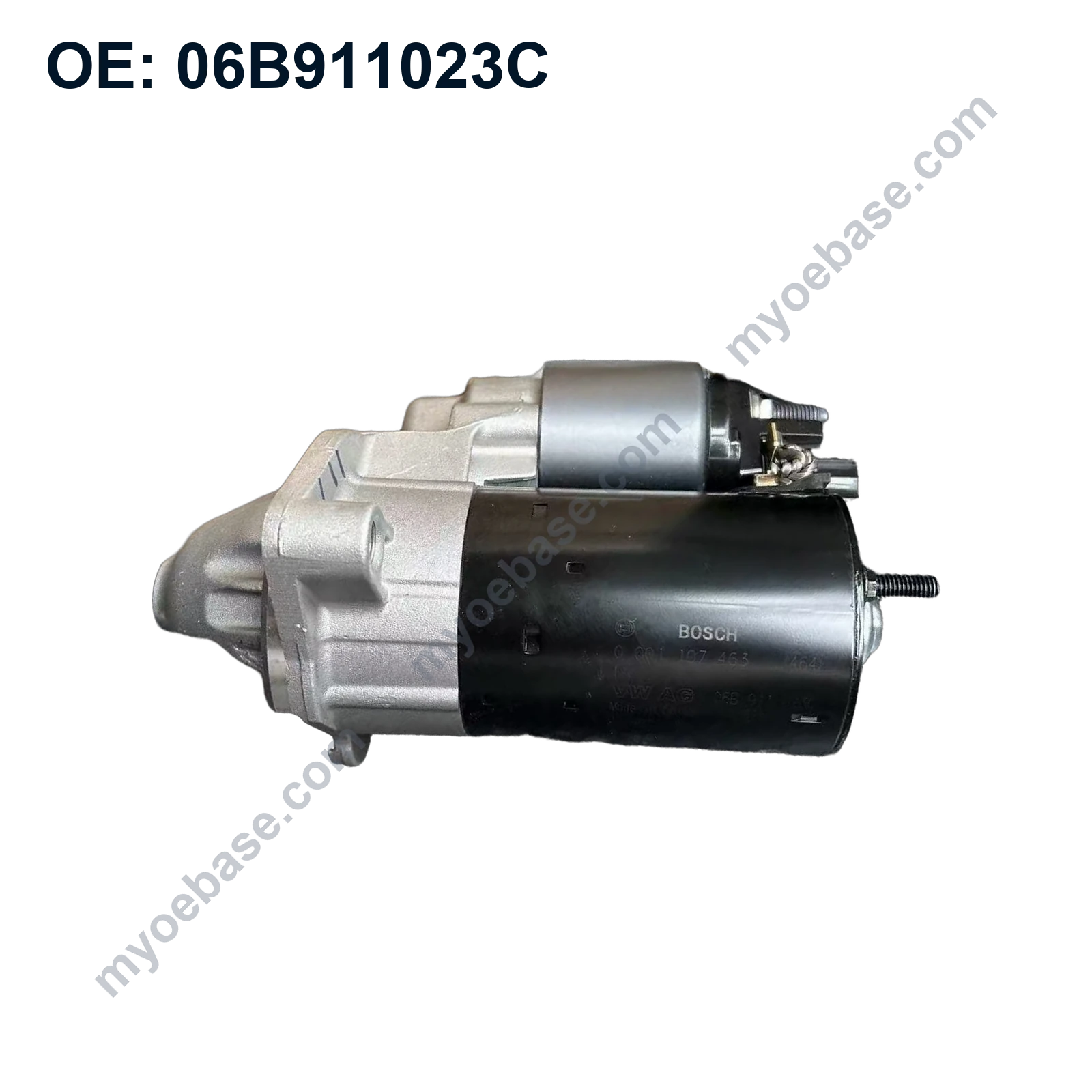
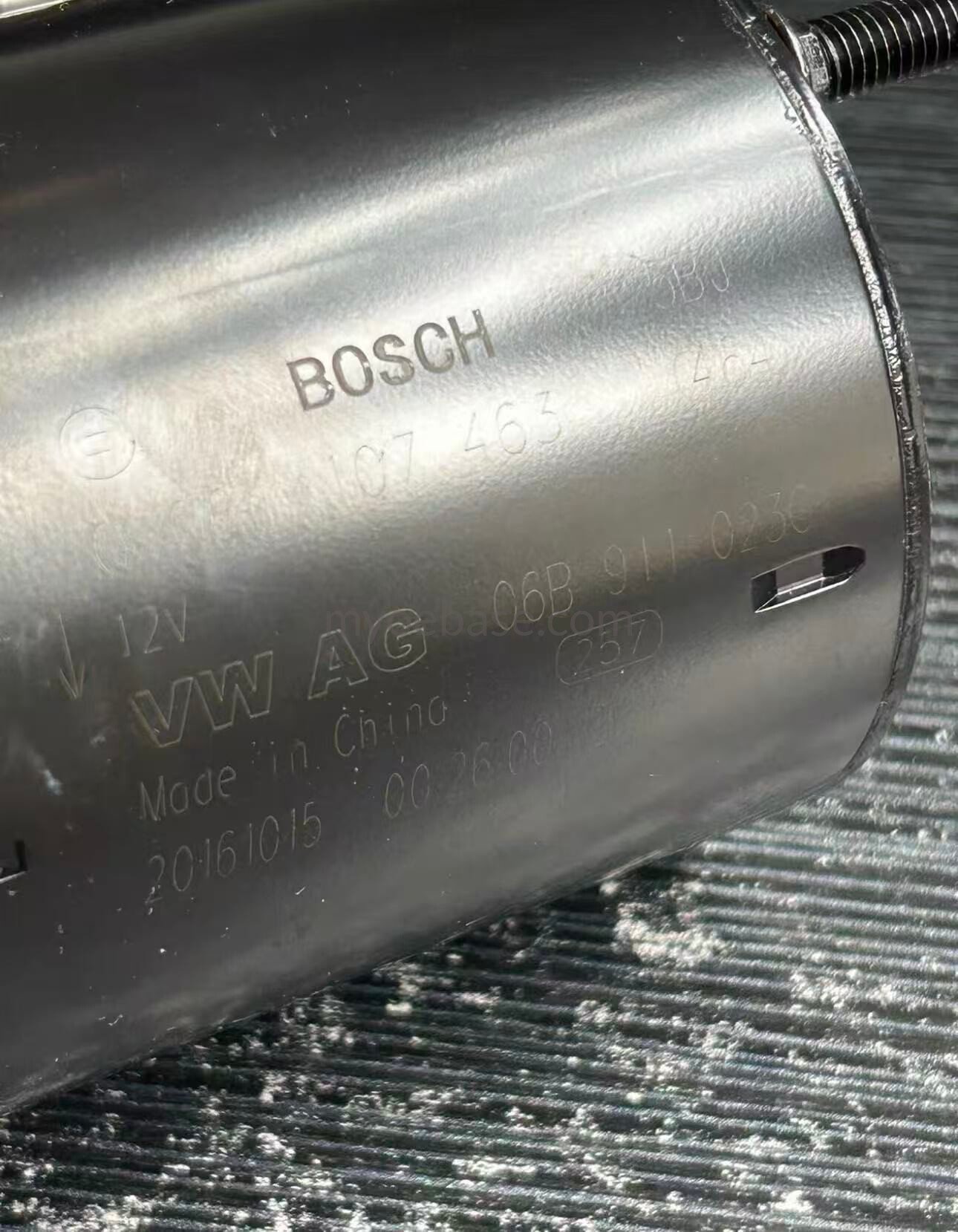
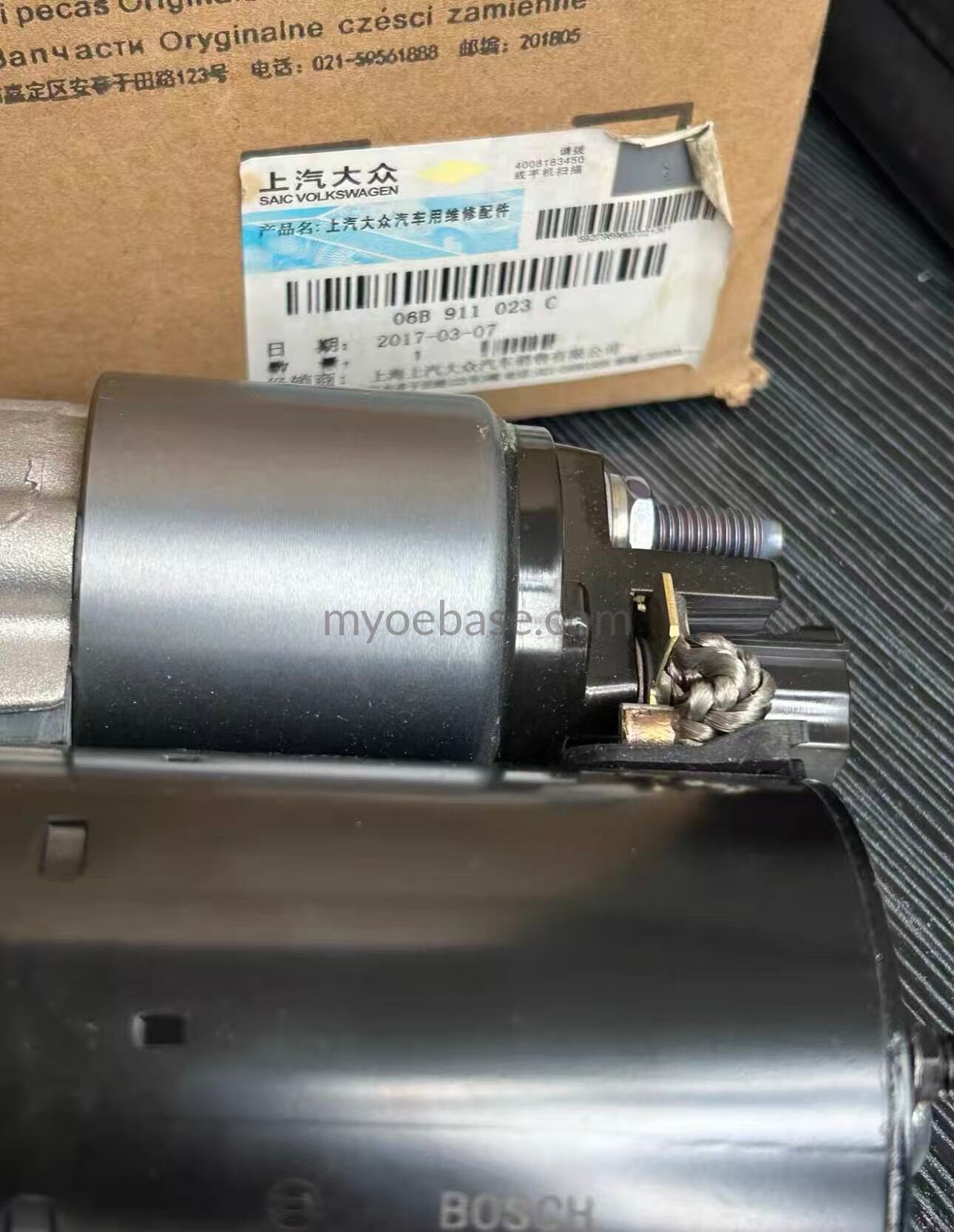
The 06B911023C Starter Motor is a brand new genuine VAG starter motor built by BOSCH for the longitudinal four cylinder petrol engines in the Audi A4 B5 and B6, the A6 C4 and C5, the VW Passat B5 and Passat Lingyu, the Santana, the Skoda Superb 3U and the SEAT Exeo generation of Volkswagen Group cars. It is the complete cranking unit, not a solenoid, not a brush kit, not a repair harness and not a reconditioned exchange starter: one complete assembly with its cast aluminium drive end housing, its black BOSCH motor housing, its silver solenoid cylinder, its pinion drive and its brass B+ terminal, ready to bolt to the bell housing. Our photographs show the real part on a plain white background. The black cylindrical motor housing carries laser etched BOSCH lettering, the BOSCH supplier number 0 001 107 463, the VW AG marking, 12V, Made in China, the production date 20161015 and the part number 06B 911 023C. The SAIC VOLKSWAGEN carton in the source photographs carries the printed label 06B 911 023 C with a 2017-03-07 date, so the number is confirmed twice, once on the metal and once on the box. Nothing in our main image has been redrawn, retouched, relit or simplified: the casting texture, the machining marks on the flange, the braided copper link, the threaded stud and every laser etched character are exactly as photographed. This is a genuine brand new unused original equipment part with no core charge, not a used unit pulled from a scrap car, not an X suffix remanufactured exchange unit and not a cheap copy with a relabelled housing. Please note that we sell ONE starter motor per unit and that the main image shows that single assembly on its own; there are no mounting bolts, no ring gear, no battery and no wiring in the parcel.
Starter motor — one brand new genuine BOSCH 06B911023C complete 12V cranking assembly with its cast aluminium drive end housing, 9 tooth pinion, black motor housing with the laser etched 06B 911 023C marking, silver solenoid, brass B+ M8 stud, braided copper link, plastic rear cap and 50 spade terminal, supplied on its own without mounting bolts, the B+ nut, a wiring pigtail, a heat shield, the flywheel ring gear, the battery, the alternator, a starter relay, diagnostic time or fitting labour.
OE/OEM Part Number:
06B911023C, 06B 911 023 C, 06B-911-023-C, 06B911023, 06B911023A, 06B911023AX, 06B911023CX, 06B911023X, 026911023C, 026911023E, 026911023F, 026911023G, 053911023, 053911023A, 053911023B, 058911023B, 058911023BX, 0001107012, 0001107013, 0001112005, 0001112006, 0001112013, 0001112014, 0001107463, 0986021210, 0986021217, 17751, 17165, 17751N, 8EA011613371, 8EA012527591, 436030, 101394, V10-12-12110, 101629, 1190305600, 114179, S0054, 200.540.092.010
Manufacturer and catalogue cross references include BOSCH 0 001 107 463 etched on this unit, 0 001 107 012, 0 001 107 013, 0 001 112 005, 0 001 112 006, 0 001 112 013, 0 001 112 014, 0 986 021 210 and 0 986 021 217, LESTER 17751 and 17165, WAI 17751N, HELLA 8EA 011 613-371 and 8EA 012 527-591, VALEO 436030, AD KUHNER 101394, VEMO V10-12-12110, FEBI 101629, JP GROUP 1190305600, HC-Cargo 114179, AS-PL S0054 and BV PSH 200.540.092.010. The VAG catalogue also groups this starter with the earlier 026, 053 and 058 prefix numbers and with 06B911023 and 06B911023A. Published power ratings vary between 1.1 kW and 1.2 kW between catalogues for the same physical unit.
Related but DIFFERENT numbers: 06B911023X, 06B911023CX, 06B911023AX and 06B911023GX are X suffix remanufactured exchange units that carry a core charge and are not the brand new part in this listing. 078911023D and the V6, VR6 and 2.5 TDI starters use a different pinion, power rating and mounting flange. The 02A and 02B family, including 02A911303B, 02B911023B, 02B911023C, 02B911023D, 02B911023J, 02B911023L and 02B911023N, belongs to the transverse Golf Mk4, Bora, Audi A3, Skoda Octavia and T4 2.5 TDI applications and is a 10 tooth, counter clockwise, roughly 2.0 kW unit with a different flange. None of those is interchangeable with 06B911023C. If the old unit in your hand has a different stamped number, a different tooth count, a different flange diameter or the plug in the wrong place, stop and check the catalogue before ordering.
Reading the part in our photographs
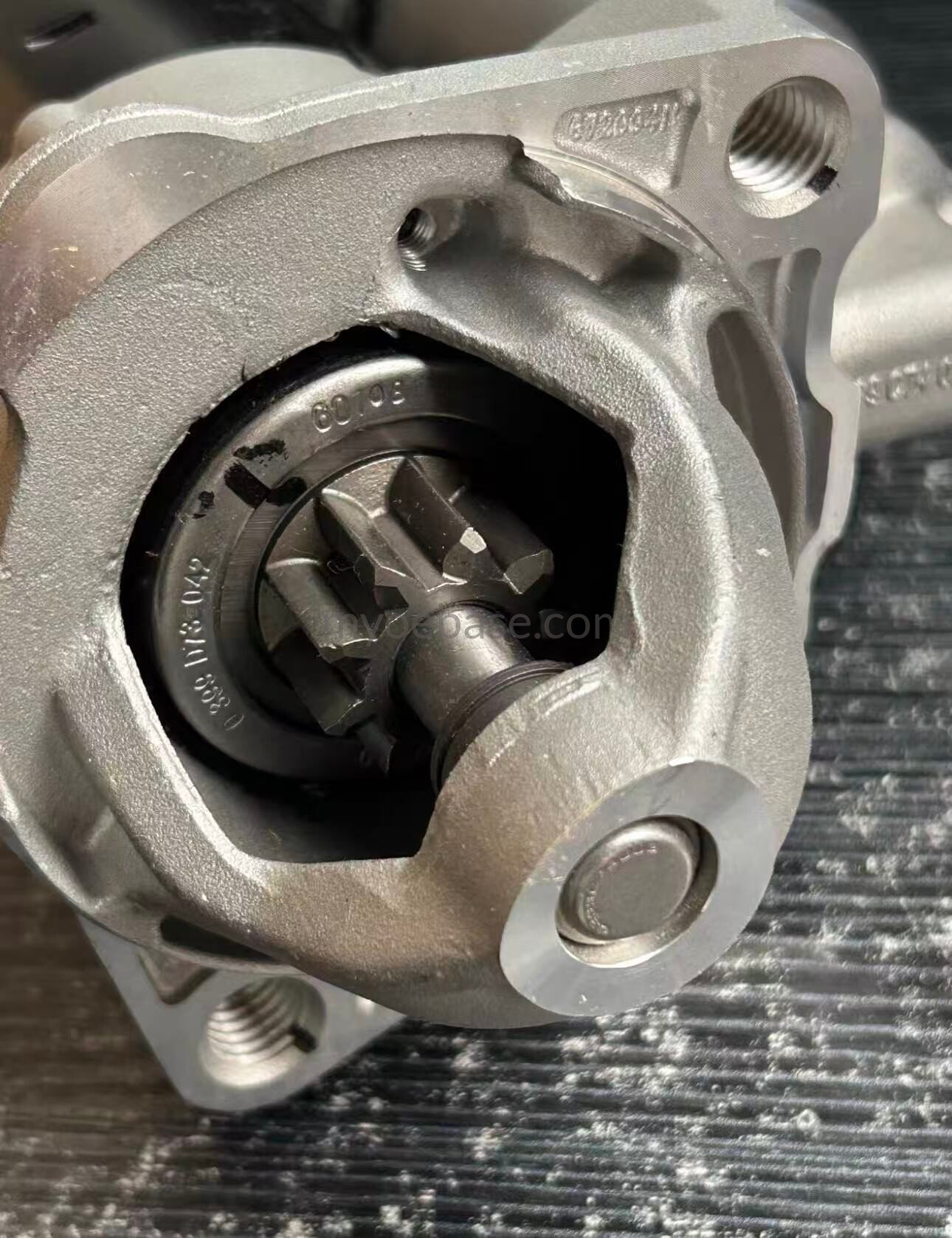
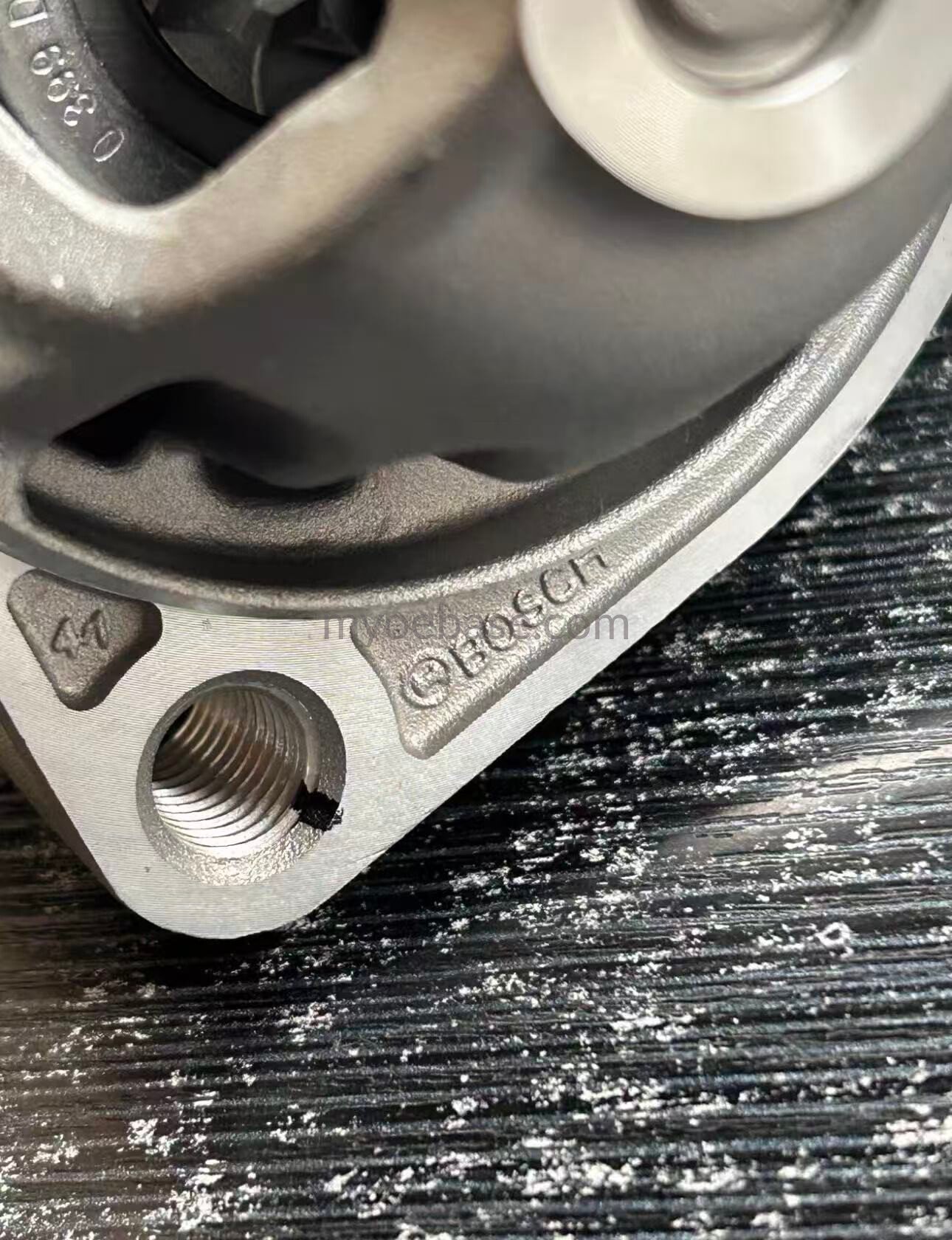
Start at the left hand end. The drive end housing is a silver cast aluminium piece with a long nose that locates in the bell housing, a machined flange with two mounting bores and the cast ribs that stiffen it against cranking torque. Inside that nose sits the 9 tooth pinion and its overrunning clutch; the pinion rests retracted and is pushed forward into the flywheel ring gear only while the solenoid is energised. The flange diameter is about 82 mm and the pinion rest position is around 14 to 15 mm on the published data, which is why a starter from the transverse 02A family cannot simply be bolted in its place. Behind the flange is the black cylindrical BOSCH motor housing, a permanent magnet gear reduction design that keeps the unit short and light for its output. Its surface carries the laser etched BOSCH word mark, the BOSCH 0001107463 supplier number, VW AG, 12V, Made in China, the date code 20161015 and the spaced part number 06B 911 023C. The etching is burnt into the paint and metal, not printed on a sticker, so it is the most reliable way to identify a used unit that has lost its box.
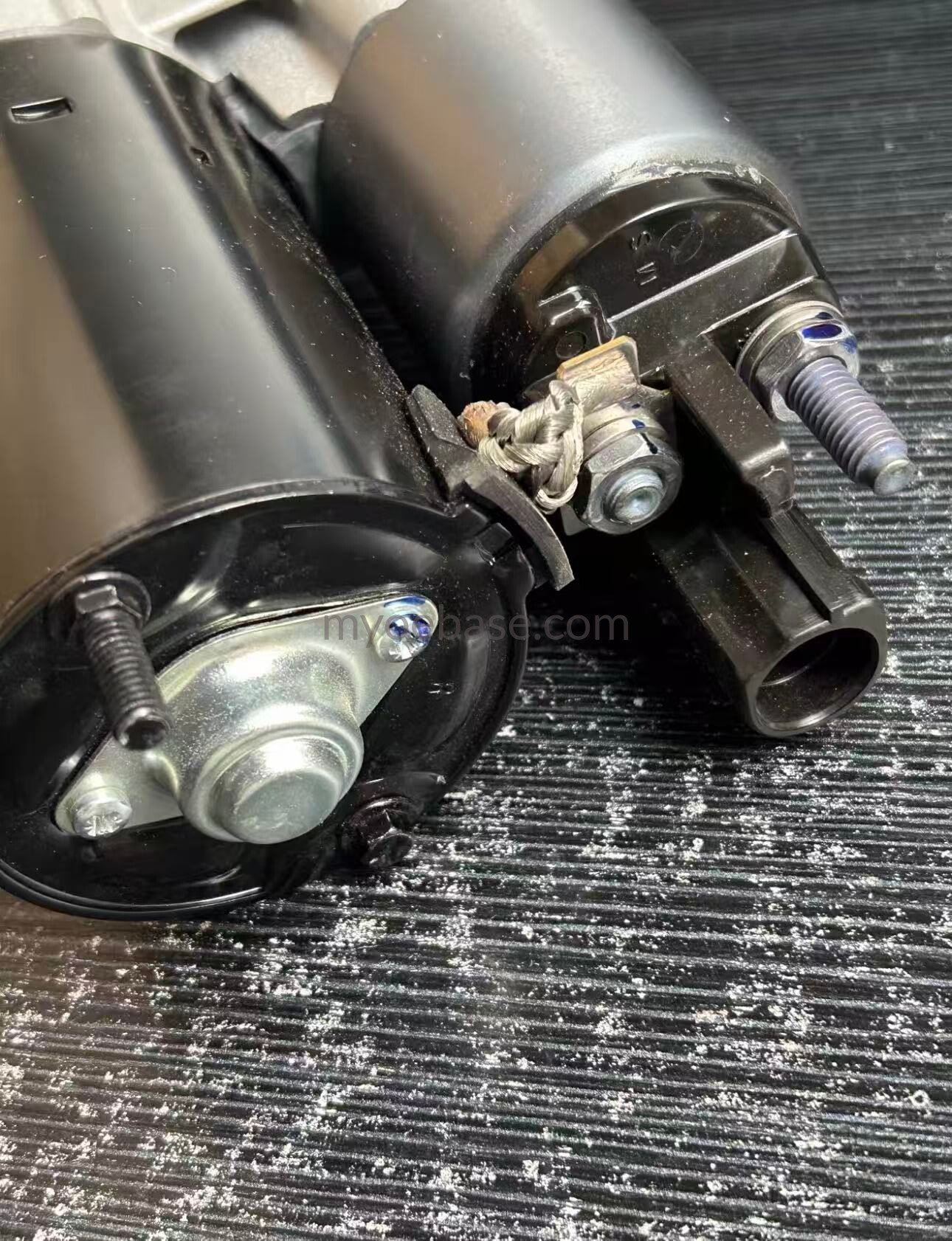
Lying along the top of the motor is the smaller silver solenoid cylinder. It does two jobs at once: a plunger pulls the pinion into mesh through a fork, and a set of heavy contacts closes the high current path from the battery to the motor windings. At the right hand end you can see the brass B+ M8 threaded stud with its nut, where the heavy battery cable lands, the braided copper link that carries current from the solenoid contacts into the motor, the small spade terminal for the 50 start signal from the ignition switch and the black moulded rear cap that protects the brush gear. The cap has its moulding ribs and clip seats intact. Compare all five of those features with the unit you remove: the etched number, the 9 tooth clockwise pinion, the two hole 82 mm flange, the B+ M8 stud on the solenoid end and the position of the 50 spade. Rotation direction is clockwise viewed from the pinion end on this application, so a counter clockwise unit will never mesh correctly. Overall length is about 270 mm and the shipping weight is about 3.7 kg.
What the starter actually does
Turn the key or press the start button and a comparatively small current flows through the ignition switch, the start relay or control unit and the 50 terminal into the solenoid windings. The solenoid plunger moves, the fork pushes the pinion forward along a helical spline into the flywheel ring gear, and only when the teeth are engaged do the solenoid’s heavy copper contacts close the main circuit. Several hundred amps then flow from the battery through the B+ M8 stud, through those contacts and the braided link, through the brushes and commutator or the permanent magnet armature, and out through the starter’s own earth path via its mounting flange and the engine block. The gear reduction inside the housing multiplies torque so a 1.1 kW motor can spin a cold engine with oil thick enough to resist it. As soon as the engine fires and the key is released, the 50 feed disappears, the plunger returns, the pinion retracts and the overrunning clutch lets the pinion free wheel for the few moments before it pulls clear, protecting the motor from being spun at engine speed by the ring gear.
That sequence explains most of the noises a failing starter makes. A single heavy click with no rotation means the solenoid is pulling in but the main contacts, the brushes or the armature are not passing current. Rapid repeated chatter is usually a battery or a bad connection collapsing under load rather than a starter fault. A whirring sound with no cranking means the motor is spinning but the pinion has not engaged, which points at a worn overrunning clutch or a sticking plunger. Grinding means the teeth are meeting the ring gear badly, either because the pinion is chipped, the flange is not seated square or the ring gear teeth are damaged. A starter that keeps spinning after the engine catches has a solenoid that is sticking or welded. Heat soak is the classic intermittent fault on these longitudinal engines: the starter sits low beside the exhaust, the windings and brushes heat up, resistance rises and a marginal unit will not crank a hot engine although it starts perfectly from cold.
Symptoms that point to this starter motor
Single click, no crank. The most common complaint is a healthy looking dashboard, bright headlights and one solid clunk from the engine bay when the key is turned to start, with no engine rotation. Worn brushes, a dead segment on the commutator or pitted solenoid contacts are the usual cause. Slow or laboured cranking. The engine turns but without the normal brisk rhythm and only catches after a long crank, worse on cold mornings. Load test the battery first, because a weak battery produces exactly the same symptom. Intermittent no start. The car starts nine times out of ten and then does nothing, often when hot, often after a short stop, and sometimes responds to a second turn of the key. That is a classic dead spot on the armature or a heat soaked solenoid.
Grinding, whirring or a starter that will not disengage. Metal on metal noise during cranking, a high pitched whirr with no cranking, or a brief screech just after the engine fires all point at the pinion, the overrunning clutch, the engagement fork or the ring gear. Ignore it and the ring gear teeth will be chewed, turning a starter job into a gearbox out job. Burning smell or smoke. Repeated long cranking attempts overheat the windings and the heavy cables; stop immediately, because the harness and the battery terminal can be damaged too. Silence with no click at all. Check the battery, the fuses, the ignition switch, the start relay, the 50 wire and the earth straps before blaming the starter, because an open control circuit produces exactly the same silence.
What it is not. A flat battery, a failed alternator that never recharges it, corroded battery terminals, a loose or oxidised engine earth strap, a worn ignition switch, a faulty starter relay, an immobiliser or clutch pedal switch fault, a blown crank fuse, a seized engine, a hydraulic locked cylinder, a damaged flywheel ring gear and a contaminated B+ connection can all look like a dead starter. On an automatic gearbox car a faulty inhibitor switch and on a manual car a clutch switch will stop the 50 signal entirely. Do not buy this part simply because the engine will not turn over: on these cars the battery and the earth path are responsible for a large share of no crank complaints, and a new starter will not fix either.
Check the starting circuit before ordering
Work in order and do it with the engine cold first. Measure battery voltage at rest, around 12.6 volts on a healthy charged battery, then watch what happens when an assistant holds the key in the start position. Bright headlights that stay bright with no crank point towards the starter circuit; lights that collapse or go out point at the battery or its connections. Load test the battery properly rather than trusting a voltmeter reading. Clean and tighten both battery terminals, check the heavy cable down to the B+ M8 stud, and inspect the engine to chassis earth strap, which on these cars is a well known source of slow cranking because the starter earths through its flange into the block.
Then do a voltage drop test during cranking on both the positive side and the earth side. Excessive drop on either side means cable, terminal or connection resistance, not a starter fault. Check for roughly battery voltage at the 50 spade terminal while the key is held in start; if it is missing, chase the ignition switch, the start relay, the inhibitor or clutch switch and the fuse before removing anything heavy. Check that the B+ stud has permanent battery voltage. Only when the feeds, the earth and the control signal are all good and a solid click still produces no rotation should the starter come off. With the unit removed, a bench test will show whether the solenoid pulls in, whether the pinion throws forward and whether the motor draws sensible current. Inspect the ring gear teeth through the bell housing opening while the starter is out, and turn the engine by hand to check for tight spots or oil or coolant in a cylinder. Never crank continuously for more than a few seconds, never short the B+ stud to the 50 terminal with a screwdriver near a battery, and always disconnect the negative battery lead before touching the heavy cable.
Finally compare the old unit with our photographs. The laser etched 06B 911 023C, the black motor housing with the silver solenoid on top, the 9 tooth clockwise pinion, the two hole 82 mm flange and the B+ M8 stud at the solenoid end all have to match. A starter from a Golf Mk4, A3, Octavia or T4 2.5 TDI may look broadly similar but has a 10 tooth counter clockwise pinion and a different flange, and a V6 or TDI unit is a different power class. If the numbers or the flange differ, recheck the VIN, engine code and gearbox before ordering.
Compatible vehicles
Use this table as a starting point only. The rows follow the VAG parts catalogue and the published application lists for 06B911023C and its BOSCH and aftermarket equivalents. Fitment depends on the VIN, the build date, the engine code, the gearbox, the market, the emissions specification and whether the car was built with a manual or automatic transmission, because the ring gear and flange detail can differ between otherwise identical cars. Every row assumes the longitudinal engine, the 9 tooth clockwise pinion, the two hole 82 mm flange, the B+ M8 stud and the 06B 911 023 C marking. The busiest applications are the Audi A4 B5 and the A4 B6 1.8 T, the VW Passat B5 and Passat Lingyu, the Shanghai VW Santana and the Skoda Superb 3U. Rows marked Not covered are listed on purpose so that owners of transverse, diesel, V6, remanufactured and later platform cars do not order the wrong starter. Confirm by VIN, engine code, gearbox and the number etched on the old unit before ordering.
| Make | Model / variant | Years / build date | Engine / notes |
|---|---|---|---|
| Audi | A4 (B5, 8D2) 1.6 / 1.8 / 1.8 T / 1.8 T quattro | 1994 – 2001 | ADP AHL ADR APT ARG AEB APU ANB AWT; longitudinal 1.8T 20V application |
| Audi | A4 Avant (B5, 8D5) 1.6 / 1.8 / 1.8 T | 1994 – 2001 | Same longitudinal engine family as the saloon; VIN check |
| Audi | A4 (B6, 8E2) 1.6 / 1.8 T / 1.8 T quattro / 2.0 / 2.0 FSI | 2000 – 2004 | AVJ BEX BFV ALT AWA AXX where the VIN lists the 06B starter |
| Audi | A4 Avant (B6, 8E5) 1.8 T / 2.0 | 2001 – 2004 | Confirm the old part number and the two hole flange |
| Audi | A4 Cabriolet (8H7, B6 / 8HE, B7) 1.8 T / 2.0 | 2002 – 2009 | Only where the VIN and old etched number agree |
| Audi | A4 (B7, 8EC) and A4 Avant (B7, 8ED) 1.8 T / 2.0 / 2.0 TFSI | 2004 – 2008 | Later applications where the catalogue still lists 06B911023C; VIN check |
| Audi | A6 (C4, 4A2) 1.8 / 2.0 / 2.0 E 16V | 1994 – 1997 | ADR ACE ABC; confirm the 9 tooth pinion and flange |
| Audi | A6 Avant (C4, 4A5) 1.8 / 2.0 / 2.0 E 16V | 1994 – 1997 | Same starter family as the C4 saloon |
| Audi | A6 (C5, 4B2) 1.8 / 1.8 T / 2.0 | 1997 – 2005 | AJE AFY AEB APU ANB AWT ALT; VIN and gearbox check |
| Audi | A6 Avant (C5, 4B5) 1.8 T / 2.0 | 1997 – 2005 | Confirm the B+ M8 stud position on the old unit |
| Audi | A6L (FAW-VW China) 1.8 T / 2.0 | 2000 – 2012 | Chinese market long wheelbase application; check the etched number |
| Audi | 80 (B4, 8C2) and 80 Avant (8C5) 1.6 / 1.8 / 2.0 E 16V | 1991 – 1996 | ABM ABT ACE 6A; earlier longitudinal four cylinder application |
| Audi | 100 (C4, 4A2) and 100 Avant (4A5) 2.0 E / 2.0 E 16V | 1990 – 1994 | AAE ABK ACE; VIN check on the flange detail |
| Audi | Cabriolet (8G7, B4) 1.8 / 2.0 E | 1991 – 2000 | Only where the old unit reads the 06B 911 023 number |
| VW | Passat B5 (3B2) 1.6 / 1.8 / 1.8 T / 2.0 | 1996 – 2000 | ADP AHL ADR AEB APU ANB AEG APK AQY; the core application |
| VW | Passat B5.5 (3B3) 1.8 T / 2.0 | 2000 – 2005 | AWM AWT AZM ALT; confirm by VIN and gearbox |
| VW | Passat Variant (3B5 / 3B6) 1.8 T / 2.0 / 1.8 T 4Motion | 1997 – 2005 | Same starter family as the saloon including 4Motion |
| VW | Passat Lingyu / Passat Leader (Shanghai VW) 1.8 T / 2.0 | 2005 – 2012 | SAIC VOLKSWAGEN China market car; matches the carton label in our photos |
| VW | Santana 2000 (Shanghai VW) 1.8 | 1996 – 2004 | Chinese market application listed for 06B911023C |
| VW | Santana 3000 and Santana Vista (Shanghai VW) 1.8 | 2004 – 2014 | Later Shanghai VW application; confirm the etched number |
| Skoda | Superb (3U4) 1.8 T / 2.0 | 2001 – 2008 | AWT AZM ALT; shares the B5 Passat longitudinal platform |
| Skoda | Superb (3U4) where catalogued with the 06B starter | 2001 – 2008 | Only where the VIN and old part confirm 9 teeth and clockwise rotation |
| SEAT | Exeo (3R2) 1.8 T / 2.0 TFSI where catalogued | 2008 – 2013 | B7 derived platform; VIN and old part number check required |
| SEAT | Exeo ST (3R5) 1.8 T / 2.0 TFSI where catalogued | 2009 – 2013 | Only where the old flange and pinion match |
| Not covered | Golf Mk4, Bora, Jetta Mk4, Audi A3 8L, Skoda Octavia 1U, New Beetle | – | Transverse 02A / 02B family starters; 10 tooth, counter clockwise, different flange |
| Not covered | 02A911303B, 02B911023B, 02B911023C, 02B911023D, 02B911023J, 02B911023L, 02B911023N | – | Transverse and T4 2.5 TDI units, roughly 2.0 kW, NOT interchangeable |
| Not covered | VW T4 Transporter, Caravelle, Multivan and California 2.5 TDI | – | Uses the 02B family with a 10 tooth counter clockwise pinion |
| Not covered | 078911023D and the V6, VR6, 2.8 and 2.7 biturbo starters | – | Different power class, pinion and flange; check the V6 part separately |
| Not covered | 1.9 TDI, 2.0 TDI and 2.5 TDI diesel engines | – | Diesel starters are higher output with a different pinion and tooth count |
| Not covered | 06B911023X, 06B911023CX, 06B911023AX and 06B911023GX | – | X suffix remanufactured exchange units, supplied against a core charge |
| Not covered | 1.2 TSI, 1.4 TSI, EA888 and MQB platform cars with stop start | – | Later stop start rated starters and control strategies; different part |
| Not covered | Automatic versus manual gearbox conversions and swapped flywheels | – | Ring gear tooth count and pinion offset differ; confirm VIN and gearbox code |
| Not covered | Batteries, alternators, ignition switches, starter relays and earth straps | – | Diagnose the whole starting circuit before condemning the starter |
| Not covered | Solenoids, brush holders, armatures, pinions and repair kits sold alone | – | This listing is one complete starter assembly, not component parts |
| Not covered | Flywheel ring gears, clutch kits, torque converters and bell housings | – | Inspect ring gear teeth while the starter is out; not included here |
| Not covered | Mounting bolts, the B+ nut, wiring pigtails and heat shields | – | Reuse or order separately by their own VAG part numbers |
| Not covered | Used, tested, repaired, opened or previously fitted starters | – | Genuine brand new part only; a fitted unit cannot be returned as unused |
Fitting – read this before you buy
Identify the old part first. Read the engine code and gearbox code from the VIN, the service book or the build sticker, and compare the old starter with our photographs: a silver cast aluminium drive end nose, a two hole 82 mm flange, a black BOSCH motor housing with the laser etched 06B 911 023C, a silver solenoid on top, a brass B+ M8 stud, a braided copper link and the 50 spade terminal. Count the pinion teeth and check the rotation direction. If the flange, tooth count, stud position or etched number differs, stop and check the catalogue. Order the correct starter and any new mounting bolts and terminal hardware before the car is stripped. A 3.7 kg unit is awkward to hold with one hand while aligning two bolts, so plan the job with a jack, a support or a second pair of hands.
The physical job. Park on level ground, let the engine cool, switch off the ignition and disconnect the negative battery lead before touching the heavy cable. On these longitudinal cars the starter sits low on the engine to gearbox join, usually reached from underneath after removing the undertray, and on some versions intake or support brackets have to come off first. Photograph the cable routing before disassembly. Unplug the 50 spade terminal, remove the nut from the B+ M8 stud and lift off the heavy battery cable, then take out the two mounting bolts while supporting the starter. Clean the flange mating face on the bell housing and the earth path without scoring the aluminium, inspect the ring gear teeth through the opening, and check the old pinion for chipped teeth or metal dust. Offer the new starter square to the flange so the locating detail seats fully before the bolts are started by hand; a cocked starter will chew the ring gear. Tighten the mounting bolts to the workshop torque for your gearbox rather than guessing, reconnect the B+ cable with a clean, tight nut and push the 50 spade home until it grips. Route both cables away from the exhaust manifold and any moving parts, and refit any heat shield that was removed. Do not hammer the nose, do not lever against the aluminium casting, do not apply sealant to the flange and do not bridge the solenoid terminals with a screwdriver while the unit is on the bench near a battery.
After fitting. Reconnect the battery, check that the heavy cable is not chafing and confirm a clean earth path with a voltage drop test during cranking. Crank in short bursts of a few seconds with a pause between attempts, listen for a clean engagement with no grinding, and confirm the pinion releases as soon as the engine catches. Repeat the test from cold and again after a hot soak, because heat related intermittent faults are exactly what a cold bench test misses. Recheck the B+ nut for warmth after several starts, keep the old unit until the car has started reliably for a few days, and inspect the ring gear if any grinding appears. If the new starter only clicks, go back to the battery, the terminal connections and the engine earth strap before assuming the part is faulty.
What is and is not in the parcel
ONE brand new genuine BOSCH built 06B911023C complete starter motor as photographed, with its cast aluminium drive end housing, 9 tooth pinion and overrunning clutch, black motor housing with the laser etched number, silver solenoid cylinder, brass B+ M8 stud and nut, braided copper link, black rear cap and 50 spade terminal. Nothing else. The main image shows that single assembly on a plain white background; it is not a pair of starters, not a starter and flywheel kit and not a starting system repair set. No mounting bolts, no B+ cable or terminal, no 50 wire or connector pigtail, no heat shield, no starter relay, no ignition switch, no clutch or inhibitor switch, no fuse, no battery, no alternator, no earth strap, no flywheel ring gear, no clutch, no torque converter, no bell housing, no solenoid, brush holder, armature or pinion sold separately, no diagnostic tool, no software, no coding or adaptation service, no workshop manual and no fitting labour. There is no core charge and no exchange unit to return: this is a brand new part, not an X suffix remanufactured starter. If you need the bolts or the terminal hardware, order them separately by their own VAG numbers rather than assuming they are in the box.
Condition and warranty
Brand new, unused and unopened, with twelve months warranty against manufacturing defects, covering the one starter assembly as supplied. The warranty excludes any unit that has been fitted, dropped, hammered, levered, over tightened, cross threaded, cut, soldered, opened, drilled, painted, cleaned with solvent, pressure washed, overheated by continuous cranking or modified, and any claim arising from a flat or faulty battery, a corroded terminal, a loose B+ nut, a missing engine earth strap, a faulty ignition switch or start relay, a damaged harness, a chipped flywheel ring gear, a misaligned flange, a seized engine or a vehicle whose VIN, engine code or gearbox requires the 02A / 02B transverse starter, a V6 or TDI unit or a later stop start part. It does not cover other starting system faults, diagnostic time, recovery, car hire or fitting labour. A starter that has been fitted and cranked cannot be returned as unused. If a part looks wrong on arrival, compare the etched number, the 9 tooth pinion, the two hole 82 mm flange, the B+ M8 stud and the 50 spade position with our photographs and send us a clear picture before it is installed; keep the old starter and the job card until the car has passed a hot start test.
Shipping and packing
Orders leave within one to two working days of cleared payment. At about 3.7 kg this is a heavy, dense assembly with a machined aluminium flange and an exposed brass stud, so each starter is individually wrapped, the threaded B+ stud and the 50 spade are capped, the pinion nose is protected against impact and the unit is boxed with rigid padding that stops it moving inside the carton. On arrival, open the parcel before booking workshop time and confirm the quantity, the laser etched 06B 911 023C, the BOSCH and VW AG markings, the silver solenoid on top of the black housing, the 9 tooth pinion, the two hole flange and the B+ M8 stud. Please photograph the outer carton before signing for a parcel showing impact or water damage, and keep the packing until the unit has been test fitted. Import duties and local taxes, where they apply, are the buyer responsibility. Tracking is emailed when the parcel is handed to the carrier.
Not sure this is the right starter?
Send us the VIN, the model, the build date, the engine code, the gearbox code and whether the car is manual or automatic, together with a clear photograph of the number etched on the black housing of the old starter, a picture of the drive end flange showing the mounting holes, a picture of the pinion so we can count the teeth, and a picture of the solenoid end showing the B+ stud and the 50 terminal. The four most useful facts are the etched number, the pinion tooth count and rotation direction, the flange diameter and hole pattern, and the position of the B+ stud: 06B 911 023C with 9 teeth, clockwise rotation, a two hole 82 mm flange and a B+ M8 stud points to this starter, while an 02B number, 10 teeth, a counter clockwise pinion or a different flange points elsewhere. Tell us whether you get a single click, rapid chatter, slow cranking, grinding, a whirr with no engagement or complete silence, whether it happens hot or cold, whether the headlights stay bright during the attempt and whether a jump start changes anything. We will check the engine code and gearbox with you and confirm whether you need this starter, a battery, an earth strap, a relay or a wiring repair. That takes minutes and is far cheaper than fitting a 3.7 kg part to a car whose real problem is a corroded battery terminal.
Wholesale
Tiered pricing for 1 pc, 5 pcs and 20 pcs is shown below, with every tier priced for ONE starter motor, not for a pair, a starter and flywheel set or a starting system repair kit. Independent VAG specialists, engine rebuilders, gearbox shops, fleet workshops, recovery operators, used car preparers and parts distributors buy these in bulk because the starter on the longitudinal 1.8 T and 2.0 generation is a predictable wear item: brush and commutator wear, pitted solenoid contacts, heat soak beside the exhaust and oil contamination eventually produce the classic hot no crank, and the resulting roadside callout is one of the most common summer jobs on these cars. A workshop that keeps one or two on the shelf can often diagnose and repair a no crank the same day instead of ordering a single heavy part and losing the job. Ask for a combined quote if you also need mounting bolts, B+ terminal hardware, earth straps, starter relays, ring gears, batteries or our other VAG engine and electrical parts; we price mixed orders together and can hold stock for repeat workshop orders. Send the engine code, gearbox and market mix with volume enquiries so we can confirm the correct starter number before dispatch.
Do not confuse this listing with our other parts
We also list the 1J0959481A Fan Switch (product 5048), the 078906433B Crankshaft Sensor (product 5039), the 06J906461D MAF Sensor (product 4813), the 036906051 MAP Sensor (product 4601), the 5730084100 DSG Pressure Sensor (product 4654) and the WHT003856 ABS Sensor (product 5023), all of which are small electronic sensors measuring coolant temperature, engine speed, air flow, intake pressure, mechatronic clutch position and wheel speed. The 04E103175AC PCV Valve (product 5009) is a crankcase breather, the WHT004739 Injector Bolt (product 5032) is a single diesel fastener and the 03L130277B Injector (product 4797) is a complete common rail injector. None of those listings is a starter motor and none includes this part. Our starter is a complete 12V cranking assembly with a solenoid, a pinion and a 1.1 kW permanent magnet gear reduction motor, not a sensor, not an alternator, not a battery and not a repair kit. A car that will not crank does not automatically need a starter: check the battery, the terminals and the earth strap first. Send us a photograph of the etched number and the drive end flange of the old unit and we will tell you exactly which parts the job needs.