
About this part
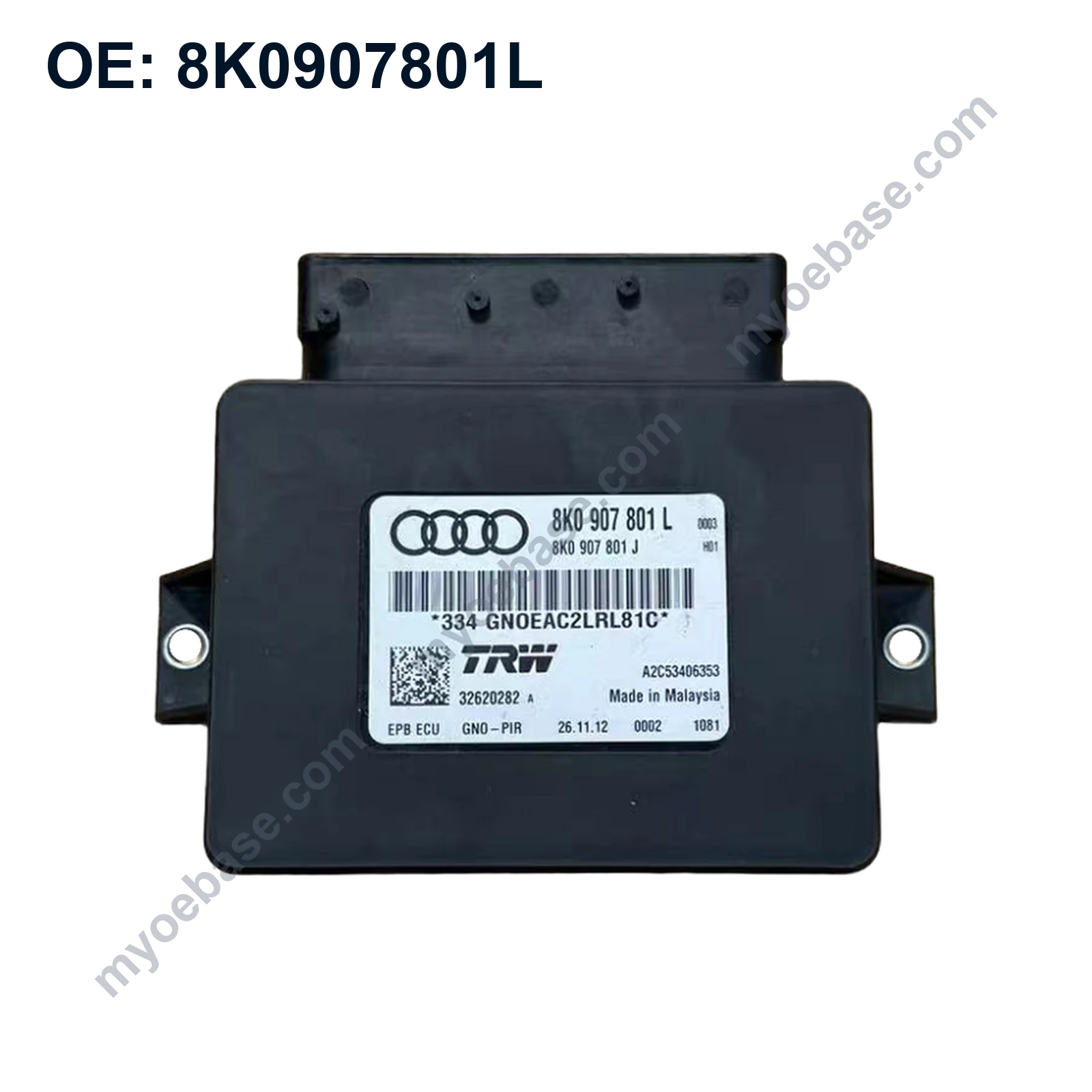
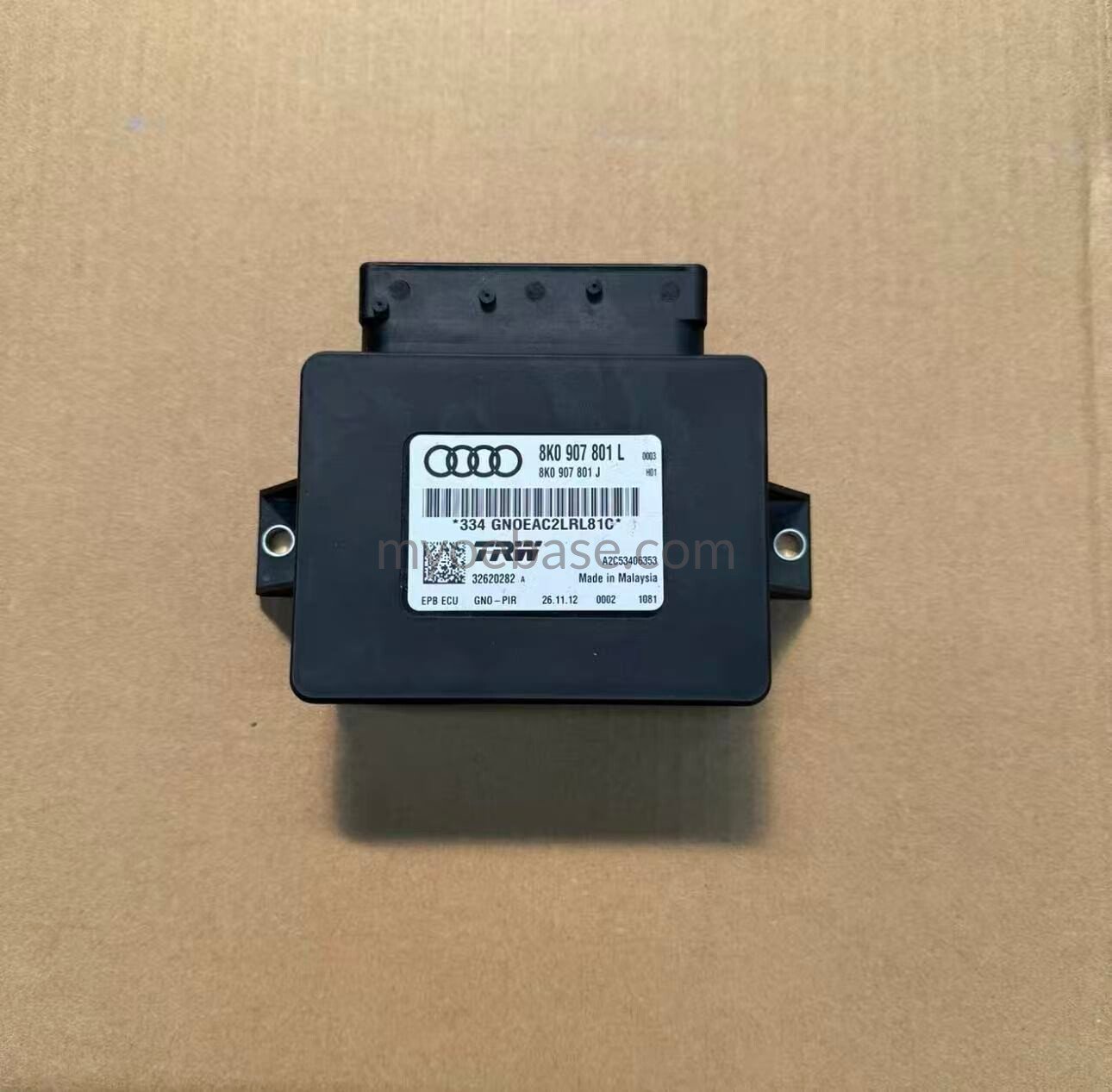
The 8K0907801L Parking Brake Module is a brand new genuine OEM Audi electronic parking brake control unit, built by TRW in Malaysia and supplied with its original white factory label as photographed. It is the compact black rectangular module with a black connector strip and small round bosses along the top edge, a white printed label in the centre carrying the Audi four rings, two part-number lines, a linear barcode, a DataMatrix code and the TRW supplier codes, and two side mounting ears each with a circular metal-ringed through-hole for the fixing bolts. Audi parts catalogues call it the control unit or CTRL unit for the park brake; diagnostic software calls it J540, address 53 Parking Brake; workshops call it the EPB module, the electric handbrake module or the parking brake ECU. It is NOT one of the two electric motors bolted to the rear brake calipers, NOT the parking brake switch in the centre console, NOT an ABS or ESC control unit and NOT a general body control module. Its single job is to receive the driver’s request from the EPB switch, drive the two rear caliper motors to apply and release the parking brake, supervise auto hold and hill hold, and report the state of the system over the CAN bus to the instrument cluster, the ABS module and the engine and gearbox controllers. The unit in our photographs is brand new and unused, with the label reading 8K0 907 801 L above 8K0 907 801 J, TRW 32620282 A, A2C53406353, Made in Malaysia, EPB ECU, GN0-PIR, 26.11.12, 0002 and 1081.
Parking brake module — one brand new genuine 8K0 907 801 L TRW electronic parking brake control unit J540 with its original factory label, two mounting ears and the top connector strip, supplied on its own without rear caliper motors, an EPB switch, a wiring harness, VCDS or ODIS coding, basic settings, diagnostic time, tools or fitting labour.
OE/OEM Part Number:
8K0907801L, 8K0 907 801 L, 8K0-907-801-L, 8K0907801K, 8K0 907 801 K, 8K0-907-801-K, 8K0907801J, 8K0 907 801 J, 8K0907801, 8K0 907 801, 32620282 A, 32620282A, A2C53406353
TRW supplier reference 32620282 A, Continental family code A2C53406353, Made in Malaysia, component description EPB ECU, production index GN0-PIR, date 26.11.12, and the factory codes 0002 and 1081. The label carries a linear barcode with the starred string *334 GNOEAC2LRL81C* beneath it and a square DataMatrix code at the lower left. The date is a production date on the supplier label, not a vehicle build date and not an expiry date. The two printed part-number lines are the software / order number and the hardware number: VCDS auto-scans of this family show Part No SW and HW on two separate lines, which is exactly how 8K0 907 801 L (with the right-hand 0003) and 8K0 907 801 J (with the right-hand H01) appear on the label. The second line is not a second module in the parcel and not a second part to order.
Which earlier number this one replaces, and why the suffix matters
Audi dealer catalogues list 8K0907801K as the superseded number for 8K0907801L. That makes K the direct predecessor and L the later, current order number for the same 2013-2016 application group. The wider 8K0 907 801 family ran through a long series of suffix letters from C through P over the life of the B8 platform, with each suffix carrying its own hardware index and software calibration. Early cars can show a D, G or H suffix in a VCDS scan, while a 2013-2014 car may show J, K or L, and a later car may show M or P. Those letters are running changes, but they are NOT freely interchangeable across the whole family. Parts databases specifically warn that modules calibrated for quattro all-wheel drive are not interchangeable with modules for front-wheel-drive cars even when the base number is identical, and the official Audi catalogue splits the L application into W/AWD and W/O AWD groups. Fitting the wrong drivetrain variant can leave the parking brake unable to complete its basic settings or produce implausible signal faults, so the suffix on the old unit is a hard gate, not a detail.
What you should take from this is simple: order by the number printed on the label of the unit coming out of the car, confirmed against the VIN and the drivetrain, not by a generic year-and-model chart. If the old unit is a K, an L is the correct replacement. If the old unit is an early C, D, G or H suffix from a 2008-2012 car, or a later M or P suffix, stop and check the catalogue before ordering, because the coding, the hardware index and the connector pinout may differ. Photograph both the label and the connector face on the old module and compare them with our photographs. A module that has been opened, relabelled or refinished is a common find on the used market and is one more reason to buy the label you can actually read.
What the photographed label tells you
The white factory label carries the Audi four-ring roundel followed by two part-number lines: 8K0 907 801 L with the small right-hand code 0003, and 8K0 907 801 J with the small right-hand code H01. Below them are a linear barcode and the starred production string *334 GNOEAC2LRL81C*, the TRW wordmark and the supplier number 32620282 A, the Continental code A2C53406353, Made in Malaysia, and a bottom block reading EPB ECU, GN0-PIR, 26.11.12, 0002 and 1081. A square DataMatrix code sits at the lower left of the label. We reproduce these exactly as printed rather than redrawing them, because the small right-hand codes are what a workshop compares against the VCDS part-number readout when it checks whether a replacement module will accept the vehicle’s coding string.
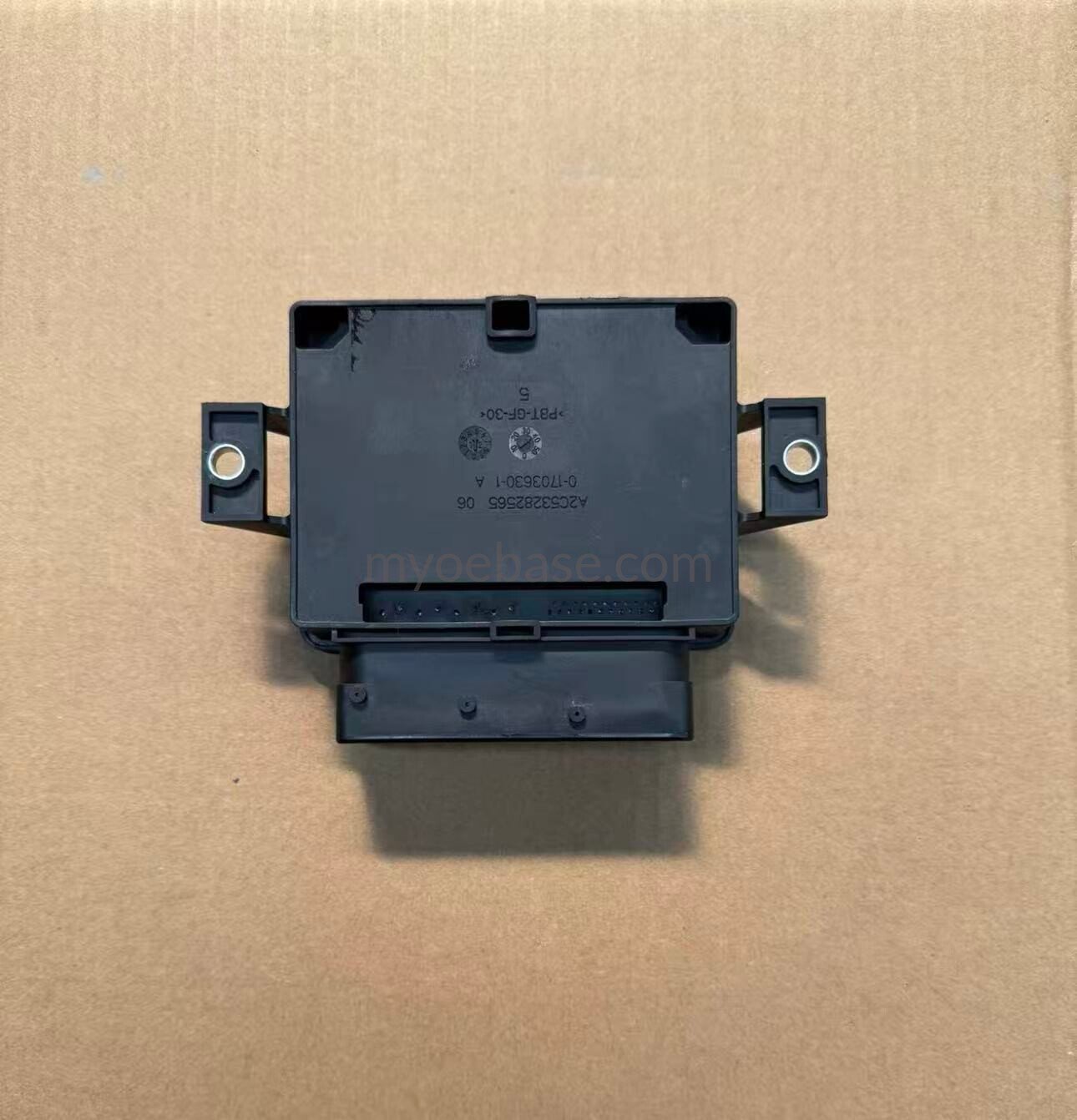
The rear face of the housing carries the Audi rings and moulded supplier, material and recycling markings. The two mounting ears have metal-ringed through-holes, and the top edge is a single black connector strip with several small round bosses. These are the physical features to compare on arrival: the hole spacing, the ear shape and the connector keying are all part of the fitment check. Because this is a genuine labelled unit rather than a bare board or a re-cased aftermarket clone, you can read the identity of what you are fitting before the module ever goes near a diagnostic tool. Keep the module and its label photograph with the job card, and record the old module’s coding string before you unplug it.
How the EPB control module works
The module is addressed as J540 in VAG documentation and appears as 53 – Parking Brake in VCDS, ODIS and other VAG-capable diagnostic tools, using the label file 8K0-907-801-V1.clb on this platform. It reads the parking brake switch, the brake pedal, the gear selector and clutch or throttle position, the door and seat-belt status, and messages from the ABS, engine, gearbox and instrument cluster controllers. From those inputs it decides whether to apply or release, then drives the two electric motors on the rear calipers through a pair of high-current outputs, measures the motor current to detect that the clamp force has been reached, and stores the applied position. Auto hold, hill-start assist, the automatic release when pulling away, and the emergency braking function that uses the parking brake if the service brake fails all run through this same controller. This is why a fault here can light the brake warning lamp, disable auto hold, log faults in the ABS and instrument cluster as well as in address 53, and in the worst case leave the car unable to move with the rear brakes clamped on.
Because the module is a coded node on the CAN bus, it is not a plug-and-play part. It stores a coding string that describes the vehicle: the drivetrain, the brake variant, the market, whether auto hold is fitted, and how the release and apply behaviour is configured. It also holds adaptation values for the two rear actuators. Replace the module without transferring that coding and running the basic settings, and the car will typically report no communication or implausible signal faults, leave the parking brake lamp on, and refuse to release. That is not a defective module; it is an unconfigured one. It is also the reason a used module that has already been coded and locked to another VIN can be much harder to adapt than a new, uncoded unit.
Why these modules get replaced, and when they should not be
Confirmed internal module failure. The genuine failure pattern is a parking brake warning lamp with no mechanical fault at either rear caliper, an inability to apply or release the brake through the switch, one or both actuators behaving erratically after the motors and wiring have been proven good, repeated short-to-ground or supply faults at the actuator outputs, a module that loses its coding after an ignition cycle, or address 53 reporting internal faults, implausible signals or loss of CAN communication. Water ingress to the housing, corrosion of the connector terminals and sustained overvoltage are the leading physical causes on B8-platform cars. The module sits at the rear of the vehicle, in the luggage compartment or under the rear seat area depending on body style, so a blocked drain, a leaking rear screen or tail-light seal, or a damp spare-wheel well can put water onto the plug. Inspect and dry the connector before condemning the electronics.
Read the fault memory before you order. Audi TSB 2031135/4 explicitly names 8K0.907.801 J, 8K0.907.801 K and 8K0.907.801 L as affected by a software issue that occurs only once. The bulletin’s service instruction is to delete the DTC and NOT replace the control module, because swapping the unit can cause the condition to occur again. Audi TSB 2034404/3 describes a different complaint on 2013 A4, A5 and Q5 models: a flat battery because the EPB module keeps the data bus awake for hours. The fix there is to check a jammed or blocked EPB switch and replace the switch, again explicitly not the control module. A third very common false alarm is low supply voltage: Ross-Tech warns that the EPB module is extremely sensitive to a weak battery, and a VCDS scan of this family commonly shows 00532 supply voltage B+ lower limit exceeded, 02432 supply voltage for the left parking brake motor, 02433 and 02434 for the right, or 01316 and 01317 communication faults with the ABS controller. Charge the battery, connect a charger during diagnosis and clear the codes before you conclude that the hardware is dead. A seized rear caliper motor, a chafed harness, a corroded connector or a sticky centre-console switch will all kill a brand new module’s reputation in a few weeks.
What a new module will not fix. It will not repair a seized caliper motor, a stretched cable, a faulty EPB switch, a missing fuse, a corroded earth, a weak vehicle battery, an ABS controller with its own faults, or a car whose coding is wrong. It will not turn a car with a conventional mechanical handbrake into an EPB car, and it is not an upgrade path to a later platform. If your diagnostic report points at the caliper motors, the switch or the supply voltage, do not order this module. A unit that has been powered up, coded to a VIN or fitted cannot be returned as unused, so the fault memory log is worth far more than a guess.
Compatible vehicles
Use this table as a starting point only. The rows below follow the evidence we could actually verify: the Audi dealer parts catalogues which list 8K0-907-801-L for 2013-2016 A4, S4, A4 allroad and RS5, split into W/AWD quattro and W/O AWD front-drive applications, and the Wolf Auto Parts used-unit catalogue which extends the same part number to 2013-2014 A5, S5, RS5, Q5 and SQ5 across 28 configurations. We deliberately do NOT claim the whole 2008-2018 B8 production run. Whether a given car takes this exact suffix depends on build date, drivetrain, market, brake variant and the options on that individual car. Confirm every order by VIN, build date, the drivetrain (quattro or front-wheel drive), and the exact number and hardware index on the label of the old module. Rows marked Not covered are listed deliberately so that owners of earlier B8 cars, newer MLB evo models, other Audi model lines, and buyers who actually need a caliper motor or a switch do not order the wrong part.
| Make | Model / drivetrain | Years / build date | Engine / notes |
|---|---|---|---|
| Audi | A4 B8 Saloon (8K2) 2.0 TFSI / 2.0 TDI, W/O AWD | 2013 – 2016 | Official catalogue front-drive application; front-drive suffix required |
| Audi | A4 B8 Avant (8K5) 2.0 TFSI / 2.0 TDI, W/O AWD | 2013 – 2016 | Including Premium, Premium Plus and Prestige trims |
| Audi | A4 quattro B8 Saloon / Avant (8K2 / 8K5) | 2013 – 2016 | W/AWD quattro application; 2.0 TFSI and 3.0 TFSI; quattro suffix required |
| Audi | S4 B8 Saloon / Avant (8K) 3.0 TFSI quattro | 2013 – 2016 | Official catalogue W/AWD S4 application |
| Audi | A4 allroad quattro (8KH) | 2013 – 2016 | 2.0 TFSI and 2.0 TDI; confirm the old suffix and VIN |
| Audi | RS5 B8 Coupe (8T) 4.2 FSI quattro | 2013 – 2015 | Official catalogue RS5 application; coded to VIN |
| Audi | RS5 B8 Cabriolet (8F7) 4.2 FSI quattro | 2013 – 2015 | Check the number on the old unit; some variants have fitment notes |
| Audi | A5 B8 Coupe / Sportback (8T / 8TA) | 2013 – 2014 | Wolf used-unit catalogue, 6 configurations; VIN confirmation required |
| Audi | A5 B8 Cabriolet (8F7) | 2013 – 2014 | Match the drivetrain suffix before ordering |
| Audi | S5 B8 Coupe / Cabriolet 3.0 TFSI quattro | 2013 – 2014 | Wolf used-unit catalogue, 4 configurations |
| Audi | Q5 (8R) 2.0 TFSI / 2.0 TDI / 3.0 TDI quattro | 2013 – 2014 | Wolf used-unit catalogue, 5 configurations; check the old suffix |
| Audi | SQ5 (8R) 3.0 TDI quattro | 2014 | Wolf used-unit catalogue; confirm VIN and build date |
| Audi | A4 / S4 / RS5 2.0 TFSI and 3.0 TFSI quattro | 2015 – 2016 | Later B8 build; compare the old hardware index H01 |
| Audi | A4 allroad / A5 with W/AWD or W/O AWD noted | 2013 – 2016 | The suffix is calibrated for the drivetrain; never mix quattro and FWD |
| Not covered | A4 B8 and A5 8T built 2008 – 2012, suffixes C to H | 2008 – 2012 | Early software and hardware index; L suffix is not catalogued for these cars |
| Not covered | Later 8K0 907 801 M / P suffix modules | – | Different software revision; Audi TSB 2034404/3 names M with new EPB software |
| Not covered | A4 B9 (8W), A5 F5, Q5 FY and other MLB evo cars 2017+ | – | EPB functions move to the ABS controller on newer platforms; different part |
| Not covered | A6 C7 / A7 4G / A8 D4 / Q7 / Q8 / A3 / Q3 / TT | – | Different control unit families and different part numbers |
| Not covered | Cars with a mechanical handbrake or no electronic parking brake | – | No J540 module, no wiring and no caliper motors fitted from the factory |
| Not covered | Buyers needing a caliper motor, EPB switch, harness or coding | – | This parcel is the control module only, not a repair kit or a service |
Fitting and coding – read this before you buy
Record the old module first. Before disconnecting anything, run a full auto-scan with VCDS, ODIS or an equivalent tool, save the complete coding string from address 53 and note the part number, hardware index and software version shown there. Photograph the label on the old unit. This takes minutes and is the only reliable source for the coding on a car whose original module has since failed. Disconnect the battery, remove the rear trim or luggage-compartment lining to reach the module, unplug the connector, undo the two mounting-ear bolts and lift the unit out. Inspect the connector for green or white corrosion, spread pins and moisture, and dry or repair it before the new module is plugged in. Compare the ear spacing, the connector keying and every line of the new label with our photographs.
Coding and basic settings are mandatory. This is a coded electronic control module, not a plug-and-play relay. After fitting, connect a battery charger: the EPB module is very sensitive to low voltage and a weak battery will interrupt the adaptation and generate false supply-voltage faults. Open address 53 – Parking Brake, confirm that the new unit is recognised and that its part number reads 8K0 907 801 L, transfer the saved coding string or let ODIS fetch the vehicle’s coding, and then perform the EPB basic settings to calibrate both rear actuators to the new module. Ross-Tech documents the address 53 basic setting groups used to open the rear calipers into service mode, close them again and run the function test; the exact group numbers depend on the car, so use the procedure for your chassis rather than a generic list. Cycle the parking brake on and off at least three times at standstill, verify auto hold where fitted, switch the ignition off and on, rescan every control module and confirm that no parking brake, ABS or instrument cluster faults return. Only then road-test the car.
Coding is a workshop job, not part of this parcel. We do not supply VCDS cables, ODIS interfaces, online login, guided fault finding, coding sessions, basic settings, workshop manuals or wiring diagrams. A new, uncoded module can normally be adapted online to the vehicle; a used unit that has already been coded and locked to another VIN may not be, which is one reason to fit a new part. If the car has no electronic parking brake at all, no amount of coding will add one: the caliper motors, harness, switch, fuse and bracket are all vehicle-specific and are not included. Never drive a car with the parking brake stuck on; it will overheat the rear brakes and damage the pads, discs and wheel bearings.
What is and is not in the parcel
One brand new 8K0 907 801 L TRW electronic parking brake control module as photographed, with its printed factory label, top connector strip and two mounting ears. Nothing else. No rear brake calipers or caliper motors, no parking brake switch, no mounting bolts or bracket, no trim clips, no wiring harness, no connector pigtail or repair wire, no fuse, no VCDS cable or ODIS interface, no online login or software subscription, no coding or long-coding service, no basic settings or adaptations, no guided fault finding, no workshop manual or wiring diagram, no diagnostic time, no tools and no fitting labour. A new module will not fix a seized caliper motor, a jammed EPB switch, a corroded connector, a chafed harness, a weak battery, an ABS fault or a car whose coding is wrong. This is a hardware listing, not a parking brake repair kit and not a coding or installation service.
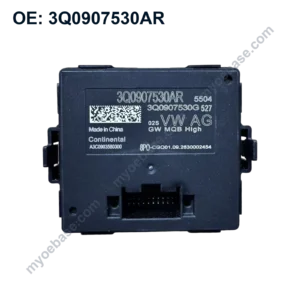
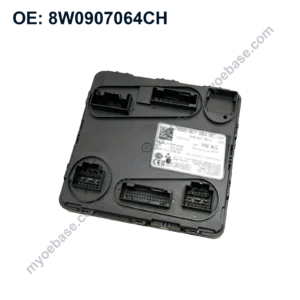
Do not confuse this with our other listings. The body control modules we sell, such as 4N0907064AH (product 4978), 4N0907064DM (product 4614), 8W0907063CG (product 4622), 5WA937084AD (product 4628) and 8W0907064CH (product 1577), supervise comfort, locking and lighting functions and are unrelated to the parking brake. The 1K0951605C alarm horn (product 4985), the ACC radar sensors, the ABS wheel-speed sensors and the DL382 transmission mechatronic are different systems altogether. A parking brake fault that actually lives in the caliper motor, the switch or the supply voltage needs those parts, not this module. If your diagnostic report points anywhere other than address 53 with a confirmed internal module fault, do not order this control unit.
Condition and warranty
Brand new, unused and uncoded, with twelve months warranty against manufacturing defects, covering the module as supplied. The warranty does not cover a unit that has been opened, drilled, soldered, repainted, dropped, pressure washed, reverse-polarity connected, exposed to water ingress through a damaged connector, damaged by a voltage spike or jump start, connected with the wrong plug, or fitted without a stable battery supply during coding. It does not cover faults caused by a seized caliper motor, a jammed EPB switch, a corroded harness, a weak vehicle battery, incorrect coding, a missing EPB option, wrong drivetrain suffix, or any other part of the car. Coding, online fees, diagnostic time, basic settings, caliper motors, switches, wiring and fitting labour are not covered. A module that has been powered up, coded to a VIN or fitted cannot be returned as unused. If a unit is faulty on arrival, send us the full VCDS or ODIS auto-scan including address 53 and the old module’s coding string before returning anything, and keep the original module and the job card until every parking brake function has been tested.
Shipping and packing
Orders leave within one to two working days of cleared payment. The module is wrapped so the printed label cannot be scuffed and the connector face is protected, then boxed with enough padding to protect the two mounting ears and the housing from impact. Electronic modules are packed against static and moisture. On arrival, open the parcel before booking workshop time and compare the housing, the connector keying, the two mounting ears and every line of the label with our photographs. Photograph the label and confirm that 8K0 907 801 L, 8K0 907 801 J, 32620282 A, A2C53406353 and Made in Malaysia are legible. Please photograph the outer carton before signing for a parcel showing impact or water damage. Import duties and local taxes, where they apply, are the buyer responsibility. Tracking is emailed when the parcel is handed to the carrier.
Not sure this is the right module?
Send us the VIN, the build date, whether the car is quattro or front-wheel drive, and a clear photograph of the label and the connector face on the module currently in the car. A full auto-scan with the address 53 block is even better, because it shows the software number, the hardware index and the coding string that a replacement will need. We will read the suffix with you, check whether your car falls inside the catalogued 2013-2016 group, and confirm whether the fault memory actually points at the module rather than the switch, the caliper motors or the supply voltage. That is far cheaper than an uncodable module or a parking brake that still will not release, and it takes minutes rather than a workshop visit. If the old unit is missing entirely, tell us the model, year and drivetrain and we will tell you what else is needed to identify the correct suffix.
Wholesale
Tiered pricing for 1 pc, 5 pcs and 20 pcs is shown below, with every tier priced for one complete parking brake control module rather than for a repair kit or a coding service. Audi specialists, independent workshops and parts distributors keep these on the shelf because B8-platform cars are now at the age where water ingress, connector corrosion and low-voltage faults start to take out the J540, and because a confirmed module failure is one of the few faults that strands a car with the rear brakes locked on. Ask for a combined quote if you also need rear caliper motors, EPB switches, connector repair wires, ABS sensors or body control modules; we price mixed orders together and can hold stock for repeat workshop orders. Send the VIN range, the drivetrain mix and a photograph of a representative old label with volume enquiries so we can confirm the suffix before dispatch.