

About this part
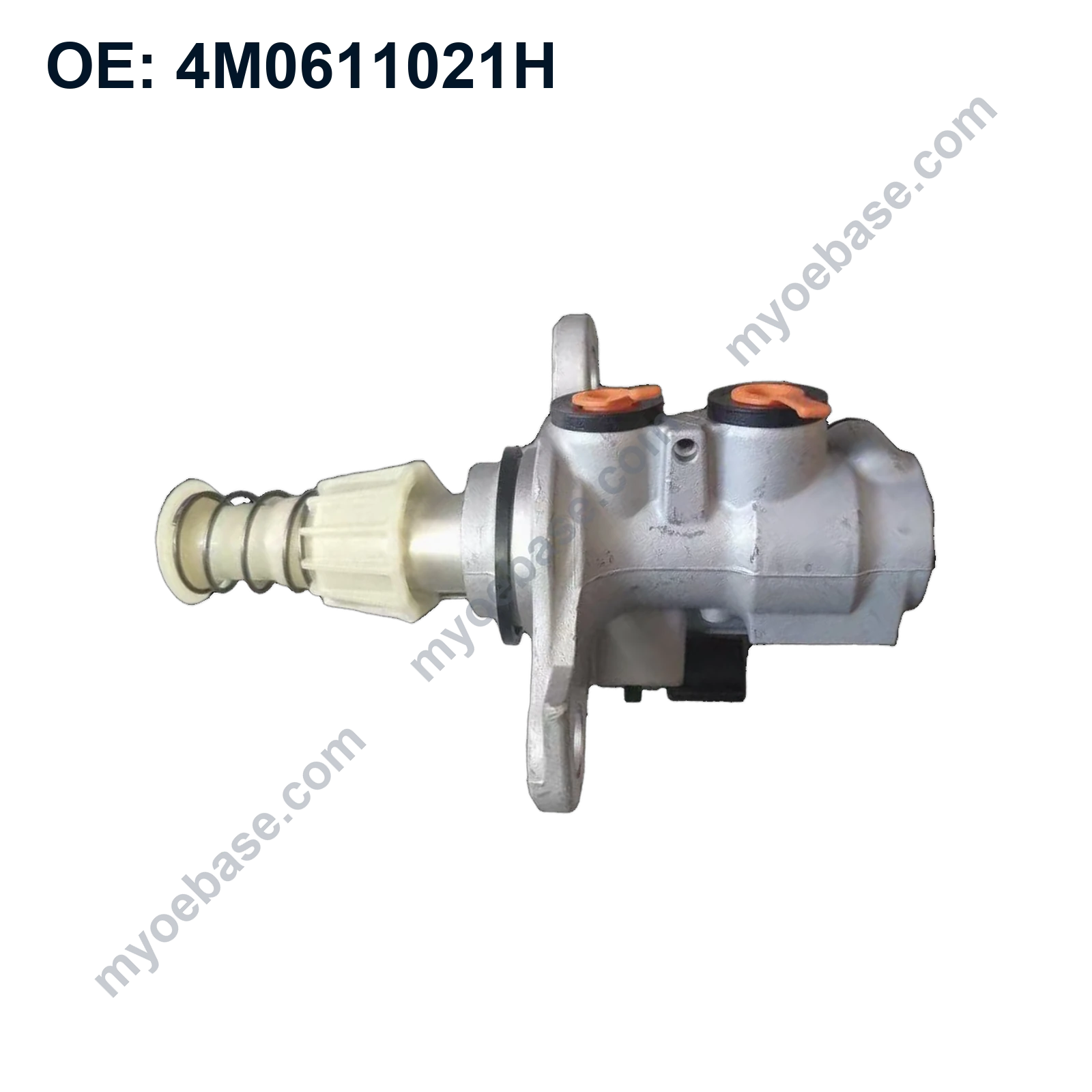
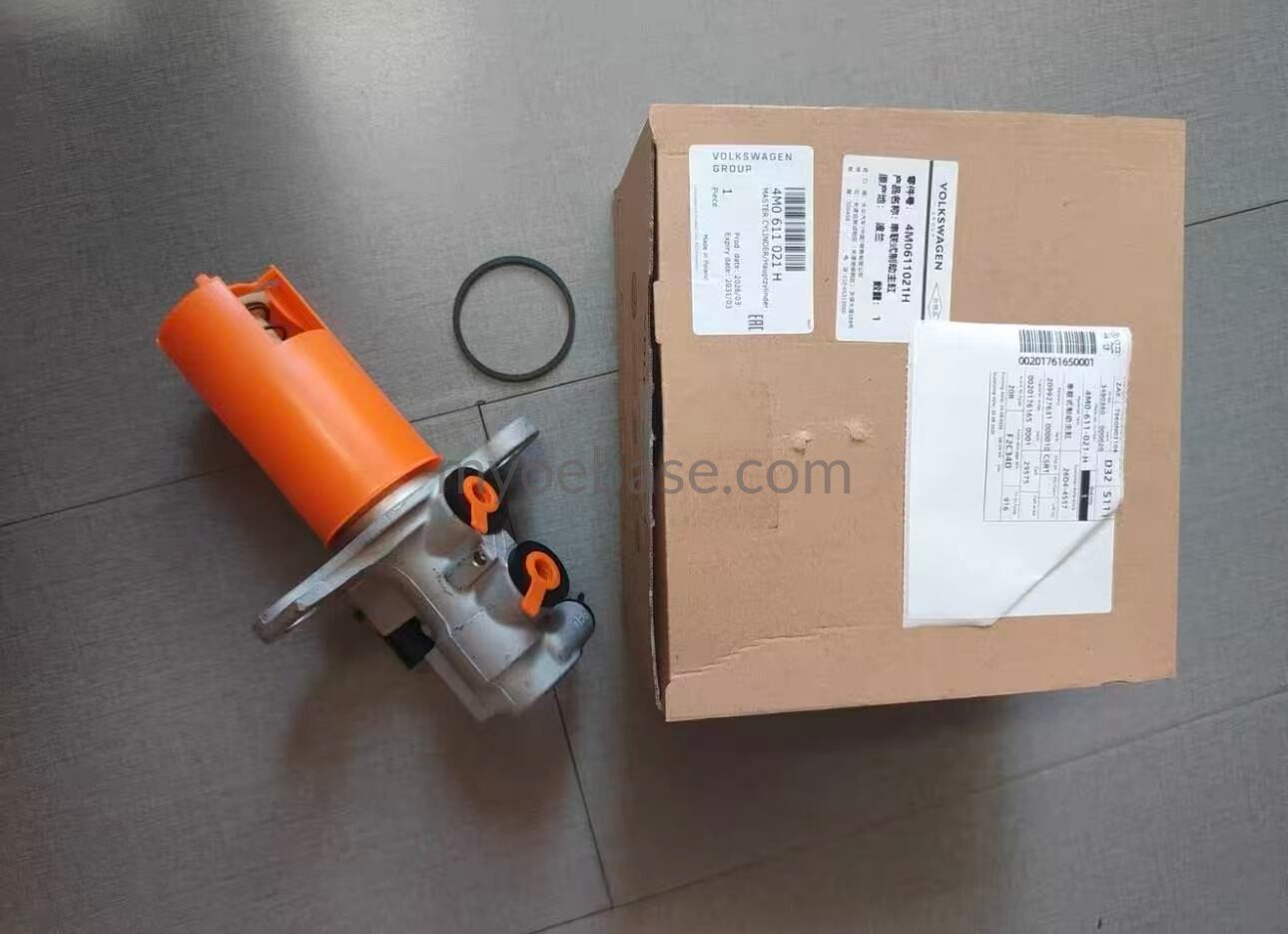
The 4M0611021H Brake Master Cylinder is a brand new genuine Volkswagen Group tandem brake master cylinder, the hydraulic heart of the braking system on the Audi Q7, Q8, SQ7, SQ8, RS Q8 and VW Touareg CR7 built on the MLB Evo platform. It is also called a tandem master cylinder, dual circuit master cylinder, brake master pump or Hauptbremszylinder, and it converts the mechanical force from your foot, multiplied by the brake booster, into hydraulic pressure in two completely separate circuits. Our photographs show the exact unit we supply: a cast aluminium cylinder body with its machined two bolt mounting flange, the white plastic pushrod with the exposed return spring that engages the brake booster, two upward facing reservoir ports protected by bright orange transit caps, the black fluid level sensor connector, the cast ribs and parting lines of the housing and the machined hydraulic outlets. The original Volkswagen Group carton label reads 4M0-611-021-H / 4M0611021H, 串联式制动主缸 (tandem brake master cylinder), VOLKSWAGEN GROUP, made in Poland, quantity 1, printed 24.08.2026, and a second Chinese language label carries the same 4M0611021H number. This is the current service part that supersedes the earlier 4M0611021A and 4M0611021G; those two numbers are no longer current but they are the numbers you are most likely to find on the old cylinder, in an older workshop manual or on an old invoice. Fitment is chassis date dependent rather than model year dependent: Q7 and SQ7 vehicles built from 17 June 2019 and Q8 and SQ8 vehicles built from 30 July 2018 use this H suffix cylinder, while earlier cars use a different, earlier revision. Because this is a safety critical hydraulic component, identify the part by the VIN, the production date of the car and the number cast or labelled on the old cylinder before ordering, and have it fitted by a qualified technician with the correct bleeding equipment.
Tandem brake master cylinder (dual circuit hydraulic unit) — one brand new genuine 4M0611021H aluminium master cylinder with orange reservoir port caps, pushrod and return spring, and the fluid level sensor connection, supplied as the cylinder only, without the brake fluid reservoir, brake fluid, brake pipes, seals, wiring harness, bleeding tools or fitting labour.
OE/OEM Part Number:
4M0611021H, 4M0 611 021 H, 4M0-611-021-H, 4M0611021A, 4M0 611 021 A, 4M0-611-021-A, 4M0611021G, 4M0 611 021 G, 4M0-611-021-G, AU4M0611021H
4M0611021H is the current Volkswagen Group service part and replaces the superseded 4M0611021A and 4M0611021G. Some dismantler and aftermarket catalogues write the same number as 4M0 611 021 H or 4M0-611-021-H, and stock systems occasionally add the prefix AU4M0611021H for the Audi application. All of these describe the one cylinder shown in our photographs; they are not a kit of several parts. The white label on the original carton reads 4M0-611-021-H with 4M0611021H, the Chinese description 串联式制动主缸, VOLKSWAGEN GROUP, made in Poland, quantity 1 and the print date 24.08.2026. Casting marks, mould numbers and the date clock on the aluminium housing are production traceability data and are not additional part numbers. Do not order by bore diameter alone: visually similar master cylinders from other VAG model families, such as the 8R0, 8KD, 4GD and 8E0 611 021 series, have different piston sizes, outlet threads, flange offsets, pushrod lengths and sensor connectors and are not interchangeable with 4M0611021H.
What you receive
One master cylinder, not a complete brake hydraulic assembly. Exactly as photographed you receive one brand new 4M0611021H tandem brake master cylinder in its original Volkswagen Group carton, with the aluminium housing, the two bolt mounting flange, the white pushrod and return spring, the two orange transit caps over the reservoir ports, the black fluid level sensor connection and the machined hydraulic outlet ports. Approximate net weight is 1.2 kg. The orange caps are protective dust caps fitted for transport; they are removed on the bench immediately before the brake fluid reservoir is fitted, and they are not the reservoir itself. Nothing else is in the parcel: no brake fluid reservoir or cap, no fluid level sensor or wiring harness pigtail, no reservoir grommets or seals, no brake fluid, no brake pipes, banjo bolts, unions or copper washers, no flange nuts or gasket, no brake booster, vacuum pump or pedal linkage, no ABS / ESC hydraulic unit, no calipers, pads, discs or hoses, and no bleeding equipment or workshop labour. Reuse the reservoir, grommets, sensor, fasteners and pipes from the old cylinder only if they are in perfect condition, and replace the reservoir grommets as a matter of course on a car of this age. The three price tiers are for 1, 5 and 20 individual cylinders, which suits independent VAG workshops, brake specialists, fleet maintenance operations and parts distributors.
Condition and handling. This is a brand new, never fitted, never filled and never bench bled cylinder. It is shipped dry with capped ports so that no dirt or moisture can enter the honed bore. Keep the caps in place until the moment of fitting: a single grain of grit or a fingerprint of mineral oil inside a master cylinder bore can score the seals and cause an internal bypass that no amount of bleeding will cure. Never clamp the aluminium housing in a vice, never press the pushrod with the ports sealed, and never dismantle the internal pistons, springs or seals. Brake fluid is hygroscopic and aggressive to paint: store the sealed carton in a dry place and keep the fluid, if handled on the bench, away from painted surfaces.
What a tandem master cylinder does
When you press the brake pedal the brake booster multiplies the force and pushes the white plastic pushrod into the rear of the master cylinder. Inside the aluminium bore two pistons sit in series, each with its own primary and secondary cup seals. The first, or primary, piston pressurises one brake circuit while mechanically pushing the second, or floating, piston, which pressurises the other circuit. Each circuit feeds a diagonally split pair of wheels through the ABS and ESC hydraulic modulator, so that a leak in one circuit leaves the other circuit able to stop the car, with a longer pedal travel and reduced braking force. Compensating and vent ports in the bore let fluid return to the reservoir as the pads wear and as the fluid expands with heat, and they must be uncovered when the pedal is released; a blocked port, an incorrectly adjusted pushrod or a swollen seal will trap pressure and cause the brakes to drag or bind when hot. The fluid level sensor connection on the housing reports a low fluid condition to the instrument cluster and, on these MLB Evo cars, the same hydraulic unit works together with the electromechanical brake booster, brake assist, ABS, ESC, traction control, hill hold, adaptive cruise braking and, on mild hybrid models, the regenerative braking blending. That is why the master cylinder on these cars must match the original exactly rather than being chosen from a generic bore size catalogue.
How it fails and what the driver feels
Master cylinder failures fall into two families. An external leak from a failed rear seal, a cracked reservoir grommet, a corroded pipe union or a weeping housing shows up as a falling fluid level, a damp area on the booster or below the flange, paint damage from brake fluid and a warning message on the dashboard. An internal leak, usually called a bypass, is more deceptive: the cup seals harden, swell or score with age, contaminated or overheated fluid, and fluid simply slips past the piston instead of being pushed into the brake lines. No fluid is lost, the reservoir stays full and there is no visible leak, yet the pedal feels soft or spongy, sinks slowly towards the floor under steady pressure at a standstill, needs one or two pumps to become firm, has a longer than normal travel, and the car feels vague or pulls under braking. Old brake fluid absorbs water, boils at a lower temperature after repeated hard stops, and corrodes the bore and the ABS modulator from the inside; a cylinder that has run for years on neglected fluid often has a ridged bore that will destroy a new set of seals in weeks. Other symptoms that are commonly misdiagnosed as a master cylinder include air trapped in the ABS modulator after a fluid change, a leaking brake hose or caliper, a failing brake booster or vacuum supply, a misadjusted pushrod, a warped disc, a seized caliper piston and a faulty pedal travel sensor. Have a workshop pressure test the hydraulic system, check for bypass at each port and scan the ABS and brake booster control units before condemning the cylinder.
Why a genuine unit is the right repair. On a two tonne MLB Evo SUV with high performance brakes, the pedal feel, the piston diameter, the split point between the two circuits, the pushrod ratio and the sensor calibration are all matched to the booster, the ABS software and the brake torque distribution. A cheap copy with a slightly different bore or a poorly finished compensating port can produce a pedal that never feels right, brakes that drag when hot, or an ESC fault under emergency braking. The cylinder we supply is the current Volkswagen Group service part in the manufacturer’s own carton, made in Poland, with the correct H suffix for the post 2019 Q7 and post 2018 Q8 production window. Keep the old cylinder when it comes off: photograph the label and the casting, compare the flange, ports, pushrod and connector with our photographs, and confirm the suffix before the new part is fitted.
Fitment traps: read before ordering
The chassis date break is the biggest trap. 4M0611021H is not a fit for every Q7 or Q8. Audi parts catalogues list this H suffix cylinder for Q7 (4MB, 4MG, 4MQ) and SQ7 built from 17 June 2019 onwards, and for Q8 (4MN, 4MT) and SQ8 built from 30 July 2018 onwards. Cars built before those dates use the earlier A or G suffix cylinder, which is a different revision. The break is a production date, not a registration year or a model year, so two cars both described as 2019 Q7 can need different cylinders. Read the build date from the VIN plate or the vehicle data sticker, or send us the full VIN, and never order from the model name alone. The same catalogues list the H suffix for the RS Q8, including cars with and without ceramic brake discs, but those high performance applications must always be confirmed against the VIN and the number on the old unit.
Engine and drivetrain coverage. Confirmed applications include the Q7 and SQ7 3.0 TDI quattro with engine codes CRTC, CRTE, CZZA and CZZB, the 50 TDI mild hybrid quattro with DHXA and DPXA, and the SQ7 TDI quattro with CZAC and DMVA; the Q8 45 TDI mild hybrid quattro with DHXC and DPXB, the 50 TDI mild hybrid quattro with DHXA and DPXA, and the SQ8 TDI mild hybrid quattro with DHVA. On the Volkswagen side the same part is associated with the Touareg CR7 / RC8 3.0 TDI 4motion with engine codes DENA and DPYD, which shares the MLB Evo platform with the Q7 and Q8. All of the confirmed applications are quattro or 4motion all wheel drive. No engine displacement or power output by itself acts as a fitment gate within that range; the production date, the VIN and the part number on the old cylinder do. If your car is a petrol, a plug in hybrid, a different market version or an earlier Q7, do not assume this part fits: check with a VIN based lookup first.
A, G and H suffixes are not three different parts in one box. 4M0611021H is the current service replacement for 4M0611021A and 4M0611021G. A dealer parts diagram, an older invoice or the casting on the old cylinder may show one of the earlier suffixes, and in that case this H suffix unit is the correct current replacement for cars inside the production date window above. If the old cylinder has a completely different number, a different flange or pushrod, a different reservoir port spacing or a different sensor plug, this listing does not apply. Catalogue cross references such as AU4M0611021H are stock codes used by dismantlers, not additional OE numbers.
Related parts that are not included. The brake fluid reservoir pushes into the two ports with rubber grommets and carries the fluid level sensor; the reservoir, grommets, cap and sensor are separate parts on the VAG diagram. The two orange items visible in our photographs are transit caps, not the reservoir and not a pair of replacement sensors. The brake pipes, the ABS / ESC hydraulic modulator, the electromechanical or vacuum booster and the pedal assembly are also separate. If you are replacing a cylinder after a catastrophic seal failure or contaminated fluid, plan to flush the entire system, inspect the modulator and calipers and budget for fresh seals and fluid at the same time.
Installation notes for a qualified technician
Preparation and removal. Brake work on these cars must be done by a workshop with the correct diagnostic tool and pressure bleeding equipment. Park on a level surface, switch off the ignition, and follow the manufacturer procedure for the electromechanical brake booster and the parking brake before opening the hydraulic system; on some MLB Evo models the brake pedal must not be operated with the ignition on while the system is open. Remove the reservoir cap and draw out as much old fluid as possible with a clean syringe, protect the painted surfaces around the booster, disconnect the fluid level sensor plug, and photograph the routing of each brake pipe before cracking any union. Use proper brake pipe spanners, cap or plug every open port immediately, then undo the two flange nuts and lift the old cylinder clear without levering against the booster or bending the pipes. Never allow mineral oil, solvent, grit or cloth fibres into the bore, and never depress the brake pedal with the master cylinder removed. Inspect the booster pushrod, the flange seal, the reservoir grommets, the sensor connector and the pipe threads; a corroded pipe, a torn grommet or a damaged booster will ruin a new cylinder.
Bench bleeding and fitting. A dry tandem master cylinder must be bench bled before it is connected to the car. Clamp the new cylinder gently by the flange in a soft jawed holder, fit the bleed kit and the reservoir or bleed adaptors, fill with the specified fresh DOT 4 or DOT 4 low viscosity fluid from a sealed container, and stroke the pushrod slowly and fully until no air bubbles emerge from either port. Short, fast strokes aerate the fluid and make the job harder. Never reuse fluid that has been bled out of the system. Then fit new reservoir grommets, transfer the reservoir and the level sensor, refit the cylinder to the booster with a new flange seal, tighten the two nuts evenly to the torque in the workshop manual and reconnect each pipe by hand before final tightening. Check the pushrod free play and the pedal to booster clearance against the manual: a pushrod adjusted too long covers the compensating port and makes all four brakes bind as the fluid warms up, which is a classic cause of a comeback after a master cylinder change.
Bleeding, coding and final checks. Fill the reservoir and pressure bleed the whole system in the sequence specified for the Q7, Q8 or Touareg, then run the ABS / ESC modulator bleed routine with a diagnostic tool; air trapped in the modulator cannot be removed by pedal bleeding alone. Clear any ABS, ESC, brake booster and brake pad wear fault codes, and where the manual requires it perform the brake pedal travel sensor or brake booster basic setting and the brake fluid level or service interval reset. With the engine running, check for a firm, high pedal with no slow sink under steady pressure, inspect every union and the flange for weeping under pressure, verify the brake lights and the dashboard fluid warning, and confirm even braking and straight stopping in a safe road test. Recheck the fluid level and all joints after the road test. Dispose of old brake fluid as hazardous waste and never mix DOT 4 with silicone DOT 5 fluid. A cylinder that has been filled, fitted or bench bled cannot be returned as unused.
Fitment
Fitment is determined by the VIN, the vehicle production date and the number on the master cylinder removed from the car, not by the model name, the registration year or the engine size alone. Use this table as a guide, then compare the flange, the reservoir ports, the pushrod and the sensor connector of your old unit with our photographs and the OE number block before ordering. Rows marked Not covered are listed deliberately so that buyers with an earlier revision or a different VAG master cylinder do not order the wrong safety critical part.
| Make | Model | Years / build date | Engine / notes |
|---|---|---|---|
| Audi | Q7 4M (4MB / 4MG / 4MQ) 3.0 TDI quattro | 17 Jun 2019 – 2025 | CRTC, CRTE, CZZA, CZZB; built from 17/06/2019 only |
| Audi | Q7 4M 50 TDI Mild Hybrid quattro | 17 Jun 2019 – 2025 | DHXA, DPXA; chassis date break applies |
| Audi | SQ7 4M TDI quattro | 17 Jun 2019 – 2025 | CZAC, DMVA; built from 17/06/2019 only |
| Audi | Q8 (4MN / 4MT) 45 TDI Mild Hybrid quattro | 30 Jul 2018 – 2026 | DHXC, DPXB; built from 30/07/2018 only |
| Audi | Q8 50 TDI Mild Hybrid quattro | 30 Jul 2018 – 2026 | DHXA, DPXA; chassis date break applies |
| Audi | SQ8 TDI Mild Hybrid quattro | 30 Jul 2018 – 2026 | DHVA; built from 30/07/2018 only |
| Audi | RS Q8 4.0 TFSI quattro | 2019 – 2026 | with and without ceramic discs; confirm by VIN and old part number |
| VW | Touareg CR7 / RC8 3.0 TDI 4motion | 2018 – 2026 | DENA, DPYD; MLB Evo platform, verify VIN |
| Not covered | Q7 / SQ7 built before 17 Jun 2019 | – | uses the earlier 4M0611021A / 4M0611021G revision |
| Not covered | Q8 / SQ8 built before 30 Jul 2018 | – | uses the earlier revision, do not order by model year |
| Not covered | 8R0 / 8KD / 4GD / 8E0 611 021 master cylinders | – | different bore, ports, flange and pushrod; not interchangeable |
| Not covered | Cars needing a reservoir, sensor, pipes or fluid | – | related parts on the VAG diagram are not included |
Safety notice
The brake master cylinder is a safety critical component. Installation, bleeding and any diagnostic basic settings must be carried out by a qualified technician following the current Audi or Volkswagen workshop manual, using the specified brake fluid and torque figures. Never drive a car with a soft, sinking or spongy brake pedal, a brake warning light, visible fluid loss or brakes that bind; have it recovered to a workshop instead. A new cylinder will not cure a fault in the booster, the ABS / ESC modulator, a caliper, a hose, a wheel bearing or the pedal linkage, and a hydraulic system filled with contaminated or overheated fluid must be flushed completely. Confirm the fitment by VIN before the protective caps are removed, because a cylinder that has been filled with brake fluid cannot be resold as new. Local regulations for the transport and disposal of brake fluid and the buyer’s import duties, where they apply, are the buyer’s responsibility.
Shipping and packing
Orders leave within one to two working days of cleared payment. Each cylinder is supplied dry in its original VOLKSWAGEN GROUP carton with the orange reservoir port caps fitted, wrapped so that the machined flange, the pushrod and the sensor connector cannot be damaged in transit, and packed in a rigid outer carton. The white label reads 4M0-611-021-H / 4M0611021H, 串联式制动主缸, made in Poland, quantity 1, printed 24.08.2026; keep that label and photograph it with the cylinder when the parcel arrives. Please photograph the outer carton before signing for a parcel that shows signs of impact or water damage, and check that both orange caps are still in place: an open port means the bore may be contaminated. Store the cylinder sealed in its carton in a dry place at room temperature until the car is on the lift. Import duties and local taxes, where they apply, are the buyer’s responsibility.
Condition & warranty
Brand new genuine 4M0611021H tandem brake master cylinder, twelve months warranty against manufacturing defects covering the cylinder as supplied. The warranty does not cover a cylinder that has been clamped in a vice, dropped, dismantled, bench bled with the wrong fluid, filled with contaminated, silicone or old brake fluid, fitted with damaged reservoir grommets, nipped with cross threaded pipes, installed with an incorrectly adjusted pushrod or a missing flange seal, run with corroded or aerated hydraulics, or damaged by a failing brake booster, a seized caliper, a blocked ABS modulator or overheating caused by dragging brakes. Fitting labour, diagnostic time, brake fluid, pipes, seals, reservoir, sensors, recovery and hire of bleeding equipment are not covered. A cylinder that has been filled, fitted or bled cannot be returned as unused. Photograph the old cylinder, its label, the ports and the flange before fitting, and keep the old part until the car has been road tested and rechecked for leaks.
Wholesale
Tiered pricing for 1, 5 and 20 master cylinders is shown below, with every tier priced for a single cylinder. Brake and suspension specialists normally keep one of these in stock for the Q7, Q8 and Touareg fleet work, because a pedal that sinks under steady pressure takes the car off the road immediately. Ask for a combined quote if you also need the matching brake fluid reservoir and grommets, fluid level sensors, brake pipe sets, ABS hydraulic units, brake pads and discs, or the earlier 4M0611021A / G revision for pre 2019 Q7 and pre 2018 Q8 cars; we price mixed orders together and can hold stock for repeat workshop orders. Send the full VIN, the vehicle production date and a photograph of the label on the old cylinder with volume enquiries so we can confirm the H suffix and the correct chassis date break before dispatch.