
About this part
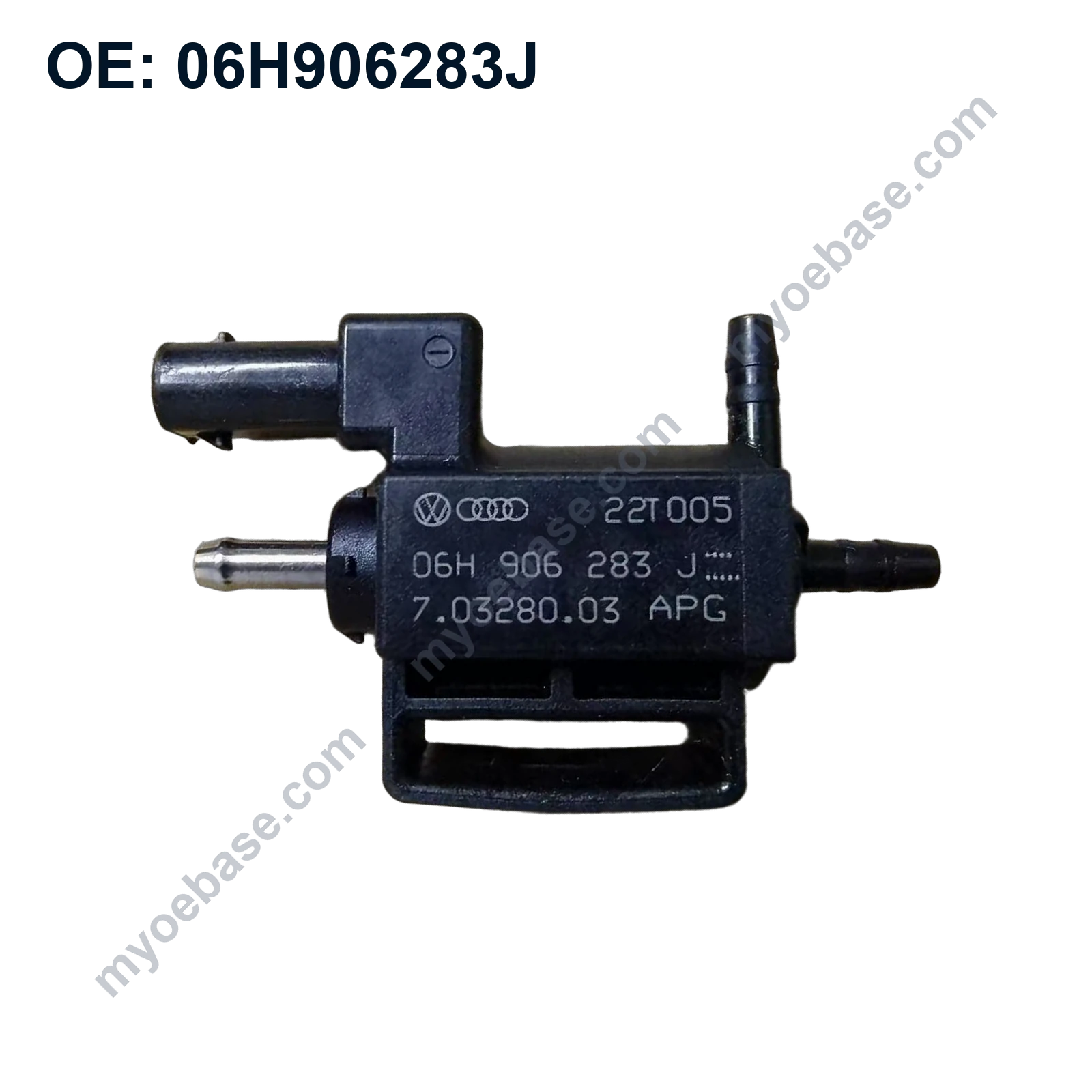
The 06H906283J Solenoid Valve is a brand new genuine OEM Pierburg electric-pneumatic change over valve for the intake manifold runner flap system on VW, Audi, Skoda and SEAT 1.8 and 2.0 TSI and TFSI petrol engines of the EA888 family. In VAG parts catalogues the component is listed simply as a valve or solenoid valve, while TecDoc calls it a Change-Over Valve, change-over flap (induction pipe); in workshop language it is the N316 intake manifold flap valve. Look carefully at the unit in our photographs. The main body is black glass fibre reinforced polyamide moulded in Germany, with the word PIERBURG, GERMANY and the material code PA6-GF30 moulded into the reverse face. The front face carries laser marked identification: the VW roundel next to the four Audi rings, the part number 06H 906 283 J, the Pierburg number 7.03280.03, the production code 22T005 and the letters APG. On one end there is a tall black two pin electrical connector tower with its moulded locking tab, and beside it a short silver metal vacuum nipple. On the opposite end two black ribbed barbed vacuum nipples point in different directions, one along the body axis and one at right angles to it. An open rectangular mounting bracket with a long through-slot is moulded into the side of the housing and clips the valve to its bracket on the intake manifold. Three ports, two electrical pins, 12 V rated, electric-pneumatic operation and a net weight of roughly 0.08 kg are the identifying specifications. Every unit supplied is a brand new, unused, genuine OEM Pierburg valve, not a reconditioned take-off, not an unbranded copy and not a bare solenoid coil. The valve ships as one complete assembly with its connector, nipples and mounting bracket intact, ready to plug in and clip into place after the vacuum lines have been checked.
Intake manifold runner flap change over valve — one brand new genuine Pierburg N316 12 V electric-pneumatic solenoid that switches vacuum to the runner flap actuator on EA888 1.8 and 2.0 TSI and TFSI engines.
OE/OEM Part Number:
06H906283J, 06H 906 283 J, 06H 906 283J, 06H906283F, 06H 906 283 F, 06H906283E, 06H 906 283 E, 06H906283B, 06H 906 283 B, 95890628310, 958 906 283 10, 06K906283, 06K 906 283, 06H906283, 06H133583F
Manufacturer and aftermarket cross references: Pierburg 7.03280.03, 7.03280.03.0, 703280030, 7.03280.07.0, 7.02256.18.0, 7.03280.04.0, 7.02256.59.0, VEMO V10-63-0128, FEBI BILSTEIN 108232, SWAG 30 10 8232, TOPRAN 639 820, METZGER 0892461, MEAT and DORIA 99025, SIDAT 83.1944, NTY ECD-AU-010, VIKA 99061834901, URO 06H906283J
These numbers occupy the same diagram position across VW, Audi, Skoda, SEAT, Porsche and Pierburg catalogues, but they are not all physically identical valves. The F and E numbers are the earlier references most often superseded by the J valve, while 95890628310 is the Porsche catalogue number that appears in the same group. The B valve is the revised corrosion resistant version with an extra fresh air connection and is not a straight like-for-like swap without the 06H133583F fresh air line. The 06K906283 number belongs to the later valve generation used after certain production date breaks. Always read the laser marked number on the old valve and confirm by VIN before ordering.
Which valve is this, and which valve is it not
This is one of the most frequently misidentified small valves in the VAG parts trade. Several aftermarket catalogues attach the labels turbocharger boost solenoid, N75 boost control valve, vapour canister purge solenoid, N80 purge valve and PCV breather valve to the 06H906283J number. Those names are catalogue aliases piled into the same parts slot, not a description of what this valve does. The N75 boost control valve manages charge pressure at the turbocharger wastegate, the N80 purge valve meters fuel vapour from the charcoal canister into the intake, and the PCV valve regulates crankcase breathing. All three are different components with different connectors, port layouts and part numbers. The 06H906283J valve switches a vacuum or pressure signal to the actuator that opens and closes the runner flaps inside the intake manifold, which is why the correct TecDoc name is Change-Over Valve, change-over flap (induction pipe). It is also not the flap actuator itself, not the runner flap position sensor often referred to as G336, not the intake manifold assembly such as 06J133201 and not an electric flap motor. If the old part on the car has a different number, a different connector shape or a different number of ports, stop and check the VIN in the official electronic parts catalogue. Buying on a vehicle compatibility table alone is the single most common cause of a wrong order on this family of valves. The physical checks are simple: two pin oval electrical connector, three nipples in total, a tall connector tower, an open slotted mounting bracket and the 06H 906 283 J laser marking on a black PA66-GF30 body.
How the runner flap valve works
On EA888 1.8 and 2.0 TSI and TFSI engines the intake manifold contains a set of tumble or runner flaps in the intake ports. At low engine speed and light load the engine control unit commands the flaps partly closed so that the incoming charge is forced through a narrower path, which increases swirl and tumble, stabilises combustion and improves low end torque and emissions. At higher speed and load the flaps open fully so the engine can breathe without restriction. On vacuum operated systems the engine control unit does not move the flaps directly. It drives this N316 change-over valve with a 12 V switched or pulse width modulated signal through the two pin connector, and the valve then routes vacuum from the supply port to the diaphragm actuator on the manifold or vents that vacuum to atmosphere. The actuator pulls the flap linkage, and a position sensor feeds the achieved flap position back to the control unit so the loop can be monitored. Because the valve is an electric-pneumatic transducer rather than a flow metering device, a sticking spool, a cracked housing, a blocked fresh air port, a split vacuum hose or corrosion on the internal passages all produce the same class of fault: the commanded flap position and the measured flap position disagree. The valve lives in a hot, wet under-bonnet environment next to the cylinder head, so condensation and blow-by vapours are a genuine durability concern on this design, which is exactly what the later factory service bulletin addressed.
Failure symptoms and fault codes
The classic code is P2015, Intake Manifold Runner Position Sensor or Switch Circuit Range and Performance, Bank 1. Depending on the engine and calibration you may also see P2014 for the runner position sensor circuit, P2004 or P2006 for a flap stuck open or stuck closed, or manufacturer specific variants that describe an implausible signal from the intake flap position sensor. Drivers usually notice an illuminated check engine lamp or EPC lamp, a noticeable loss of mid range pull, hesitation or a flat spot when pulling away, a slightly rough or hunting idle, worse fuel economy, and in some cases a harder cold start. Because the flaps default to a safe position when the system is de-energised, a failed valve can be surprisingly mild at city speeds and only become obvious above roughly 3000 rpm when full flap travel is required. Do not assume the valve is the culprit simply because P2015 is stored. Carbon buildup that jams the flaps, a broken plastic flap linkage, a seized actuator diaphragm, a leaking vacuum hose, a damaged position sensor, chafed wiring and a corroded two pin connector produce the same code. A valve that has failed internally through corrosion will often show discolouration or residue near the ports, and the vacuum supply port may no longer hold vacuum when tested with a hand pump.
Diagnosis before you buy
Read the fault memory with a diagnostic tool that can display VAG measuring blocks, then run the guided fault finding routine for the intake manifold flap valve N316 and watch the commanded and actual flap positions together while an assistant raises engine speed. Inspect all three vacuum hoses for splits, perishing, loose clips and incorrect routing, and confirm that the supply side actually holds vacuum with a hand vacuum pump. Check the two pin connector for spread terminals, green corrosion and a secure latch, verify battery voltage at the connector with the ignition on, and measure the solenoid coil resistance against a known good unit. Actuate the valve with a scan tool and listen for a clean click while confirming that vacuum appears at the outlet port. Inspect the flap linkage and the actuator rod for free movement and check the intake ports for heavy carbon deposits. Only condemn the valve when the electrical side, the vacuum supply, the hoses, the actuator and the flap mechanism all check out. Audi technical service bulletin 2044003/1 of 19 April 2016 documents corrosion inside the N316 valve as a cause of P2015 on a range of 2.0 TFSI models, and its prescribed repair is the revised 06H906283B valve with the additional fresh air connection, installed together with the 06H133583F fresh air line routed along the cylinder head cover. That bulletin is a repair instruction, not a claim that every 06H906283J valve is faulty. If your old valve is the J number and the car left the factory with a J valve, this genuine J valve is the correct like-for-like replacement. If you are repairing a corrosion related P2015 under the bulletin, discuss the B valve and fresh air line upgrade with your workshop before ordering.
Vehicle fitment and the production date breaks
The table below summarises the catalogue coverage for the 06H906283J valve across the VW, Audi, Skoda, SEAT and Porsche ranges. It is deliberately broad because this valve appears in many EA888 1.8 and 2.0 TSI and TFSI applications, but there are real production date breaks that a generic compatibility table cannot see. On some A3 8V 2.0 TFSI and A4 B9 applications the catalogues show the J valve only up to a build date in 2016 or 2019, after which the later 06K906283 valve with Pierburg 7.02256.59.0 is specified. Older B8 and Tiguan applications may be fitted with the B valve and Pierburg 7.03280.04.0 from new. There are also catalogue entries for the VW Atlas 3.6 litre V6 and for Porsche Macan and Cayenne derivatives under the Porsche number 95890628310, which we list as boundary cases requiring a VIN check rather than as confirmed fitments. The final authority is always the VIN read in the official electronic parts catalogue together with the engine code, the build date and the number laser marked on the old valve. Send us those four items and we will confirm the match before you order.
| Brand | Model / engine | Year | Notes |
|---|---|---|---|
| VW | Golf VI 5K GTI 2.0 TSI CCTA CCZB | 2009 – 2013 | EA888 Gen2; confirm the laser number on the old valve |
| VW | Golf VII 5G 1.8 TSI | 2013 – 2020 | EA888 Gen3; build date check near 2016 |
| VW | Golf VII 5G GTI 2.0 TSI | 2013 – 2020 | Runner flap valve on the intake manifold |
| VW | Golf VII R 2.0 TSI CDLF DJHA | 2014 – 2019 | High output EA888; VIN and old number check |
| VW | Golf Alltrack and SportWagen 1.8 TSI | 2015 – 2019 | North American Gen3 applications |
| VW | Jetta VI 1.8 TSI | 2014 – 2018 | Transverse EA888; two pin oval connector |
| VW | Jetta VI GLI 2.0 TSI Gen3 | 2012 – 2018 | Also listed by ECS Tuning for the Gen3 GLI |
| VW | Passat B6 3C 1.8 and 2.0 TSI | 2008 – 2010 | Early Gen2; some cars use the B valve, VIN check |
| VW | Passat B7 1.8 and 2.0 TSI | 2011 – 2015 | Including 06J133201 intake manifold cars |
| VW | Passat B8 3G 2.0 TSI | 2015 – 2019 | Gen3; confirm by VIN before ordering |
| VW | Passat CC 2.0 TSI | 2009 – 2017 | Same engine family, different body |
| VW | Tiguan 5N 2.0 TSI | 2011 – 2017 | First generation Tiguan |
| VW | Tiguan AD1 2.0 TSI | 2017 – 2020 | Second generation; production date check |
| VW | Beetle 5C 1.8 and 2.0 TSI CPLA CPPA | 2012 – 2019 | A5 platform Beetle |
| VW | Scirocco 2.0 TSI | 2009 – 2017 | VIN and engine code check |
| VW | Eos 2.0 TSI | 2009 – 2015 | VIN check |
| VW | Sharan II 2.0 TSI | 2011 – 2018 | VIN check |
| VW | Touran II 1.8 and 2.0 TSI | 2016 – 2019 | VIN check |
| VW | Arteon 2.0 TSI | 2018 – 2020 | Late build date check, some cars use 06K906283 |
| VW | T-Roc 2.0 TSI | 2018 – 2020 | VIN check |
| VW | Atlas and Atlas Cross Sport 2.0 TSI | 2018 – 2023 | Catalogue listed; VIN check required |
| VW | Atlas 3.6L V6 SE | 2018 – 2023 | Listed under 06H906283J by some catalogues as a boundary case; VIN essential |
| Audi | A1 8X 1.8 TFSI CDAA | 2014 – 2018 | Smallest EA888 application |
| Audi | A3 8P 1.8 and 2.0 TFSI CCZA CCTA | 2007 – 2013 | Earlier generation; verify old valve number |
| Audi | A3 8V 1.8 and 2.0 TFSI | 2013 – 2019 | Some catalogues end the J valve at a 2019 build date |
| Audi | S3 8V 2.0 TFSI CJXD DJHB | 2013 – 2019 | High output engine; confirm by VIN |
| Audi | A4 B8 8K 1.8 and 2.0 TFSI | 2008 – 2015 | Including allroad and CNCD 224 hp |
| Audi | A4 B9 8W 2.0 TFSI CVKB CYRB | 2016 – 2019 | Build date breaks in 2016 and 2017; VIN essential |
| Audi | A5 8T and F5 2.0 TFSI | 2008 – 2016 | Coupe, Sportback and Cabriolet |
| Audi | A6 C7 4G 1.8 and 2.0 TFSI CAEB | 2012 – 2018 | VIN check |
| Audi | A7 4G 2.0 TFSI | 2012 – 2018 | VIN check |
| Audi | Q3 8U 2.0 TFSI CCTA CCZC | 2011 – 2018 | Q3 is named in Audi TSB 2044003/1 for 2015 and 2016 |
| Audi | Q3 F3 2.0 TFSI | 2019 – 2020 | Late cars may use 06K906283; VIN check |
| Audi | Q5 8R 2.0 TFSI CAEB CPMB | 2009 – 2017 | Includes 2010 to 2016 TSB vehicles |
| Audi | Q5 FY 2.0 TFSI | 2017 – 2020 | VIN and build date check |
| Audi | TT 8J 2.0 TFSI CCTA CCZA | 2008 – 2014 | VIN check |
| Audi | TTS 8S 2.0 TFSI | 2015 – 2018 | VIN check |
| Skoda | Octavia II 1Z 1.8 and 2.0 TSI | 2007 – 2013 | Including vRS |
| Skoda | Octavia III 5E 1.8 and 2.0 TSI | 2013 – 2019 | Including vRS; VIN check |
| Skoda | Superb II 3T 1.8 and 2.0 TSI | 2008 – 2015 | VIN check |
| Skoda | Superb III 3V 1.8 and 2.0 TSI | 2015 – 2019 | VIN check |
| Skoda | Yeti 5L 1.8 TSI | 2009 – 2017 | VIN check |
| Skoda | Kodiaq 2.0 TSI | 2017 – 2020 | Late build date check |
| Skoda | Karoq 1.5 and 2.0 TSI | 2018 – 2020 | VIN check |
| SEAT | Leon III 5F 1.8 and 2.0 TSI | 2013 – 2020 | Including Cupra; VIN check |
| SEAT | Altea and Altea XL 1.8 TSI | 2007 – 2015 | VIN check |
| SEAT | Exeo 1.8 and 2.0 TSI | 2009 – 2013 | VIN check |
| SEAT | Ateca 1.4 and 2.0 TSI | 2016 – 2020 | VIN check |
| Porsche | Macan 2.0T and Cayenne derivatives | 2015 – 2018 | Listed under 95890628310 in cross references; boundary case, VIN essential |
| Not covered | Revised 06H906283B valve plus 06H133583F fresh air line | 2016 onwards | Audi TSB 2044003/1 corrosion repair; different port layout, not a straight swap |
| Not covered | 06K906283 with Pierburg 7.02256.59.0 | 2019 onwards | Later valve generation after the production date break |
| Not covered | N75 turbocharger boost control solenoid | All years | Different valve, different function and different number |
| Not covered | N80 vapour canister purge solenoid | All years | Different valve despite the catalogue alias |
| Not covered | PCV crankcase breather valve 06H103495AK | All years | Separate crankcase ventilation part |
| Not covered | Intake manifold 06J133201, flap actuator, G336 sensor | All years | Assembly and sub components are not included |
| Not covered | Early 06H906283, A, C and D references | 2007 – 2010 | First generation numbers; check the old valve before ordering |
| Not covered | Diesel TDI, 1.2 and 1.4 TSI, hybrid and naturally aspirated | All years | Different intake flap systems and different valves |
| Not covered | Electric flap actuator motors instead of vacuum actuators | All years | No N316 vacuum change over valve on these engines |
Installation notes
Fit the valve with the engine cold and the ignition off. Take a clear photograph of the three vacuum hoses before removal so the routing can be reproduced exactly, then mark each hose with tape if the ports are not already identified. Release the two pin connector by pressing its locking tab rather than pulling on the wires, unclip the valve from the slotted bracket, and transfer the hoses one at a time to the new valve so no port is left open or crossed. Inspect the rubber hoses and replace any that are soft, cracked or oil soaked. Press the new valve into the bracket until the clip seats, reconnect the plug until it clicks, and make sure no hose is kinked against the cylinder head cover or a hot exhaust component. Clear the fault memory, then carry out the intake flap basic setting or adaptation with a diagnostic tool, ideally with battery voltage above 13.7 V and the engine idling. Road test the car through the full rev range and confirm that P2015 does not return, that flap actual and commanded positions track each other and that the EPC lamp stays off. Recheck for vacuum leaks and hose chafing after a short run. The valve is a clip-in, plug-in service part; no coding or component protection is involved, but the basic setting should not be skipped. This is a general guide only. Torque values, hose routing and adaptation routines differ by engine code, so follow the factory repair manual for the specific vehicle.
What is not included and what is not covered
The price is for ONE complete 06H906283J valve. Vacuum hoses, hose clamps, the mounting bracket on the car, the intake manifold assembly, the runner flap actuator diaphragm, the flap position sensor G336, the wiring loom pigtail, the 06H133583F fresh air line, gaskets, fasteners, diagnostic time and labour are NOT included. Not covered are the N75 turbocharger boost control solenoid, the N80 vapour canister purge valve, the PCV crankcase breather valve, the 06J133201 intake manifold with its integrated flaps, electric flap actuator motors, the revised 06H906283B valve and fresh air line kit, the later 06K906283 valve generation, and the early 06H906283, A, C and D references used on some first generation applications. Diesel TDI engines, the 1.2 and 1.4 TSI engines with a different flap arrangement, naturally aspirated petrol engines and hybrid models are not covered. Cars built after the documented production date breaks, including certain 2019 and later A3 8V and A4 B9 2.0 TFSI vehicles, may require 06K906283 instead. If the number on the old valve does not match one of the numbers in our OE block, do not order this part.
Condition and warranty
This is a brand new, unused, genuine OEM Pierburg valve in original specification, not a used, reconditioned, remanufactured or exchange unit and not an aftermarket pattern part. Every valve is visually checked for a complete connector tower, intact locking tab, undamaged barbed nipples, a clean slotted mounting bracket and readable laser marking before it is packed. Twelve months warranty applies against manufacturing defects. Warranty does not cover incorrect fitment, crossed vacuum lines, damage from a corroded connector, a contaminated vacuum supply or installation errors. Because electrical parts are vehicle specific, please keep the original packaging and the order reference until the repair is confirmed.
Packing and shipping
Net weight is approximately 0.08 kg and the packed weight with protective padding is about 0.15 kg. Each valve is bagged, cushioned and boxed so the connector tower, the silver metal nipple and the two black barbed nipples cannot be snapped in transit. The protective caps and the mounting bracket are left in the factory position. Wholesale orders are packed in multiples with individual protection per unit. If a parcel arrives crushed, photograph the box before opening it and contact us so the claim can be handled quickly.
Not sure this is the right valve
Send us the vehicle VIN, the engine code, the build date and a clear photograph of the laser marked face of the old valve. We will compare the number, the connector shape and the port layout against our stock unit and confirm before you pay. This is especially important on cars near the 2016 and 2019 production date breaks, on Porsche and Atlas applications listed under 95890628310, and on any vehicle where a previous owner may already have fitted the revised B valve and fresh air line. If you are chasing a P2015 code, tell us the stored code and the measured flap positions as well, because the fault may be a sticking flap or a split hose rather than the valve itself.
Trade and wholesale supply
The three tier prices on this listing are for one sample piece, five pieces and up, and twenty pieces and up. Workshops and distributors fitting EA888 engines regularly keep this valve on the shelf because P2015 diagnosis is a routine job on high mileage 1.8 and 2.0 TSI and TFSI cars. All tiers are supplied from the same genuine Pierburg stock with the same laser marked number and the same twelve months warranty. For mixed bulk orders across the 06H906283 family, contact us with the numbers you need and we will build a single quote.
Related parts in the same family
Other numbers you may encounter while working on the same system include 06H906283F and 06H906283E as the earlier valves superseded by J, 06H906283B as the revised corrosion resistant valve paired with the 06H133583F fresh air line, 06K906283 with Pierburg 7.02256.59.0 for later build dates, and the Porsche catalogue number 95890628310. Pierburg service references 7.03280.03, 7.03280.03.0, 7.03280.07.0 and 7.02256.18.0 all appear in this group. Our store also carries related VAG engine and electrical service parts such as product 5086, product 5080, product 5074, product 5067, product 5039, product 5009 and product 4710. If you need a different number from this family, search the number in our store or ask us to source it.