

About this part
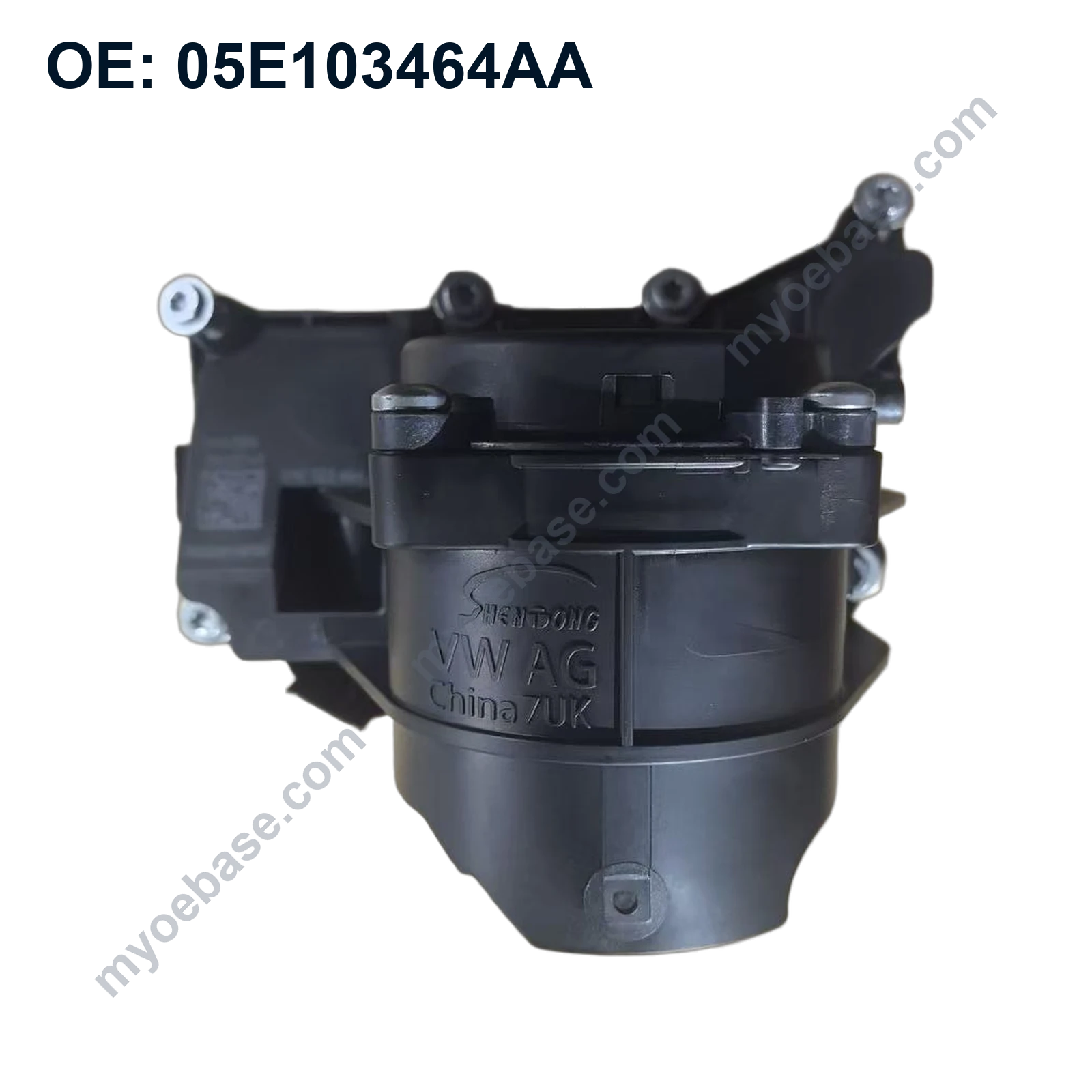
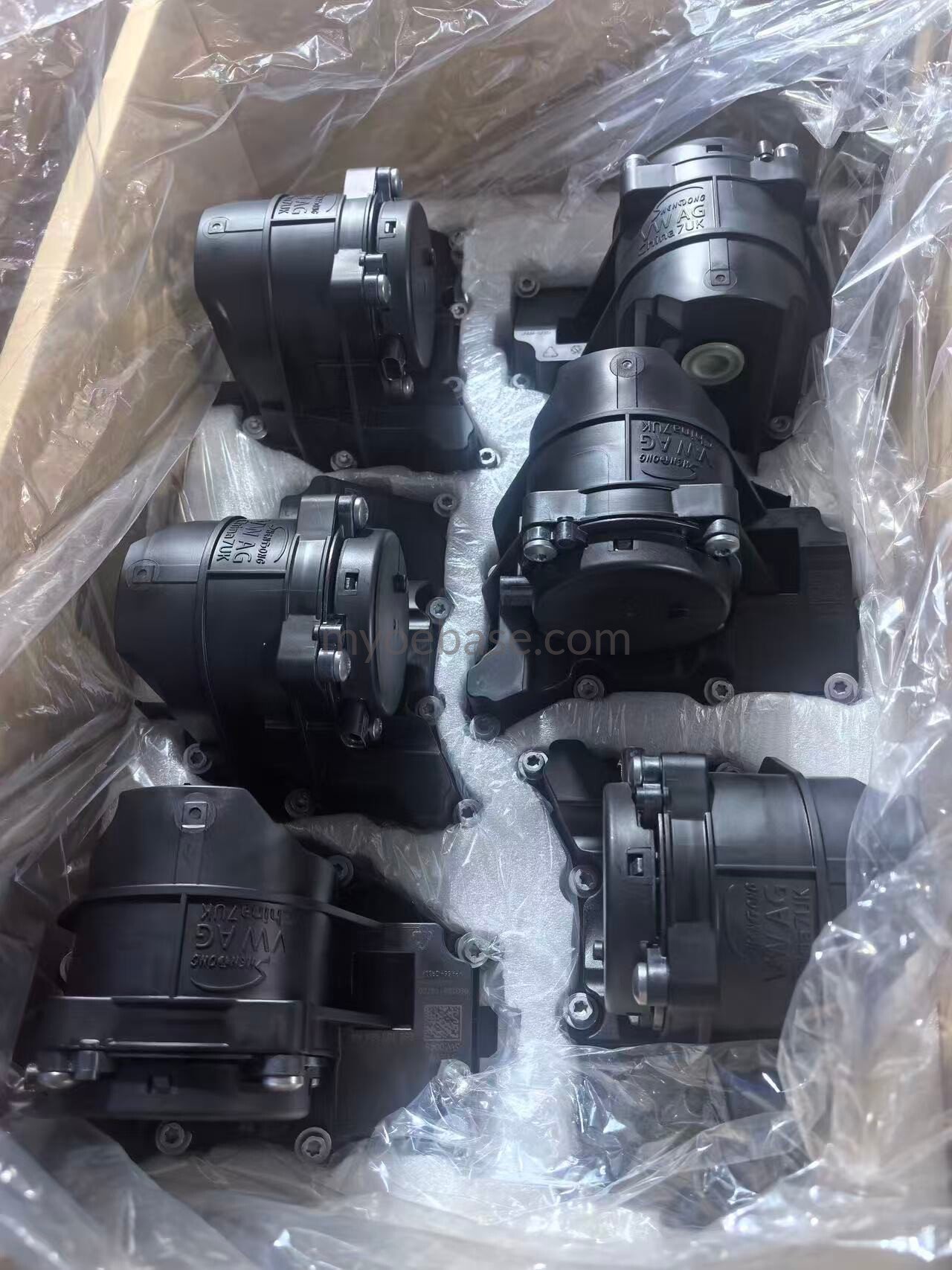
The 05E103464AA Oil Separator is a brand new genuine OEM active crankcase ventilation oil separator for the 1.5 litre TSI EVO petrol engines of the EA211 EVO family used across the Volkswagen Group. Unlike the simple passive breather valve fitted to earlier engines, this unit is an electrically driven centrifugal separator: a control unit mounted directly on the housing talks to the engine ECU over a LIN bus and drives a small electric motor that spins a stack of separator discs at anything from zero to 12000 rpm according to engine load and speed. Blow-by gas from the crankcase passes a coarse separator and then the spinning disc pack, where centrifugal force throws even sub micron oil droplets out of the gas stream and returns the oil to the sump while the cleaned vapour is routed back into the intake. Volkswagen quotes a separation efficiency above 90 percent for 0.4 micron oil particles, which is the reason this design was adopted for the China 6 and RDE emissions calibrations: less oil reaching the combustion chamber means lower oil consumption, less deposit build up on the valves and in the chamber, and fewer oil droplets passing into the intake and the particulate filter. The moulded black PA66-GF glass fibre reinforced nylon body carries a flanged mounting face with its bolts, a tapered outlet spigot, the three pin electrical connector, supplier embossing and a laser marked DataMatrix code, part number and hardware and software version markings such as HW:003 and SW:0049. Applications include the VW Sagitar, Lavida, Bora, Tharu, Tiguan L and Tayron 1.5T in the Chinese market and the Jetta, Taos, Golf 8, T-Roc, Tiguan, Passat, Touran, T-Cross, Taigo and Caddy 1.5 TSI overseas, plus the Skoda Octavia, Karoq and Scala, the SEAT Leon, Ateca and Tarraco and the Audi A3 8Y and Q3 35 TFSI. When the separator fails the usual signs are rising oil consumption, oil seepage from crankcase seals caused by excess crankcase pressure, oil pooling in the charge pipe and intercooler, blue smoke on start up or on overrun, rough idle, an illuminated electronic power control lamp K132 and exhaust emissions warning lamp K83, and fault memory entries for the active oil separation function unit.
Active crankcase oil separator — genuine 05E103464AA electrically driven centrifugal oil mist separator with integrated LIN control unit, three pin plug, flanged housing and laser marked DataMatrix code, brand new and factory tested, supplied as one single complete unit for 1.5 TSI EVO EA211 engines.
OE/OEM Part Number:
05E103464AA, 05E 103 464 AA, 05E-103-464-AA, 05E103464E, 05E103464G, 05E103464J, 05E103464M, 05E103464R, 05E 103 464 E, 05E 103 464 G, 05E 103 464 M, 05E 103 464 R
VAG function unit for active oil separation GX47, control unit for active oil separation J1240, active oil separation motor V704
What you receive
This listing is for one single complete active oil separator, exactly one 05E103464AA unit as shown in the photographs, with the moulded housing, the integrated control unit, the electric motor, the three pin connector and the laser marked DataMatrix code. The tiered pricing below applies to 1 unit, 5 units and 20 units respectively, which suits independent VAG workshops, engine rebuilders and parts distributors who keep crankcase breather components on the shelf. One separator is used per engine, so a single order covers one vehicle. The mounting gasket or seal, the fixing bolts, the breather hoses, the wiring harness repair plug and the engine control unit are not included unless separately listed; reusing a flattened or oil swollen seal is a common cause of a repeat oil leak after the new part has been fitted, so we recommend a fresh seal every time. Check the laser marked number and the index letter on the original unit before ordering, or send us the VIN and engine code and we will confirm the match.
Because this is an electronic assembly with a control unit and an electric motor, each separator is shipped in anti static protective packaging with a cap over the connector and the open ports plugged so that dust and moisture cannot enter the disc pack in transit. Do not remove the protective plugs until the unit is being fitted, never wash the inside of the separator with solvent, and do not drop the assembly or lever against the connector housing — a cracked control unit or a bent motor shaft will produce a speed deviation fault that no amount of cleaning will clear.
How active oil separation works and why the unit fails
The principle. Every petrol engine passes a small amount of combustion gas past the piston rings into the crankcase. That blow-by gas carries a fine aerosol of engine oil. On older EA211 engines a passive labyrinth and a pressure controlled valve dealt with it, but at the boost levels and blow-by rates of the 1.5 TSI EVO a passive system cannot reliably catch the finest droplets. Volkswagen therefore introduced the function unit for active oil separation GX47. The control unit for active oil separation J1240 is bolted directly to the separator and receives a speed request from the engine control unit over a bidirectional LIN bus. It then drives the active oil separation motor V704, which is connected by a shaft to a disc separator. The official speed map runs from 0 rpm on overrun fuel cut-off through roughly 2000 rpm at idle, 4000 rpm at low partial load and 6000 rpm at medium partial load up to 12000 rpm at full load. Centrifugal force flings even the finest oil particles onto the discs, where they coalesce and drain back to the sump. The 1.5 TSI evo2 development uses a stack of around thirty rotating discs in place of the earlier two passive stages.
What goes wrong. The three pin connector carries a 9 to 16 volt supply, the LIN bus signal and ground. Corrosion, water ingress, a chafed harness, a loose latch or a broken wire will stop active separation completely and leave only the coarse and stationary fine separators working. The control unit reports an electric drive blocked fault, an overheated drive, a target to actual speed deviation greater than three percent, or a general drive malfunction, and the ECU switches on both the electronic power control lamp and the emissions warning lamp. On the mechanical side, sludge from extended oil change intervals contaminates the disc pack, a blocked breather hose raises crankcase pressure and pushes oil out through the crankshaft seals and the sump gasket, and a tired PCV hose lets unmetered air in and produces lean mixture and idle faults. Typical complaints are a quart of oil every few thousand kilometres, oil wetting the intercooler hoses, smoke after a long overrun, a hunting idle and a persistent fault code for the active oil separation unit. It is worth checking the breather hoses, the intake tract and the oil condition before condemning the separator, because a new unit fitted to a sludged engine with a blocked hose will fail again quickly.
Diagnose before replacing. Read the fault memory with ODIS, VCDS or an equivalent VAG capable tool and look specifically at the active oil separation function unit, then check the three pin supply, ground and LIN signal at the connector. Compare the target and actual separator speed on live data if the scan tool exposes it, inspect the breather hoses for splits and blockage, and measure crankcase pressure or at least look for oil pushed out around the seals. A compression or leakdown test is useful if blow-by is excessive, since a worn engine will overwhelm any separator. Clear the fault memory after fitting and recheck it after a road test through the full load range.
Part number confusion: read this before ordering
It is not a water separator and it is not aluminium. A number of marketplace listings describe this part as an aluminium alloy oil and water separator that filters moisture out of the engine. That is incorrect on both counts. The housing of the 05E103464AA is moulded black PA66-GF glass fibre reinforced nylon, and what it separates is oil mist from crankcase blow-by gas, not liquid water from fuel or coolant. There is no drain, no filter element and no serviceable cartridge. If a listing promises a filtration accuracy figure for water or quotes an aluminium billet body, it is describing a different product and should not be used as a compatibility reference.
The 04E103464 family is a different part. Numbers such as 04E103464AA, 04E103464AM, 04E103464K and 04E103464F belong to the earlier 1.4 TSI EA211 passive oil separator and are widely catalogued by VAICO, Febi and other aftermarket suppliers. Those units have no motor, no control unit and no LIN connector, and they do not interchange with the 05E active unit even though the 103 464 middle group is identical. Likewise the 06H103495AK crankcase breather valve used on the 1.8 and 2.0 TSI EA888 engines is a completely separate design. On the 05E family the index letters E, G, J, M, R and AA denote successive supersessions and market variants of the same active separator; always match the full number, the connector pin count and the engine code on the original part. TDI diesel engines and the 1.0 and 1.4 TSI variants are not covered by this listing.
Plug, position and coding. The separator bolts to the engine block on the crankcase ventilation circuit and connects with a three pin plug: pin 1 is the 9 to 16 volt supply, pin 2 the bidirectional LIN bus and pin 3 ground. It is a plug and play replacement with no standalone coding routine, but the fault memory must be cleared and the LIN communication confirmed with a scan tool. If the three wires are open circuit or the control unit is faulty the engine runs with passive separation only and the warning lamps stay on, so a correct mechanical fit with a bad electrical connection is not a successful repair. Always use a new seal, tighten the mounting bolts evenly and route the harness away from hot exhaust and turbocharger components.
Installation notes
Fitting. Let the engine cool, switch the ignition off and disconnect the battery negative terminal. Unplug the three pin connector, release the breather hoses and note their routing before removal, then undo the mounting bolts and lift off the old separator. Clean the mating face on the block without letting dirt fall into the open crankcase port. Fit a new gasket or seal, seat the 05E103464AA squarely on the flange and tighten the bolts evenly in a cross pattern to the vehicle maker’s torque specification — overtightening a nylon flange will crack it. Reconnect the breather hoses and the electrical plug until the latch clicks, and make sure the harness is clipped clear of hot and moving parts. Remove the protective port plugs only as each hose is offered up.
After fitting. Reconnect the battery, clear the engine fault memory, start the engine and let it reach operating temperature, then check for oil or vacuum leaks around the flange and hoses. Use a scan tool to confirm that the active oil separation unit is communicating on the LIN bus and that no drive blocked, overheat or speed deviation faults return. Take a road test covering idle, part load and full load, then re-read the fault memory. Because a blocked breather or excessive blow-by can reproduce the original symptoms, investigate those before fitting a second unit. Diagnostic labour, coding work and any consequential engine damage are the responsibility of the fitting workshop and are not covered by the parts warranty.
Physical specification. Moulded PA66-GF housing with flanged mounting face, tapered outlet, three pin electrical connector, integrated J1240 control unit and V704 disc separator motor, laser marked part number, DataMatrix code and hardware and software version markings. Operating voltage 9 to 16 V, separator speed 0 to 12000 rpm in five steps, net weight approximately 0.7 kg and packed weight around 1.0 kg. Brand new, factory tested for housing integrity, connector continuity and control unit communication, supplied one unit per box. Confirm the part number, the three pin connector and the engine code on the original separator before ordering.
Fitment
Fitment is by the full laser marked number on the original separator, the three pin LIN connector and the 1.5 TSI EVO engine code, not by the model name alone. Use this table as a guide and check your VIN or the old part before ordering. The passive 04E103464 1.4 TSI separator, the EA888 06H103495AK breather valve and all TDI diesel applications are not covered:
| Make | Model | Years | Engine / System |
|---|---|---|---|
| VW | Sagitar / Jetta 1.5 TSI EVO | 2019 – 2026 | EA211 EVO, 1.5 TSI, first China application |
| VW | Lavida 1.5 TSI EVO | 2019 – 2026 | EA211 EVO, 1.5 TSI |
| VW | Bora / Virtus 1.5 TSI EVO | 2019 – 2026 | EA211 EVO, 1.5 TSI |
| VW | Tharu / Taos 1.5 TSI | 2020 – 2026 | 1.5 TSI, DNKA |
| VW | Tiguan L / Tiguan 1.5 TSI | 2019 – 2026 | EA211 EVO, 1.5 TSI |
| VW | Tayron / Tiguan 2.0 BlueMotion | 2019 – 2026 | EA211 EVO family |
| VW | Golf 8 / Golf VII 1.5 TSI EVO | 2019 – 2026 | 1.5 TSI EVO, EA211 |
| VW | Jetta 1.5 TSI (North America) | 2022 – 2026 | DNKA, 1.5L L4 |
| VW | Passat / Passat Estate 1.5 TSI | 2019 – 2026 | 1.5 TSI EVO |
| VW | T-Roc / T-Roc Cabriolet 1.5 TSI | 2017 – 2026 | 1.5 TSI EVO |
| VW | Touran / Caddy / Taigo / T-Cross | 2018 – 2026 | 1.0 1.5 TSI EVO family |
| Audi | A3 8Y 35 TFSI 1.5 | 2020 – 2026 | 1.5 TFSI, EA211 EVO |
| Audi | Q3 / Q3 Sportback 35 TFSI | 2019 – 2026 | 1.5 TFSI, EA211 EVO |
| Skoda | Octavia / Scala / Kamiq 1.5 TSI | 2019 – 2026 | 1.5 TSI EVO |
| Skoda | Karoq / Superb 1.5 TSI | 2018 – 2026 | 1.5 TSI EVO |
| SEAT | Leon / Ateca / Tarraco 1.5 TSI | 2018 – 2026 | 1.5 TSI EVO |
| SEAT | Ibiza / Arona 1.5 TSI | 2018 – 2026 | 1.5 TSI EVO |
Shipping and packing
Orders leave within one to two working days of cleared payment. Each separator is capped at the connector and at the open ports, cushioned in anti static packaging and boxed individually so the disc pack, the control unit and the laser marked DataMatrix code cannot be damaged in transit. Tracking is emailed when the parcel is handed to the carrier. Customs charges, where they apply, are the buyer’s responsibility.
Condition & warranty
Brand new genuine quality 05E103464AA active oil separator, twelve months warranty against manufacturing defects covering the unit as supplied. The warranty does not cover sludge contamination from extended oil change intervals, a blocked breather hose, excessive engine blow-by, a damaged three pin connector or LIN harness, a cracked flange from overtightening, solvent cleaning, or diagnostic labour. If a part arrives faulty, send us photographs and the engine fault scan before returning anything.
Wholesale
Tiered pricing for 1 unit, 5 units and 20 units is shown below. Independent VAG workshops usually keep one or two of these on the shelf because a failed active oil separator is a recurring cause of high oil consumption and oil in the charge air tract on the 1.5 TSI EVO engine. Ask for a combined quote if you also need the flange seal, breather hoses, PCV pipes, intake gaskets or ignition components for the same job; we price mixed orders together and can hold stock for repeat workshop orders.