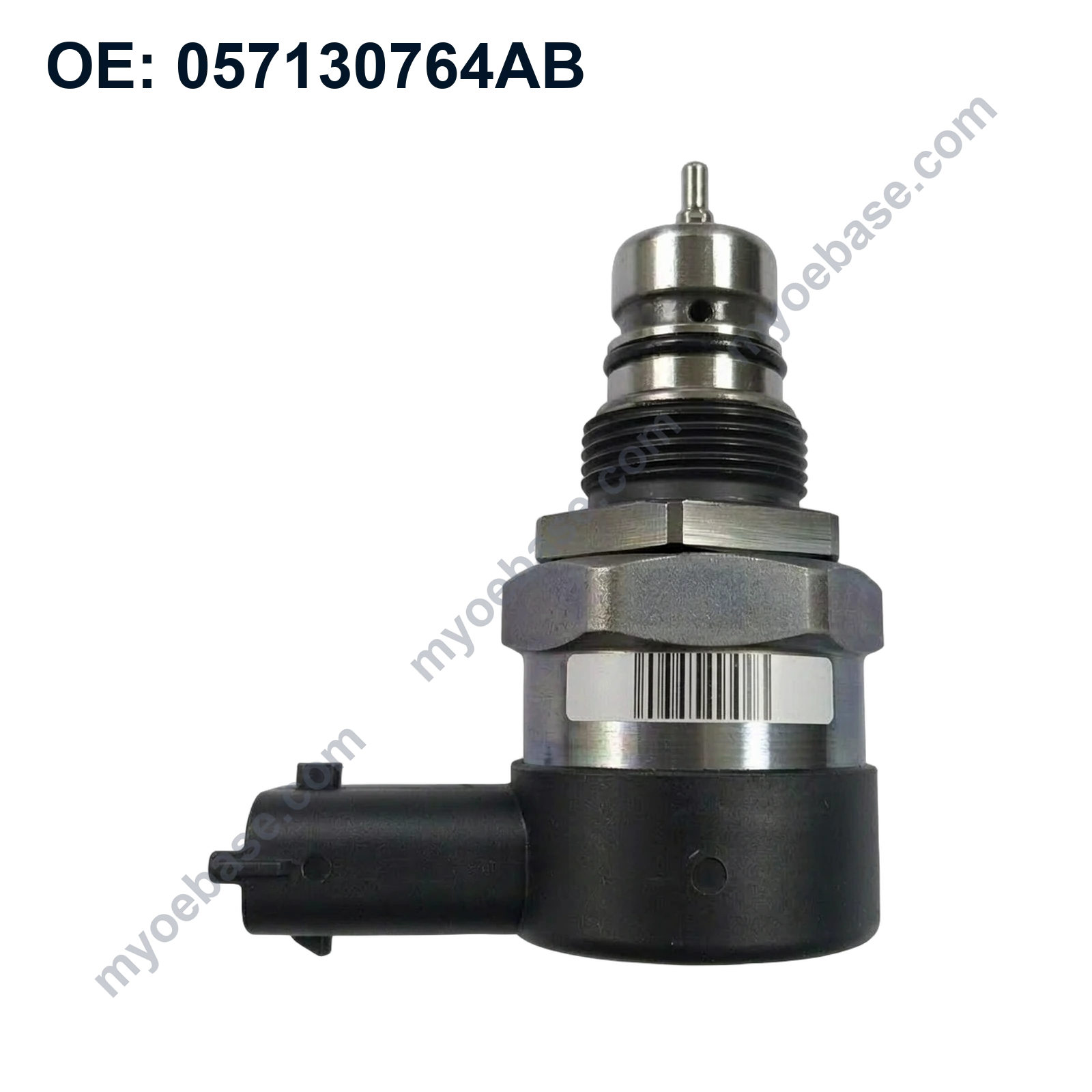
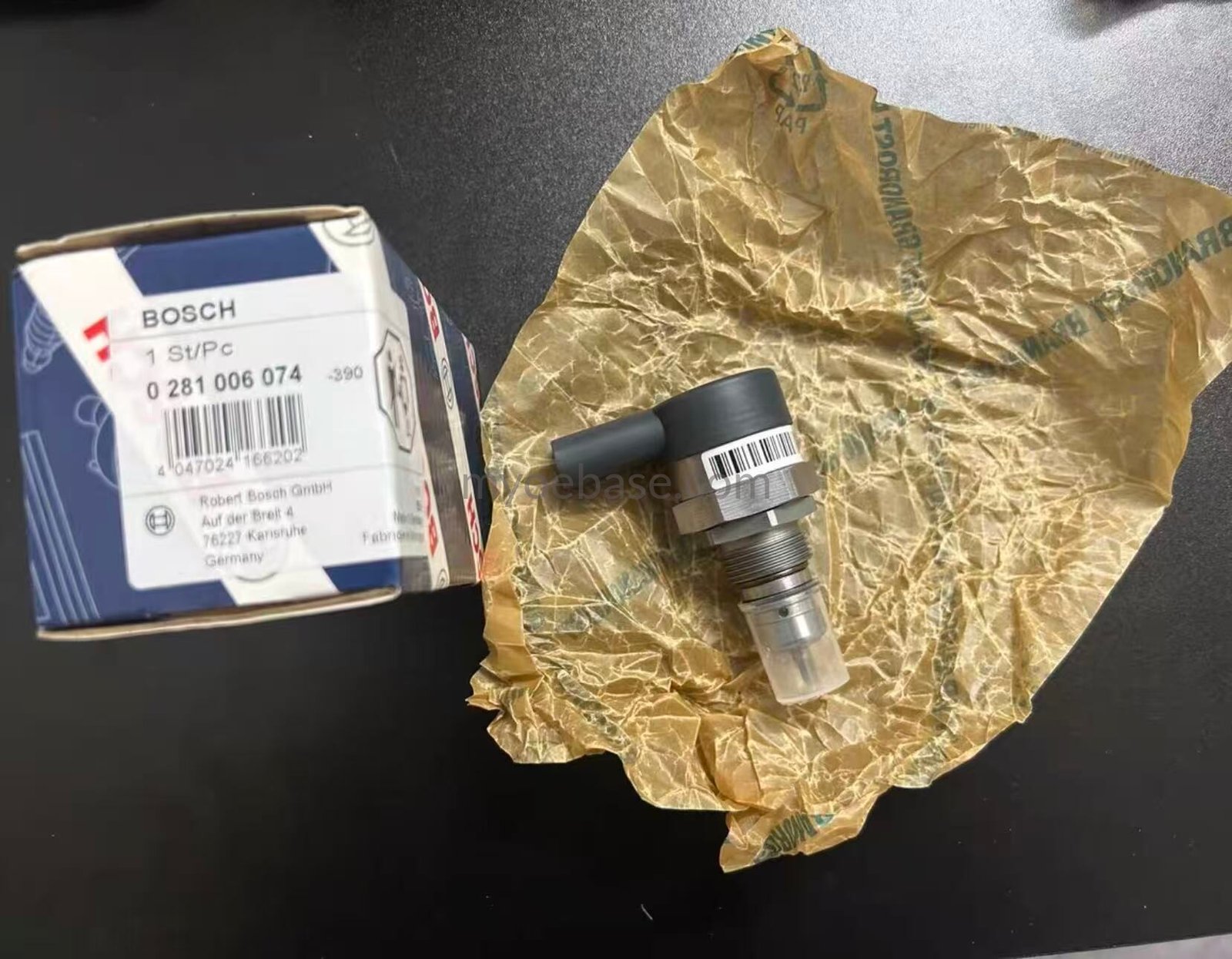
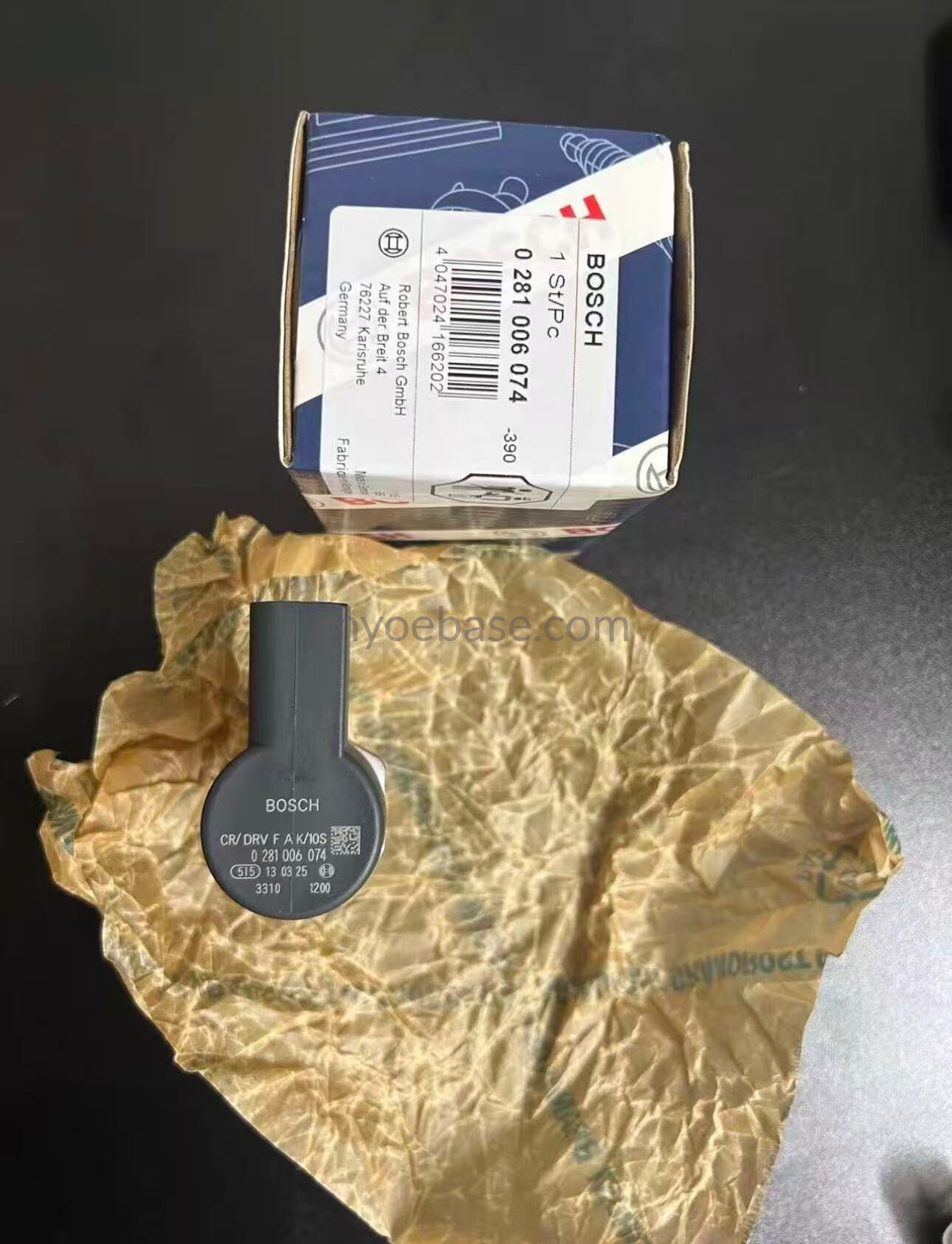
The 057130764AB Fuel Valve is a brand new genuine OEM Bosch common rail fuel pressure control valve, theDRV pressure regulator that meters the fuel returning from the rail to the tank and thereby lets the engine ECU hold the commanded rail pressure. Volkswagen Group lists it as 057 130 764 AB and Bosch supplies it as 0 281 006 074 (written 0281006074 without the spaces), trade number CR/PCV3-20 S AK/30S. In the hand it is a tall, upright valve rather than a flat disc: a fine silver pin tipped with a rounded silver dome sits at the very top, above a short black threaded neck, then a wide machined silver hexagonal flange with a white rectangular barcode sticker wrapped around the silver band below it. The lower half is a chunky matte black cylindrical solenoid coil housing, and a black electrical plug with its locking tab projects horizontally to the LEFT side of the coil. That left-hand plug, the hex across the flats, the thread length and the position of the barcode sticker are the features to compare against the old valve before you order. This is the pressure REGULATING valve on the common rail, not an injector, not a high pressure fuel pump, not a rail pressure sensor and not a low pressure lift pump in the tank. It is a genuine Bosch part, brand new and unused, with clean threads, straight connector pins, an unopened sealing face and no fault memory, adaptation values or fuel contamination carried over from another car. Because it is an electro-mechanical control part, match the complete VW AG number and the Bosch number against the VIN based catalogue rather than relying on the shape alone: several DRV valves from this family look nearly identical but are calibrated for a different rail pressure range and a different connector pin out.
Fuel pressure regulator valve — one brand new genuine OEM 057130764AB Fuel Valve, Bosch common rail DRV pressure control valve with VW AG 057 130 764 AB and Bosch 0281006074, supplied as a complete upright assembly with the silver pin and dome, black threaded neck, hex flange, white barcode sticker, matte black solenoid coil and the left-hand electrical plug. Fuel lines, rail seals, mounting hardware and diagnostic adaptation are ordered or performed separately.
OE/OEM Part Number:
057130764AB, 057 130 764 AB, 057.130.764.AB, 057130764AA, 057 130 764 AA, 958 606 240 00, 95860624000, 0 281 006 074, 0281006074, CR/PCV3-20 S AK/30S
Manufacturer: Bosch, common rail pressure control valve (DRV /druckregelventil), Bosch number 0 281 006 074 = 0281006074, trade number CR/PCV3-20 S AK/30S, supplied for Volkswagen AG OE 057 130 764 AB. EAN 4047024603998.
The first three entries are the same current VW AG order number in unspaced, spaced and dotted catalogue formats. 057 130 764 AA is the earlier VAG revision and 958 606 240 00 is the Porsche catalogue number for the same valve family; both are listed so you can recognise the part on an old invoice, but neither is a blanket supersession claim – always check the number physically fitted to your car. Some online catalogues quote Bosch 0281006075 next to this application; that is a DIFFERENT Bosch number and is not what is supplied here. The number on the Bosch box and on the product sticker in our photos is 0 281 006 074 / 0281006074, and the user has confirmed that this is the maker number to quote. Note also that 057 130 764 H, 03L 130 089 and 059 130 090 AH belong to older or differently calibrated control valves: the same hex body and a plug that happens to fit does not make them interchangeable. The ECU expects a particular control characteristic and leak rate from this valve; fitting a look-alike with a different Bosch number can produce rail pressure that is plausible at idle but drops out under load, with hard starting, torque loss and a stored rail pressure fault. For general background see the Bosch Mobility diesel systems catalogue, and for a VIN based number lookup use your franchise workshop system or the Volkswagen genuine parts catalogue.
| Brand | Model | Years | Engine | Fitment note |
|---|---|---|---|---|
| Volkswagen | Golf Mk7 / VII 1.6 and 2.0 TDI | 2012 – 2020 | 1.6 TDI, 2.0 TDI CR | Common rail DRV; confirm 057 130 764 AB on old part |
| Volkswagen | Passat B7 / B8 1.6 and 2.0 TDI | 2010 – 2023 | 1.6 TDI, 2.0 TDI, 2.0 BiTDI | VIN decides revision; do not order by shape |
| Volkswagen | Tiguan 5N and AD1 1.4 / 2.0 TDI | 2008 – 2024 | 1.4 TDI, 2.0 TDI 4motion | Check old Bosch number and plug orientation |
| Volkswagen | Touareg 7P 3.0 V6 TDI | 2010 – 2018 | 3.0 V6 TDI CR | Rail pressure regulator; verify by VIN |
| Volkswagen | Polo 6R / 6C 1.2 / 1.4 / 1.6 TDI | 2009 – 2017 | 1.2 TDI, 1.4 TDI, 1.6 TDI | Small TDI rail; match complete OE number |
| Volkswagen | Touran 1T / 5T 1.4 / 1.6 / 2.0 TDI | 2005 – 2022 | 1.4 TDI, 1.6 TDI, 2.0 TDI | Several valve revisions across build years |
| Audi | A1 8X 1.4 and 2.0 TDI | 2011 – 2018 | 1.4 TDI, 2.0 TDI | Confirm by VIN before ordering |
| Audi | A3 8P / 8V 1.6 and 2.0 TDI | 2008 – 2020 | 1.6 TDI, 2.0 TDI, 2.0 TDI quattro | Late 8V builds may use a different revision |
| Audi | A4 B8 2.0 TDI | 2008 – 2016 | 2.0 TDI, 2.0 TDI quattro | Common rail pressure control valve |
| Audi | A5 B8 2.0 TDI | 2009 – 2016 | 2.0 TDI, 2.0 TDI quattro | Same VAG number family; check old valve |
| Audi | A6 C7 2.0 and 3.0 TDI | 2011 – 2018 | 2.0 TDI, 3.0 V6 TDI | Match Bosch 0281006074 on old unit |
| Audi | Q5 8RB 2.0 and 3.0 TDI | 2009 – 2017 | 2.0 TDI, 3.0 V6 TDI | Rail mounted regulator; VIN check advised |
| Audi | Q7 4L / 4M 3.0 and 4.2 TDI | 2006 – 2020 | 3.0 V6 TDI, 4.2 V8 TDI | Later 4.2 TDI build years listed by catalogues |
| Audi | TT 8J / 8S 2.0 TDI | 2008 – 2018 | 2.0 TDI | Confirm plug and number against old valve |
| Skoda | Octavia III 5E 1.6 and 2.0 TDI | 2013 – 2020 | 1.6 TDI, 2.0 TDI, 2.0 TDI RS | VAG 057 130 764 AB family |
| Skoda | Superb II / III 1.6 and 2.0 TDI | 2009 – 2023 | 1.6 TDI, 2.0 TDI, 2.0 TDI 4×4 | Build month can change the revision |
| SEAT | Leon 1P / 5F 1.6 and 2.0 TDI | 2005 – 2020 | 1.6 TDI, 2.0 TDI, 2.0 TDI FR | Compare old Bosch number |
| SEAT | Ibiza 6J 1.4 and 1.6 TDI | 2008 – 2017 | 1.4 TDI, 1.6 TDI | Match complete OE number |
| Porsche | Cayenne 958 3.0 / 4.2 D | 2011 – 2018 | 3.0 V6 D, 4.2 V8 D | Porsche number 958 606 240 00; verify by VIN |
| Not covered | 057130764H / 03L130089 / 059130090AH | various | Other DRV calibration families | Different Bosch number; not an interchange claim |
What this valve actually does
A common rail diesel does not regulate rail pressure with a simple mechanical spring and return line in the way an older injection pump did. The high pressure pump delivers more fuel than the injectors need, and this DRV valve is the electrically controlled bleed that lets the surplus flow back to the tank. The ECU drives the solenoid with a pulse width modulated signal; a stronger command opens the control path further and rail pressure falls, a weaker command closes it and pressure rises. A pressure sensor on the rail reports the result and the ECU corrects continuously, including during cranking, idle, acceleration, overrun and regeneration. That closed loop is why a tired or sticking valve can cause symptoms that feel like a fuel quality problem or a failing pump: long crank in the morning, unstable idle, a flare or dip on that first acceleration, loss of torque when hot, a sudden limp mode, or a rail pressure fault code stored after a hard pull. Typical stored codes on these engines include rail pressure too low, rail pressure above the requested value and implausible rail pressure during cranking. The exact code depends on the control unit and engine, so read the live rail pressure actual and requested values rather than replacing parts on a guess. Our related common rail injector and injector return line are listed for comparison, because leak-off from an injector can mimic a sticking pressure regulator.
How the original valve fails
These valves live in a hot, vibrating position on or near the fuel rail, with Diesel fuel, fine sediment and bio-diesel residues passing through the control path for many years. The usual failure is gradual: the needle and seat wear, the control piston begins to stick, or the solenoid winding and its internal connection become temperature sensitive. Cold starts are often the first complaint because a worn seat leaks more when the fuel is thick, so the pump cannot build cranking pressure until the engine has turned for several seconds. Later the fault appears hot, when the coil resistance climbs and the valve no longer follows the ECU command. Contaminated fuel accelerates all of this, which is why a new valve fitted without addressing a blocked fuel filter or a water contaminated tank can fail early. Another trap is assuming that because the electrical plug clicks in, the valve is compatible: several DRV families share a two pin connector but are calibrated for a different pressure range. If the replacement has the wrong calibration the engine may start and idle normally yet lose rail pressure at higher load, which is easy to misdiagnose as a weak high pressure pump. For that system view see our high pressure fuel pump listing; the pump and the regulator must be judged as a pair, not in isolation.
Fitting and diagnosis notes
Relieve the fuel system pressure before you open any joint, disconnect the battery negative terminal and keep ignition sources away: a common rail line can hold well over a thousand bar after shut down. Clean the area around the valve thoroughly before removal so that grit does not fall into the open rail port, and cap the port while the old valve is out. Compare the old part side by side with this one: the silver pin and dome at the top, the black threaded neck, the hex flange, the white barcode sticker band, the black coil body and the plug coming out on the LEFT must all be in the same position. Fit a fresh seal where the design uses one, torque the valve to the workshop manual value rather than guessing, and route the connector so the loom is not pulling against the plug or rubbing on a hard edge. After fitting, prime the low pressure side, crank without extended starter bursts until pressure builds, then check for leaks with the engine running and read rail pressure actual versus requested with a diagnostic scanner such as VCDS or ODIS. Clear the old fault codes only after you have recorded them, then road test and recheck. On some control units an adaptation or basic setting is needed after a pressure valve is renewed; if the car still logs a pressure fault after a correctly fitted new valve, look at the fuel filter, the low pressure supply, the injectors’ leak-off and the high pressure pump before condemning the new part. Never loosen a high pressure line with the engine running.
What is in the box and what is not
The box contains ONE brand new genuine Bosch 057130764AB Fuel Valve as pictured, supplied dry and sealed in its original Bosch packaging. It does not include a fuel rail, a rail pressure sensor, an injector, a high pressure pump, a fuel filter, seals and O rings, mounting bolts, the electrical loom or any diagnostic tooling. Those are separate items and are not implied by the three quantity options on this page. If you are unsure which valve is fitted, send us a photo of the old part’s complete label and the VIN before ordering, because the AB, AA and H revisions can look similar from a distance and the wrong one will not regulate correctly.
Warranty and condition
Every valve we sell here is brand new genuine OEM Bosch stock, not a used part, not a rebuilt unit and not a generic copy. It carries a twelve months warranty against manufacturing defects. The warranty covers the valve itself; it does not cover labour, towing, diagnostic time or consequential damage to the fuel system. Because this is a precision control component, retain the old part and the packaging until the car has been road tested and the fault codes are clear. Do not bench test the solenoid by applying battery voltage directly: the valve is designed for a controlled ECU drive signal.
Ordering, shipping and wholesale
Choose 1 pc (sample) for a single valve, 5 pcs and up or 20 pcs and up for workshop and trade quantities; the price steps down automatically in those two tiers and every tier is stocked. Net weight of the valve alone is about 0.4 kg and it ships in a rigid carton with the thread and plug protected. Ordering the correct number matters more than ordering quickly: the 0281006074 Bosch number and the VW AG 057 130 764 AB line are the two lines to match. Related diagnostic parts we also list include the air mass meter and the Bosch starter motor, but neither is a substitute for this pressure control valve.
Still not sure?
If the old valve’s number is unreadable, give us the VIN, engine code and a clear picture of the complete assembly including the side with the plug. We will check the number against the parts catalogue before you spend money on a part that cannot regulate your rail correctly. A wrong guess costs far more than a short message.