

About this part
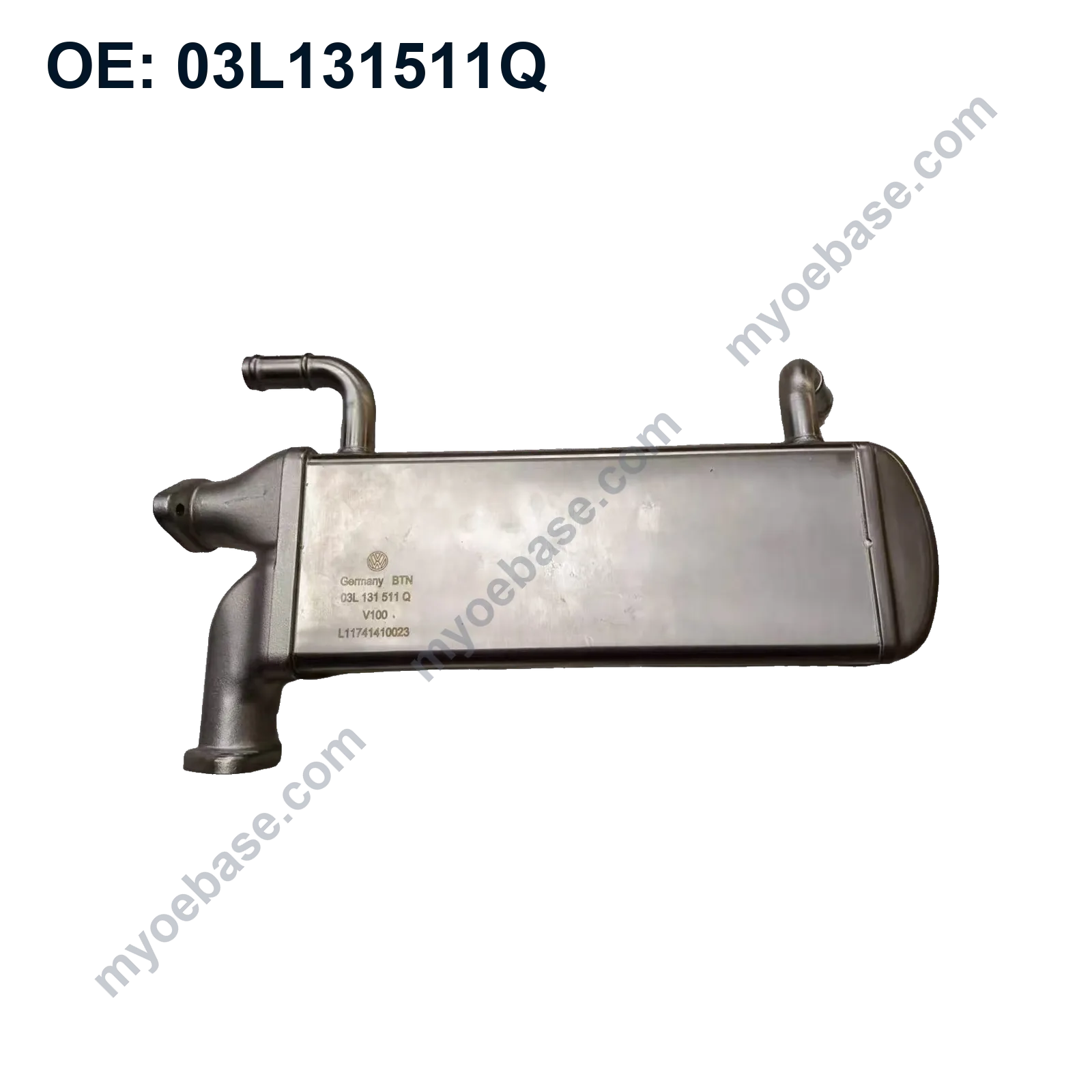
The 03L131511Q EGR cooler is the water-cooled exhaust gas recirculation cooler used on the Volkswagen 2.0 and 2.5 TDI engines in the Amarok pick-up and the Crafter van and chassis cab. It is a genuine OEM-quality part, brand new, built with a stainless steel tube bundle inside cast aluminium end tanks to the original drawings, for workshops and owners replacing a cooler that has blocked with soot, cracked on the gas side or started passing coolant into the exhaust. The cooler is supplied on its own, without the EGR valve, exactly as the part number describes.
EGR cooler — water-cooled EGR cooler without EGR valve for Volkswagen Amarok 2H and Crafter 2E / 2F 2.0 TDI and 2.5 TDI engines; direct fit for 03L131511A, 03L131511J and 03L131511L.
OE/OEM Part Number:
03L131511A, 03L131511J, 03L131511L, 03L131511Q
What the cooler does, and why it fails
It is a heat exchanger, not a pipe. Exhaust gas leaving the manifold passes through a bundle of stainless tubes while engine coolant circulates around them inside the aluminium housing. The gas leaves the cooler at a far lower temperature and is then metered back into the intake, which drops combustion temperature and keeps nitrogen oxides inside the Euro 5 limit. On the Amarok and Crafter the cooler sits on the cold side of the engine, bolted to the EGR valve flange with a gasket at each end and coolant hoses on the housing.
Failure mode one: soot blockage. The gas passages in the tube bundle are small, and diesel soot mixed with oily crankcase vapour from the turbo inlet deposits on the tube walls. Flow falls away gradually, so the fault usually shows up first as a P0401 insufficient EGR flow code during a motorway cruise or a long climb, followed by poor economy, a hesitation on light throttle and eventually a limp-home strategy. Blocked coolers also raise exhaust back pressure and can push the EGR valve itself out of its learned range.
Failure mode two: internal cracks and coolant loss. Repeated heat cycles between a cold start and full load work-harden the tube-to-header joints. Once a joint cracks, coolant is drawn into the gas path: the coolant level drops with no visible external leak, white sweet-smelling smoke comes out of the tailpipe at idle, and the expansion bottle may pressurise or bubble. Left alone, coolant reaches the intake and the cylinders, which is how a cheap cooler turns into an expensive engine repair. Cracks in the aluminium housing itself usually leak externally at the housing seam or the hose necks.
Why a new cooler, not a cleaned one. Flushing a blocked cooler can restore flow for a while, but it does nothing for the thinned tube walls and fatigued joints that caused the blockage in the first place, and a cooler that has already wept coolant will weep again. This part is supplied brand new with the tube bundle, end tanks and sealing faces as manufactured, pressure tested before packing.
Symptoms, diagnosis and installation
• Typical symptoms — P0401 / P0402 / P2403 EGR flow faults, rough running or hesitation at small throttle openings, black smoke under load, rising fuel consumption, white smoke and a sweet smell from the exhaust at idle, unexplained coolant loss with no puddle under the vehicle, bubbling in the expansion tank, and on higher-mileage vans a soft coolant hose that will not hold pressure.
• Confirm it before ordering — read address 01 for EGR flow and cooler efficiency faults and compare requested with actual EGR mass at idle and at 2000 rpm. A cooler that is blocked shows actual flow far below request; a cooler that is leaking coolant usually shows up in a cooling system pressure test held for thirty minutes with the engine warm, and in a sniff test at the expansion bottle. Check the EGR valve for carbon build-up at the same time — a sticking valve mimics a blocked cooler, and the two are often replaced together.
• Installation notes — work on a cold engine, drain the coolant into a clean container, and disconnect the battery before touching the wiring. Unbolt the gas pipe at the cooler inlet and the flange at the EGR valve, then release the coolant hoses; the cooler can be withdrawn upwards once the mounting bolts are out. Fit new gaskets at both gas flanges — reusing the old ones is the most common cause of a leak after the job — clean the mating faces without scraping into the gas passages, and torque the flange bolts evenly to the published figure. Refill with the correct G12++ / G13 coolant mixed to the workshop ratio, bleed the system properly with the heater on full, and check for leaks after a full warm-up and cool-down cycle. Clear the fault memory, run the EGR readiness cycle and road test before handing the vehicle back. On vans that have run for a long time with a leaking cooler, change the engine oil and filter too, because coolant contamination thins the oil.
• Fitment caution — this cooler is supplied without the EGR valve. Compare the shape of the housing, the position of the coolant necks and any casting number with the part you are removing before you order; Amarok and Crafter engines were built in several variants and the pipework differs between them. If you are unsure, send us a photo of the old cooler and the engine code from the data sticker.
Fitment
The 03L131511Q cooler is fitted to the Volkswagen Amarok and to the first and second generation Crafter with the 2.0 TDI common rail and the 2.5 TDI five-cylinder diesel. Engine codes are the reliable check here: the same body and year can carry different emissions hardware depending on market, so confirm your engine code on the vehicle data sticker, the timing cover label or a VIN decode before ordering. The table below lists the usual applications.
| Make | Model | Years | Engine |
|---|---|---|---|
| VW | Amarok 2H pick-up | 2010 – 2022 | 2.0 TDI / BiTDI — CDBA, CNFA, CDCA, CNEA, CSHA, CNFB |
| VW | Amarok S1B / S6B / S7B platform & chassis | 2011 – 2022 | 2.0 BiTDI — CNEA, CSHA |
| VW | Crafter 30-35 / 30-50 2E bus, box and chassis | 2011 – 2016 | 2.0 TDI — CKTB, CSLA, CSLB, CKTC, CKUB, CKUC, CSNA, CSLC |
| VW | Crafter 2F platform / chassis | 2011 – 2016 | 2.0 TDI — CKTB, CKTC, CKUB, CKUC, CSNA, CSLB, CSLC |
| VW | Crafter 2E / 2F (early diesel) | 2006 – 2013 | 2.5 TDI — BJJ / CEBA, BJK / CEBB, BJL / CECA, BJM / CECB |
Shipping and packing
Orders leave within one to two working days of cleared payment, packed in a foam-lined box so the tube bundle and the gas flanges arrive undistorted. Tracking is emailed when the parcel is handed to the carrier. Customs charges, where they apply, are the buyer’s responsibility.
Condition & warranty
Brand new, twelve months warranty against manufacturing defects covering leaks and internal blockage of the cooler as supplied. The warranty does not cover damage from overheating, from a cooling system filled with the wrong coolant, from a blocked EGR valve left in service, or from incorrect torque on the flange bolts. If a part arrives faulty, send us photos and the fault scan before returning anything.
Wholesale
Tiered pricing for 1 pc, 5 pcs and 20 pcs is shown below. Workshops and resellers servicing Amarok and Crafter vans should ask for a combined quote — we price mixed orders of EGR coolers, EGR valves, gaskets and cooling parts together.