

About this part
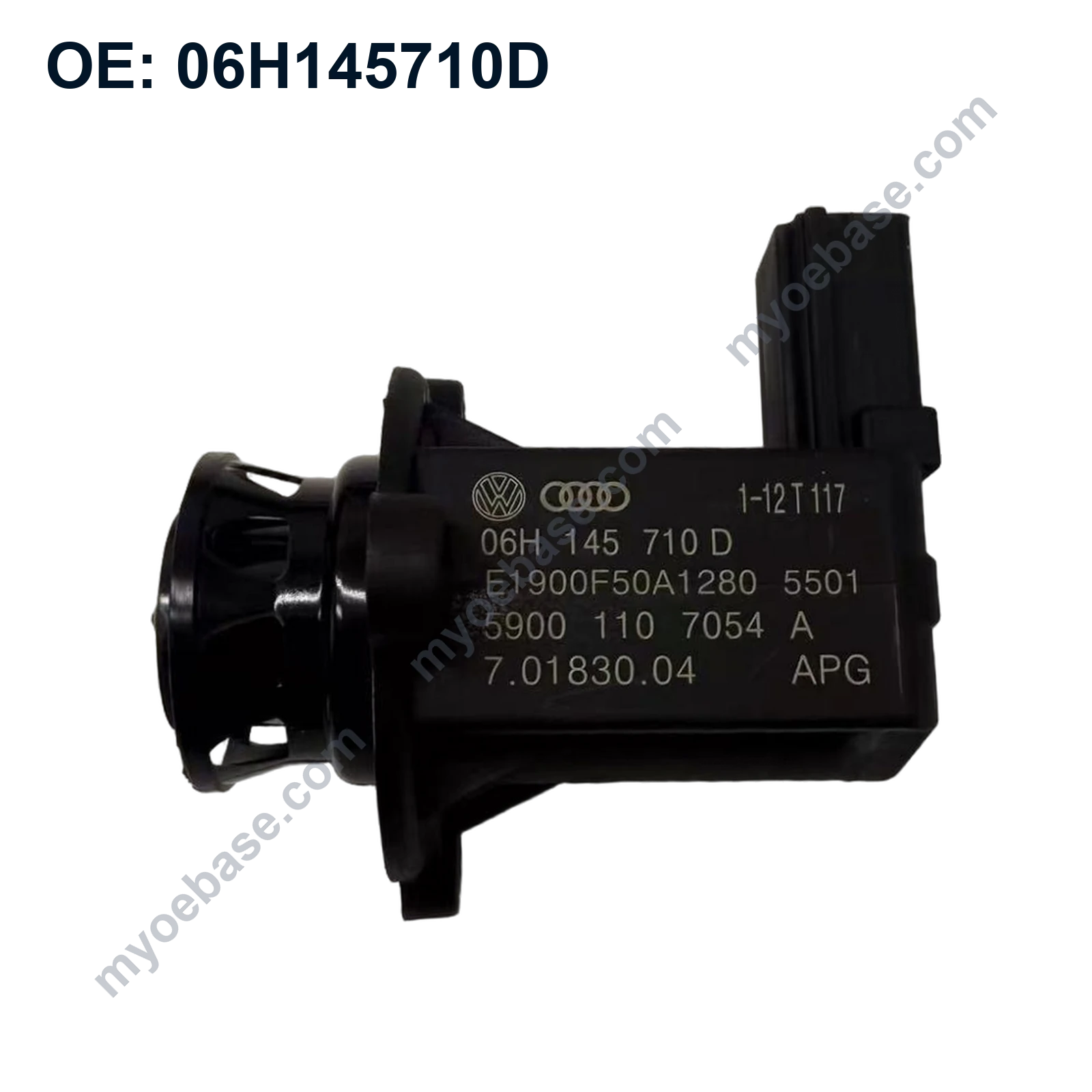
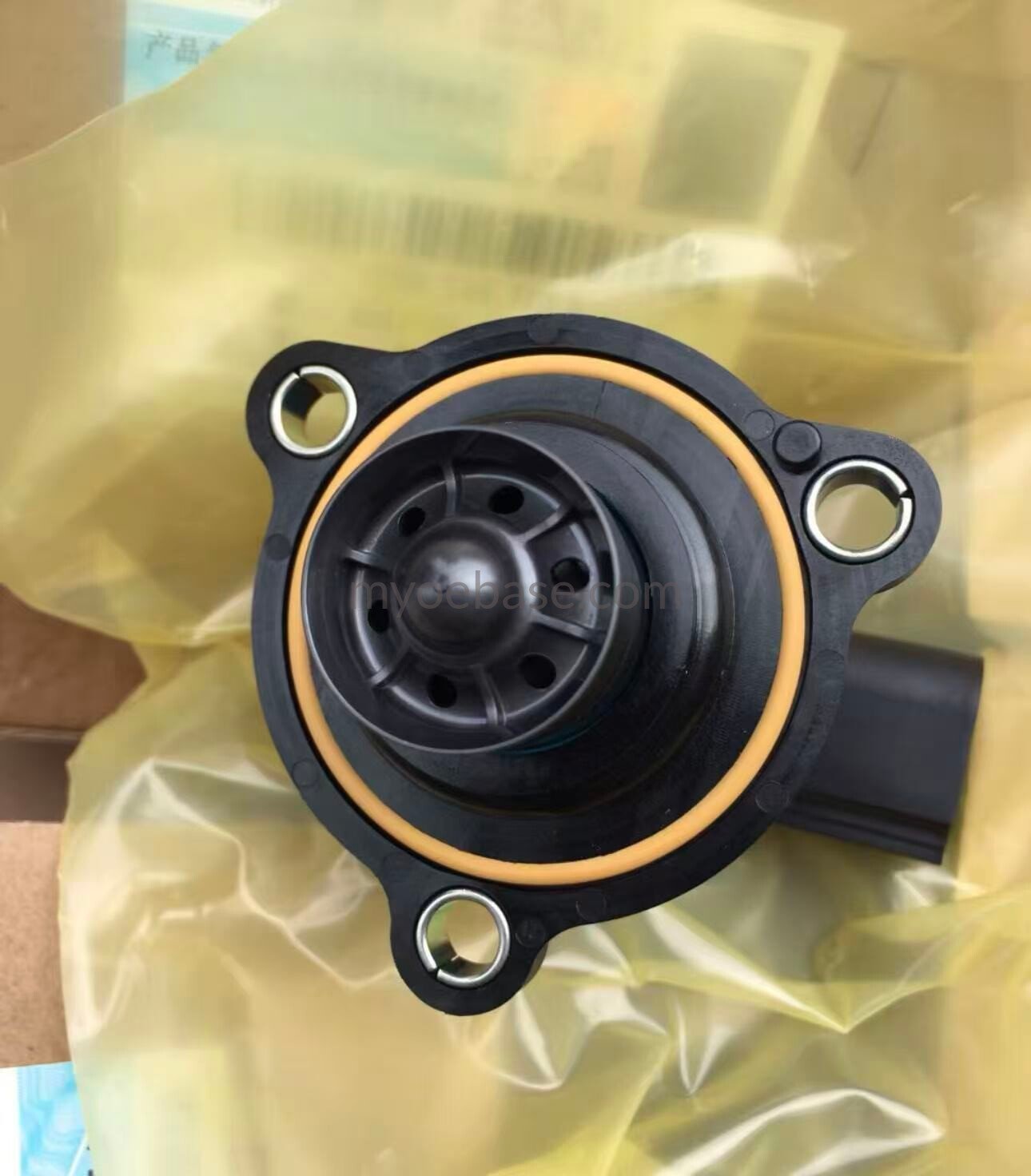
The 06H145710D Diverter Valve is a brand new genuine OEM Pierburg piston type turbocharger boost recirculation valve for VW, Audi, Skoda and SEAT 1.4, 1.8 and 2.0 TSI and TFSI petrol engines of the EA113 and EA888 Gen1 and Gen2 families, and for the 2.5 T five cylinder and 4.0 TFSI V8 engines that use the same valve. In the VAG electronic parts catalogue the entry is listed simply as VALVE with the alternative names cut off valve, cut off solenoid and turbocharger boost pressure relief valve, while Pierburg and TecDoc call it a divert air valve for the charger. In workshop language it is the diverter valve, the DV, the turbo recirculation valve or revision D. Look carefully at the unit in our photographs. The main rectangular body is black high temperature reinforced thermoplastic, moulded in Germany, with a tall square black two pin electrical connector tower standing up at one end and an open circular cage or shroud port at the other end whose radial ribs and real through gaps are clearly visible. A moulded mounting foot with three bolt holes sits underneath the housing. The flat front face carries laser marked identification: the VW roundel beside the four Audi rings, the part number 06H 145 710 D, the production code row E1900F50A1280 5501, the supplier row 5900 110 7054 A, the Pierburg number 7.01830.04, the letters APG and the date code 1-12T117. Inside the housing is a sliding spring loaded piston, not a rubber diaphragm, and the assembly arrives with its O ring seal already fitted. It is a 12 V electric solenoid driven directly by the engine control unit through a 2 pin plug, it weighs roughly 0.30 kg and it bolts straight onto the compressor housing of the turbocharger with three M6 Torx bolts. Every unit supplied is a brand new, unused, genuine OEM Pierburg valve, not a reconditioned take off, not an unbranded copy, not a diaphragm valve relabelled as revision D and not a bare solenoid coil. The valve ships as ONE complete assembly with the connector tower, the shrouded cage port, the piston, the spring, the O ring and the mounting foot intact, ready to bolt on and plug in once the mating surface and the wiring have been checked.
Turbocharger diverter valve — one brand new genuine Pierburg 12 V piston type solenoid that recirculates excess boost pressure back to the turbo inlet when the throttle closes on EA113 and EA888 turbo engines.
OE/OEM Part Number:
06H145710D, 06H 145 710 D, 06H145710, 06H 145 710, 06H145710B, 06H 145 710 B, 06F145710B, 06F 145 710 B, 06F145710C, 06F 145 710 C, 06F145710D, 06F 145 710 D, 06F145710G, 06F 145 710 G, 06F201282, 06F 201 282, 06F201282B, 06F 201 282 B, 5900 110 7054 A, 7.01830.04, 7.01830.04.0, 701830040, 7.01830.13, 7.01830.13.0, 701830130
Manufacturer and aftermarket cross references: Pierburg 7.01830.04.0, 7.01830.13.0, 7.00415.02.0, 7.00415.03.0, 7.00415.05.0, 7.00415.07.0, febi bilstein 101370, 39245, SWAG 30 10 1370, 30 93 9245, METZGER 0892235, 0892121, VEMO V10-63-0081, V10-77-1010, V10-77-1030, TOPRAN 116 500, HITACHI 2509327, 2509307, Dorman 911-240, URO URO-010861, WILMINK WG1494665, TRUCKTEC 07.14.209, AUTLOG AV6153, BUGIAD BSP25037, MAXGEAR 58-0081, AIC 57689, NTY ECD-AU-004, LUCAS FDR7029, MEAT and DORIA 9287, HOFFER 9287, Stark SKDVC-3890001, RIDEX 4314D0010. Associated service parts: connector 1J0 973 722 A and mounting bolts N 105 464 04.
Which valve is this, and which valve is it not
This part causes more ordering mistakes than almost any other small VAG component, so it is worth being precise. The VAG catalogue files 06H145710D under a wastegate index, but the valve is not a wastegate actuator and it does not control the exhaust side bypass flap. It is also not the N75 boost pressure control solenoid mounted near the air filter, not the N80 evaporative emissions purge valve and not the crankcase PCV or oil separator valve on the valve cover. Those four parts look similar in thumbnail photographs, share the same black plastic and the same two pin plug, and are frequently mislabelled by general purpose aftermarket catalogues. A diverter valve sits on the compressor housing of the turbo itself, has a large open circular port that faces into the charge air tract, and has three bolt holes. An N75 or N80 solenoid has small vacuum nipples and a mounting bracket. If the part you removed has rubber vacuum hoses attached and no large circular port, you need a different component.
Nor is this an atmospheric blow off valve. It is an internal recirculating valve: when it opens it sends compressed air back to the intake side ahead of the turbo, not out to the atmosphere. The popular spacer or sound plate that vents to atmosphere is a separate accessory and is not included here. The words blow off valve and BOV in some marketplace listings are loose shorthand for the same recirculating function.
Revision D is the first piston type valve, and it carries the shrouded circular cage that you can see in our photographs. The earlier 06F145710B, 06F145710C and 06F145710G valves and the Pierburg 7.00415.x family are diaphragm type valves with a rubber membrane; they are the numbers that D replaces, but they are not the same internal construction and their Pierburg numbers must not be confused with the 7.01830.x piston family. On the other side of the family, 06H145710C, 06H145710F and 06H145710J with Pierburg 7.02901.x are the later unshrouded piston valves used on Gen3 engines. VAG part number suffixes are revision and supplier codes, not a simple alphabetical timeline: some sources describe an early diaphragm version C and a later piston version C, and describe C as the newest revision without the shroud. That is why we ask you to match the laser marked number on your old valve rather than buying by letter order alone. Finally, the market is full of copied 06H145710D valves. A genuine unit has the VW roundel and four Audi rings laser marked into the plastic, a Pierburg number row, German manufacture and a real sliding piston behind the cage. A cheap copy with a rubber membrane, a printed sticker instead of laser marking or an empty cage is not the part described on this page.
How the piston diverter valve works
A turbocharger keeps spinning for a moment after the driver lifts off the throttle. If the throttle plate closes while the compressor is still pushing air, pressure backs up against the compressor wheel, the flow stalls and the wheel can surge. Surge loads the thrust bearing, makes the characteristic fluttering or chirping noise and slows the turbo so the next acceleration feels flat. The diverter valve exists to give that air somewhere to go. Under boost the piston is seated and the valve seals the bypass path so all measured charge air reaches the engine. When the ECU sees the throttle close it energises the solenoid, the piston lifts and the compressed air is routed back into the intake tract ahead of the compressor. Pressure equalises in a fraction of a second, the turbo keeps spinning freely and boost is available again as soon as the throttle reopens.
The important engineering change at revision D is the piston. The earlier diaphragm valves use a rubber membrane as the sealing element. Under high boost, and especially on remapped or Stage 1 and Stage 2 cars, that membrane can split, tear away from its seat or go soft with heat and oil vapour. A split membrane is a permanent boost leak, so the engine never reaches target boost and logs an underboost fault. A sliding piston with a spring and a seal has no membrane to tear, holds boost more reliably and resists the oil and temperature cycling found next to a turbocharger. Pierburg TecDoc material describing the electric divert air valve also notes that direct electrical actuation removes the vacuum hoses, vacuum reservoir, check valves and electric change over valve of the older pneumatic layout, and quotes a switching time reduction of up to seventy percent; that figure comes from dealer TecDoc extracts, so treat it as a supplier specification rather than a workshop measurement. What matters in practice is that the valve is ECU driven, has only one two pin plug, and has no vacuum lines to perish, crack or be connected backwards.
Because it is a measured air path, the O ring at the compressor housing matters as much as the piston. A flattened, hardened or pinched seal lets unmetered air escape and produces the same symptoms as a failed valve. We supply the valve with its seal pre fitted; inspect it before installation and lightly oil it with clean engine oil so it seats without rolling or cutting.
Failure symptoms and fault codes
A valve stuck open or a piston that no longer seats behaves like a permanent boost leak. The common complaint is that the car feels flat above about 3000 rpm, will not hold full boost on a long pull, hesitates after a gear change and takes longer to build boost again. The ECU usually logs P0299 turbocharger or supercharger underboost, and fuel consumption rises because the driver uses more throttle to make the same progress. A valve stuck closed cannot relieve pressure at lift off, so you may hear compressor surge as a fluttering, chuffing or pigeon like noise on a closed throttle, occasionally with P0234 overboost and a limp mode event. An electrical fault in the coil or its wiring normally sets P0033 turbocharger bypass valve control circuit, sometimes with a circuit open or short to ground sub code. Some owners report a rapid chattering noise at part throttle that disappears under full load; that is the piston oscillating rather than seating.
One failure mechanism is worth calling out because it is easy to misdiagnose. Oil can seep past the turbo seals, travel into the two pin connector and contaminate the solenoid with oil and metallic swarf until the coil stops responding. If the plug on your old valve is wet with oil, replacing the valve alone may only give a temporary fix; check the turbocharger shaft play, the crankcase ventilation system and the charge air pipe for pooled oil at the same time. Equally, an underboost code is not a diagnosis of the diverter valve. A split charge air hose, a loose clamp at the intercooler, a leaking throttle body gasket, a weak wastegate actuator, a restricted intake, a failing MAP sensor or a tired turbo can all produce the same code.
Diagnosis before you buy
Read live data before ordering. Compare specified boost against actual boost through a full throttle pull in third or fourth gear, watch the divert air valve activation or duty cycle where the diagnostic tool exposes it, and look at the short term fuel trims and the mass air flow reading. If actual boost tracks target closely and the valve activates cleanly at lift off, the leak is elsewhere in the charge air system. Smoke testing the intake side is the fastest way to find a split hose or a leaking intercooler joint. With the engine off, unplug the connector, check for oil, corrosion and spread terminals, measure the coil resistance and confirm that the harness supplies battery voltage on command. Remove the three bolts and inspect the valve itself: look for a split rubber membrane on older valves, a scored or jammed piston, a displaced O ring, carbon and oil sludge in the cage and cracks in the plastic housing around the bolt holes. Then read the laser marked number on the flat face. If it says 06H 145 710 D, this is the correct same number replacement. If it says 06H 145 710 C, F or J, or one of the 06F 145 710 diaphragm numbers, stop and check the application by VIN before fitting this part. Clear the fault codes after fitting, road test through several on and off throttle cycles and recheck for stored codes.
Vehicle fitment and the engine generation breaks
The table below summarises catalogue coverage for the piston type revision D valve. It covers the EA113 and the EA888 Gen1 and Gen2 1.4, 1.8 and 2.0 TSI and TFSI engines, the 2.5 T five cylinder engines built before 2017 and the 4.0 TFSI V8 applications that share the same valve. The single most important limitation is the generation break: several specialist VAG parts suppliers state explicitly that 06H145710D does not fit the 2013 and later MQB EA888 Gen3 cars, which use the later unshrouded 06H145710C, 06H145710F or 06H145710J valves with Pierburg 7.02901.x numbers. A few performance parts suppliers list D against Gen3 1.8 and 2.0 TSI engines as well. Because the catalogues disagree, we do not claim Gen3 coverage: if your car is 2013 or newer, or is a Golf VII, A3 8V, Octavia III or Leon III, confirm by VIN and by the number laser marked on the old valve before ordering. A compatibility table cannot see the production date, the engine code, the market specification or a previous owner who already upgraded the valve.
The same caution applies to Chinese market cars. Magotan, Sagitar, Tiguan, Passat, Octavia, Superb, A4L, Q5 and A3 built by the FAW and SAIC joint ventures use the same EA888 Gen1 and Gen2 engine families, but locally sourced parts can carry different numbers from the imported catalogue. Use the VIN, the engine code, the build date and the number printed on the valve you removed as the final authority, not the model name alone. On the EA113 engines with the original K03 turbo, the older diaphragm valve 06F145710G is still an acceptable standard replacement at factory boost, but any tuned or higher boost application is the reason to choose this piston type valve instead.
| Brand | Model / engine | Year | Notes |
|---|---|---|---|
| VW | Golf V 1K GTI 2.0 TFSI AXX BWA BPY CAWB CCTA | 2004 – 2009 | EA113 K03 turbo; piston valve is the tuned car upgrade |
| VW | Golf V 1K 1.4 TSI CAXA and Golf Plus 5M 1.4 TSI | 2007 – 2009 | EA113 twincharged 1.4; confirm by VIN |
| VW | Golf VI 5K GTI 2.0 TSI CCZB CCTA | 2009 – 2013 | EA888 Gen2; verify the suffix on the old valve |
| VW | Golf VI 5K R 2.0 TSI CDLC CDLF | 2009 – 2013 | EA113 and EA888 Gen2 depending on market |
| VW | Golf VI 5K and Cabriolet 517 1.4 TSI CAXA | 2008 – 2016 | EA113 1.4 TSI; build date check |
| VW | Jetta V 1K2 1.4 TSI and 2.0 TFSI BPY CCTA | 2005 – 2010 | EA113 and EA888 Gen1 |
| VW | Jetta VI 162 163 1.4 TSI and 2.0 TSI CCTA CPLA | 2010 – 2018 | EA888 Gen2; GLI included |
| VW | Passat B6 3C 2.0 FSI TFSI AXX BWA BPY | 2005 – 2010 | EA113; also Passat Variant 3C5 |
| VW | Passat B6 3C 1.4 TSI and 1.8 TSI BZB CDAA | 2007 – 2010 | EA888 Gen1 |
| VW | Passat B7 362 365 1.8 TSI and 2.0 TSI CDGA CCZB | 2010 – 2015 | EA888 Gen2; Alltrack included |
| VW | Passat CC 357 358 1.8 TSI and 2.0 TSI CCTA CCZB | 2008 – 2016 | EA888 Gen1 and Gen2 |
| VW | Tiguan 5N 1.4 TSI and 2.0 TSI CAWA CAWB CCTA CCZA | 2007 – 2018 | EA888 Gen1 and Gen2; 4Motion included |
| VW | Scirocco 137 138 1.4 TSI and 2.0 TSI CAWB CCZB CDLC | 2008 – 2017 | EA888 Gen1 and Gen2; R models included |
| VW | Eos 1F 1.4 TSI CAXA and 2.0 TFSI BWA BPY | 2006 – 2015 | EA113 and EA888 Gen1 |
| VW | Beetle 5C 1.8 TSI CPKA and 2.0 TSI CCTA CPLA | 2012 – 2019 | Confirm by VIN on later build dates |
| VW | CC 358 1.8 TSI and 2.0 TSI CDGA | 2011 – 2016 | EA888 Gen2 |
| VW | Touran, Sharan and Golf Plus 1.4 TSI CAXA | 2007 – 2015 | EA113 1.4 TSI; check the old valve number |
| VW | Polo GTI 6R and Lavida and Bora 1.4 TSI | 2010 – 2017 | Market specific calibration; VIN check required |
| Audi | A3 8P 8PA 1.4 TFSI CAXC and 1.8 TFSI BYT CDAA | 2004 – 2013 | EA888 Gen1; Sportback included |
| Audi | A3 8P 8PA 2.0 TFSI AXX BPY CAWB CCZA | 2004 – 2013 | EA113 and EA888 Gen1 |
| Audi | S3 8P 2.0 TFSI BHZ CDLA CDLC BZC | 2006 – 2013 | EA113 high output; piston valve recommended |
| Audi | A3 Cabriolet 8P7 1.4 1.8 2.0 TFSI | 2008 – 2013 | EA888 Gen1 |
| Audi | A4 B7 8E 2.0 TFSI BPG BWE BWT BYK BPJ | 2004 – 2008 | EA113; also A4 Cabriolet 8H |
| Audi | A4 B8 8K 1.8 TFSI CABB CDHB and 2.0 TFSI CDNC CAEB | 2008 – 2015 | EA888 Gen2; Allroad and Avant included |
| Audi | A4L and A6L China market 1.8 2.0 TFSI CDZA CADA | 2009 – 2016 | Locally sourced numbers may differ; VIN required |
| Audi | A5 8T 8F 8TA 1.8 TFSI CJEB and 2.0 TFSI CDNC CAEB | 2007 – 2017 | EA888 Gen2; Cabriolet and Sportback included |
| Audi | A6 C6 4F 2.0 TFSI BPJ BYK | 2005 – 2011 | EA113 |
| Audi | A6 C7 4G 2.0 TFSI CDNB CAEB CHJA | 2011 – 2018 | EA888 Gen2; confirm build date |
| Audi | Q5 8R 2.0 TFSI CDNB CDNC CAEB CADA | 2008 – 2017 | EA888 Gen2 |
| Audi | Q3 8U 2.0 TFSI and RSQ3 2.5 TFSI CTSA | 2011 – 2018 | RSQ3 is 2.5 T five cylinder, pre 2017 build |
| Audi | TT 8J 1.8 TFSI CDAA and 2.0 TFSI BWA CCZA CCTA | 2006 – 2014 | EA113 and EA888 Gen1 and Gen2 |
| Audi | TTS 8J 2.0 TFSI CDMA CDLA CDLB | 2008 – 2014 | EA113 high output |
| Audi | TT RS 8J 2.5 TFSI CEPA CEPB | 2009 – 2014 | 2.5 T five cylinder, pre 2017 |
| Audi | RS3 Sportback 8PA 2.5 TFSI CEPA | 2011 – 2012 | 2.5 T five cylinder, pre 2017 |
| Audi | A1 8X 1.4 TFSI CAXA CAXC | 2010 – 2015 | EA113 1.4 TFSI |
| Audi | A7 4G 2.0 TFSI and 4.0 TFSI | 2010 – 2018 | V8 applications use the same valve; VIN check |
| Audi | A8 4H 2.0 TFSI and 4.0 TFSI CEUA CTGA | 2010 – 2018 | V8 applications use the same valve; VIN check |
| Audi | S6 S7 RS6 RS7 C7 4.0 TFSI CWUB CRDB CEUC | 2012 – 2018 | 4.0 TFSI V8; confirm by VIN and old number |
| Skoda | Octavia II 1Z 1.4 TSI 1.8 TSI and 2.0 RS | 2005 – 2013 | EA113 and EA888 Gen1; Combi included |
| Skoda | Superb II 3T 1.4 1.8 2.0 TSI | 2008 – 2015 | EA888 Gen1 and Gen2 |
| Skoda | Yeti 5L 1.4 TSI and 2.0 TSI | 2009 – 2017 | Confirm engine code and old valve number |
| Skoda | Rapid and Octavia III 5E 1.8 TSI | 2013 – 2017 | Generation break area; VIN and old number required |
| SEAT | Leon II 1P 1.4 1.8 2.0 TSI and Cupra CDLA | 2005 – 2012 | EA113 and EA888 Gen1 |
| SEAT | Altea 5P and Altea XL 1.4 1.8 2.0 TSI | 2006 – 2015 | EA113 and EA888 Gen1 |
| SEAT | Toledo III 5P 1.8 TFSI and 2.0 TFSI | 2005 – 2009 | EA113 and EA888 Gen1 |
| SEAT | Exeo 3R 1.8 TSI and 2.0 TFSI | 2009 – 2013 | Confirm by VIN |
| Not covered | EA888 Gen3 MQB 2013 and later, Golf VII, A3 8V, Leon III | 2013 and later | Usually 06H145710C, 06H145710F or 06H145710J with 7.02901.x |
| Not covered | Pierburg 7.00415.x diaphragm valve family | All years | Different internal construction, not interchangeable |
| Not covered | Wastegate actuator, N75, N80, PCV and oil separator valves | All years | Different components with different part numbers |
| Not covered | Diesel TDI, 1.2 TSI, hybrid and naturally aspirated engines | All years | Different boost control hardware |
Installation notes
Allow the engine and turbocharger to cool, disconnect the battery if you prefer to work with the ECU powered down, and unclip the two pin connector by releasing its locking tab rather than pulling on the wires. Remove the three M6 Torx bolts evenly and lift the valve off the compressor housing. The factory fastener is listed as N 105 464 04, M6x16 in most catalogues and M6x18 in some; a two pin repair plug is listed as 1J0 973 722 A. Bolt torque must come from the VW ELSA or Audi erWin repair procedure for your exact engine: the twenty to thirty newton metre range quoted in general guides is a rough orientation only, not a specification, because the valve body is plastic and an over tightened bolt will crack the mounting foot. Tighten the three bolts progressively and in a cross pattern so the housing sits flat.
Clean the sealing face on the compressor housing, remove any old O ring material, and check that the new seal is seated and lightly lubricated with clean engine oil. Offer the valve straight onto the flange; do not lever against the open circular cage or shroud, since the radial ribs are thin and can be cracked. Make sure the cage points into the compressor recirculation passage and that no wiring, hose or heat shield is trapped under the mounting foot. Reconnect the plug until the tab clicks, clear the stored fault codes, then road test with several full throttle pulls and closed throttle lift offs while watching boost and listening for surge or a fluttering noise. No basic setting or adaptation is required for this valve, unlike some intake flap actuator systems; if a workshop tells you the car needs a basic setting after fitting a diverter valve, check that they are not confusing it with a different solenoid. Inspect the connector after a few hundred kilometres for any sign of oil ingress.
What is not included and what is not covered
The price is for ONE complete 06H145710D diverter valve with its pre fitted O ring. The three mounting bolts N 105 464 04, the two pin connector 1J0 973 722 A, any wiring repair section, the turbocharger, the charge air pipes, the intercooler, gaskets, an atmospheric vent spacer or sound plate, vacuum hose, diagnostic labour and workshop tools are NOT included. This is an electrically actuated valve with no vacuum ports, so there are no vacuum lines supplied and none are needed. We do not supply a diaphragm repair kit and we do not sell the bare solenoid coil separately.
Not covered: the 2013 and later MQB EA888 Gen3 applications that use 06H145710C, 06H145710F or 06H145710J with Pierburg 7.02901.x, unless the old valve on your car is genuinely marked 06H 145 710 D. Not covered: the 7.00415.x diaphragm valve family, which is a different internal construction. Not covered: wastegate actuators, N75 boost control solenoids, N80 purge valves, PCV valves and oil separators. Not covered: diesel TDI, naturally aspirated petrol, hybrid and 1.2 TSI engines that use different boost control hardware. Not covered: any performance calibration, remap or increase in boost pressure; fitting a stronger valve does not itself change the engine tune.
Condition and warranty
Every valve is brand new, unused and genuine OEM Pierburg, not a reconditioned exchange unit, not a take off from a scrap vehicle, not a refinished housing and not an unbranded copy. It carries the laser marked VW roundel, four Audi rings, 06H 145 710 D part number, 5900 110 7054 A supplier row and Pierburg 7.01830.04 number shown in our photographs. It is supplied with a twelve months warranty against manufacturing defects from the date of delivery. The warranty covers the part itself; it does not cover labour, consequential damage, incorrect application, overtightened bolts, contamination from a failing turbocharger or damage caused by a tune that exceeds the design boost pressure. Because this part number is widely copied, keep the packaging and photograph the laser marked face when the parcel arrives, then compare it with the listing photographs before fitting.
Packing and shipping
Net weight is approximately 0.30 kg and the packed weight with protective foam is roughly 0.45 kg. The valve is shipped in a padded carton with the connector tower and the open cage port protected so the radial ribs cannot be crushed in transit, and the O ring is left seated on the valve. Each unit is visually checked for a complete shroud, an intact locking tab, legible laser marking and a clean sealing face before dispatch. Trade buyers who take five or twenty pieces receive individually protected valves in one outer carton, with the part number on each inner label so your goods in team can identify stock without opening the protective wrap.
Not sure this is the right valve
Send us the VIN, the engine code from the timing cover or the vehicle data sticker, the build date, and a clear photograph of the laser marked flat face of your old valve. The four things we need to see are the full part number with its suffix letter, the Pierburg number row, whether the old unit has a shrouded circular cage, and whether the plug is wet with oil. With those details we can confirm the correct replacement before you order, and we would much rather answer a fitment question than process a return. If the old valve has rubber vacuum nipples and no large circular port, it is not a diverter valve and this listing is the wrong part. If the number ends in C, F or J on a 2013 or newer car, check with your dealer or workshop before ordering revision D. Matching the number on the old part is always more reliable than matching a model name in a compatibility table.
Trade and wholesale supply
Three quantity tiers are available: a single sample piece, five pieces and up, and twenty pieces and up, with a lower unit price at each step for workshops, tuners, independent parts stores and export distributors. All tiers ship the identical genuine OEM Pierburg valve; there is no cheaper alternative or unbranded substitute hidden in the bulk tiers. The three options on this page are quantity breaks for the same part number, not different products. Because this valve is the standard upgrade from the diaphragm 06F145710G on tuned 2.0 TSI cars, stocking it alongside the charge air hoses, the M6 Torx bolts and the two pin repair plug saves a second order when a boost leak job lands on the ramp. Ask us about mixed cartons and consolidated shipping for larger orders.
Related parts in the same family
If your diagnostic work points elsewhere in the intake or boost control system, our catalogue also includes the 06H906283J N316 intake manifold runner flap change over valve, product 5103, the 06H103495AK crankcase PCV valve, product 4710, the 04E103175AC PCV valve, product 5009, the 06J906461D mass air flow sensor, product 4813, and the 8V0906262D oxygen sensor, product 5067. These are different components with different part numbers and they are not interchangeable with the turbocharger diverter valve on this page. Reading the number laser marked on the old unit remains the fastest way to pick the right listing.