

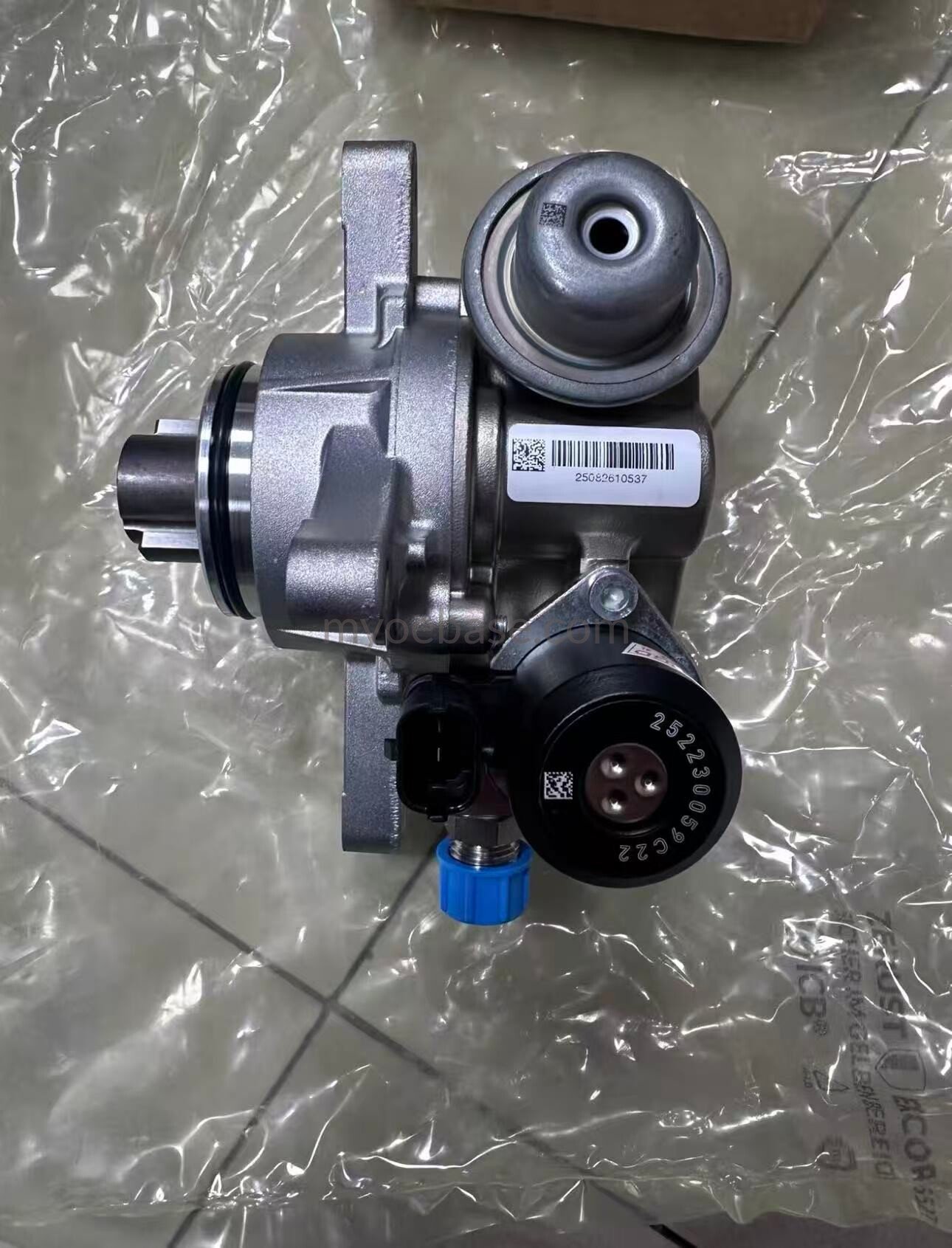

About this part
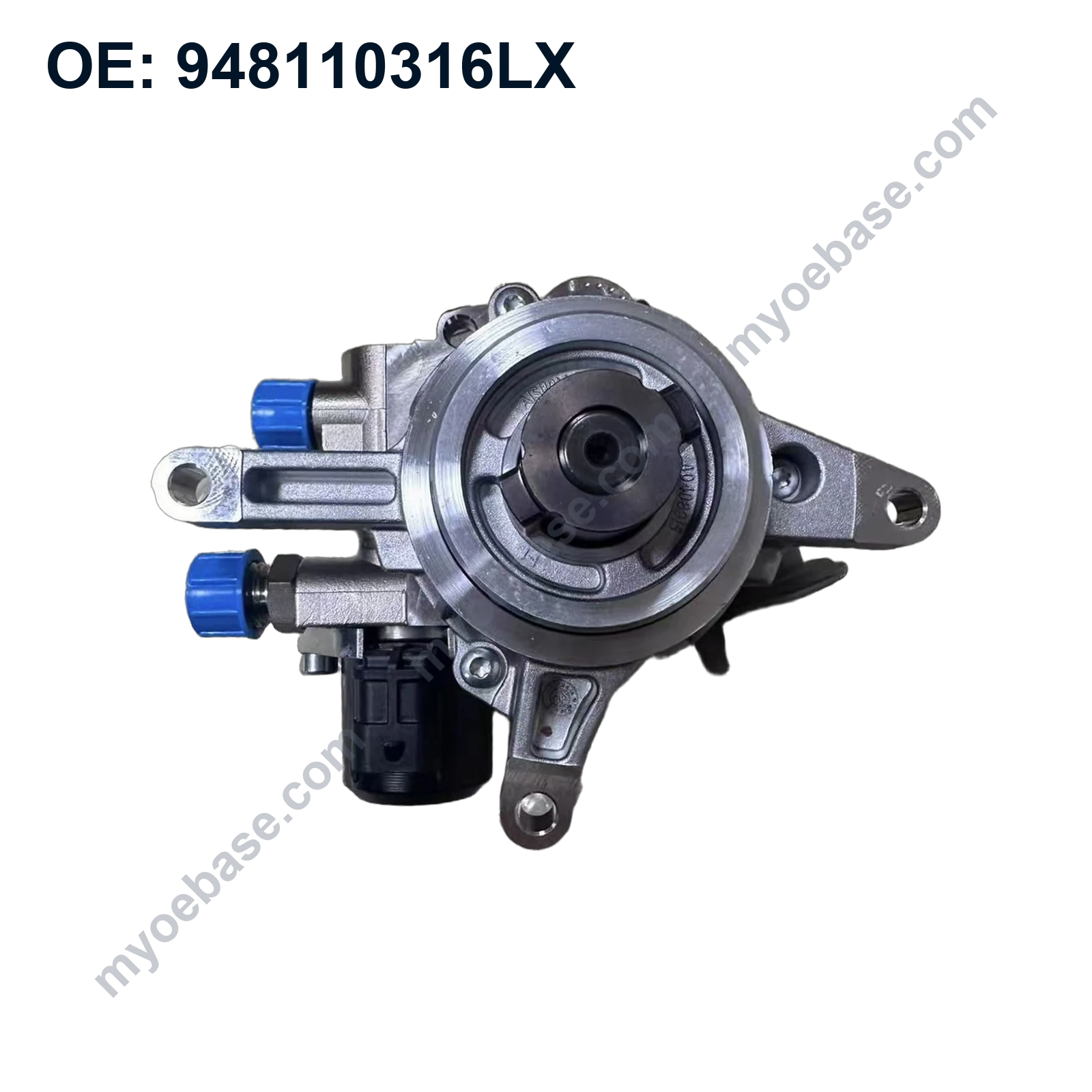
The 948110316LX Fuel Pump is a brand new genuine Porsche mechanical high pressure fuel pump for the direct fuel injection DFI system on the 958 Cayenne 4.8 litre V8 and the 970 Panamera 3.6 litre V6 and 4.8 litre V8 petrol engines. This is the complete camshaft driven pump that bolts to the engine, not the electric low pressure pump inside the fuel tank, not a fuel rail, not a rail pressure sensor, not an injector, not a high pressure line, not a cam follower, not a seal kit, not a reconditioned used part and not an unbranded copy with a relabelled casting. Look at the unit in our photographs: a three ear cast aluminium mounting flange with three drilled bolt holes, a large machined circular drive hub on the front face with the three lobe cam drive cup, two fuel ports closed with blue protective caps, a black electrical connector on the fuel volume control valve solenoid, a round black pulsation damper dome, cast reinforcing ribs on the two side arms and a flat machined sealing face around the drive shaft. The white label on the housing carries a DataMatrix code and a barcode, and the casting carries laser marked identification. Bosch is the original equipment manufacturer for this pump family. Packed weight is roughly 2.2 kg and the box measures about 15 by 13 by 12 cm. Every unit is a brand new, unused, genuine OEM pump supplied with a new sealing O-ring, ready to bolt on after the usual fuel system checks have been done.
High pressure fuel pump — one brand new genuine Porsche mechanical DFI pump for the 958 Cayenne and 970 Panamera 3.6 V6 and 4.8 V8 petrol engines, camshaft driven and supplied with a new pump seal.
OE/OEM Part Number:
948110316LX, 948 110 316 LX, 948-110-316-LX, 948.110.316.LX, 948110316AX, 948110316CX, 948110316EX, 948110316FX, 948110316HX, 948110316PX, 94811031520, 94811031522, 94811031523, 94811031524, 94811031525, 94811031526, 94811031527, 00004330128, 00004330128001
These are the catalogue numbers that occupy the same diagram position in the Porsche fuel manifold parts list. The AX, CX, EX, FX and HX numbers are earlier references that consolidate onto 948110316LX, and 948110316PX is the later number some catalogues list against it. The dash and dot forms above are only different ways of writing the same number. Do not order from this list alone: read the number on the old pump or the original box and confirm by VIN in the Porsche PET catalogue, because this part is VIN specific and the V6, V8 and Turbo versions of the same model year use different pumps.
How to identify the right pump
Start with the VIN, the engine code and the build date, then read the number stamped or laser marked on the old pump and on the yellow Porsche box label. A 958 Cayenne S or GTS with the 4.8 litre naturally aspirated V8 and a 970 Panamera with the 3.6 litre V6 or the 4.8 litre V8 use this pump. The 4.8 litre Turbo and Turbo S cars do not: they use 94811031581 or, on the Panamera Turbo S, 948110316KX. The 3.0 litre twin turbo V6 Panamera S and 4S of the 970.2 facelift are listed by some catalogues and excluded by others, so those cars must be checked by VIN before you order. A 958.2 Cayenne S from 2015 onwards is a 3.0 litre turbo V6 and is not covered by this number. Physically, compare the three ear flange, the round machined drive hub, the position of the two capped ports, the black solenoid connector and the pulsation damper with the photographs. If the old pump has a different flange, a different connector or a different damper, stop and check the number again rather than forcing a fit.
What this pump does and how it fails
On a direct injection engine the electric pump in the fuel tank delivers petrol at about 5.5 to 6 bar, roughly 80 to 87 psi, to the engine bay. The camshaft driven high pressure pump then raises that to rail pressure: around 40 bar at idle in normal running and well over 100 bar under load and at high demand, depending on the engine and operating point. Always read the exact setpoint and actual value with PIWIS or a Porsche capable scanner rather than quoting a catalogue number as gospel. A fuel volume control valve on the pump meters how much fuel is compressed on each cam lobe, the internal piston does the work, and the round pulsation damper smooths the pressure pulses so the rail and the injectors see a stable supply. The engine control unit compares requested and actual rail pressure continuously; when the pump can no longer hold the setpoint it logs a fuel pressure fault and can cut engine power to protect the catalytic converters. Wear on the drive shaft, the cam follower, the internal piston, the quantity control valve or the vacuum diaphragm, plus contaminated fuel and a weak low pressure supply, are the usual reasons a pump stops holding pressure. A pump that has been run with a starved low pressure side often fails again quickly if the tank pump or its control module is not repaired at the same time.
Symptoms of a failing high pressure pump
Typical complaints are a long crank when the engine is cold or after the car has stood overnight, hard starting, rough idle, hesitation or a flat spot on acceleration, misfires under load, reduced power with an Engine Power Reduced message, poor fuel economy and a check engine light. Some owners hear a ticking or whining noise from the pump area or notice a fuel smell and dampness around the pump flange. Common diagnostic codes on this platform include P1021 and P1026 for fuel high pressure quantity deviation, P0087 for fuel rail pressure too low, P0089 for the fuel pressure regulator and P2293 for the fuel pressure regulator 2 performance. None of these codes proves the pump is bad on its own: a worn cam follower, a failing low pressure pump or its PWM control module, a fuel rail pressure sensor reading nonsense, a corroded engine to chassis ground strap or a damaged harness can all produce the same numbers.
Diagnose before you replace
Use PIWIS or an equivalent Porsche capable tool and compare Fuel Rail Pressure Setpoint against Actual at idle, at a steady cruise and under wide open throttle. If the actual value sits well below the setpoint, for example 25 bar against a 40 bar request, the fault is on the high pressure side. Next confirm that the low pressure side really holds 5.5 to 6 bar; the 958 Cayenne uses a single PWM controlled in-tank pump and its control module was changed for the 958.2 facelift, so a weak tank pump or an overheating module can mimic a dead high pressure pump exactly. If the low side is steady but pressure collapses under load, the pump itself is the prime suspect. Check the cam follower before condemning an expensive assembly: a worn follower is a low cost part and on its own can trigger P1021, so replacing it first has saved many owners the cost of a complete pump. If the pressure sensor reports impossible values such as more than 1000 bar or a fixed value with the engine switched off, replace the sensor under the intake manifold instead. Finally inspect the engine ground strap and the pump wiring for corrosion, and clear the fuel system adaptation after any repair so the DME can relearn the quantity control valve.
Fitment – Porsche 958 Cayenne and 970 Panamera
The table below is the wide catalogue view. Model years differ between catalogues because the 958.2 Cayenne and 970.2 Panamera facelifts changed the engine range: the Cayenne S became a 3.0 litre turbo V6 and the Panamera S and 4S gained a 3.0 litre twin turbo V6. The 4.8 litre V8 stayed on the Cayenne GTS and the Panamera GTS. Where a row says VIN check, the number on the old pump is the final authority. Diesel, hybrid and four cylinder cars are not covered, and the Turbo models are listed separately under Not covered.
| Brand | Model / engine | Year | Notes |
|---|---|---|---|
| Porsche | Cayenne 958 (92A) S 4.8L V8 294 kW / 400 hp | 2010 – 2011 | Naturally aspirated V8; confirm by VIN and old pump number |
| Porsche | Cayenne 958 S 4.8L V8 294 kW / 400 hp | 2012 | 958.1 S; main documented application |
| Porsche | Cayenne 958 S 4.8L V8 294 kW / 400 hp | 2013 | 958.1 S; same DFI fuel manifold position |
| Porsche | Cayenne 958 S 4.8L V8 294 kW / 400 hp | 2014 | Last full year of the V8 Cayenne S; VIN check |
| Porsche | Cayenne 958 GTS 4.8L V8 309 kW / 420 hp | 2013 | GTS V8; three ear flange pump |
| Porsche | Cayenne 958 GTS 4.8L V8 309 kW / 420 hp | 2014 | GTS V8; confirm by VIN |
| Porsche | Cayenne 958.2 GTS 4.8L V8 324 kW / 440 hp | 2015 – 2017 | V8 GTS continued after the facelift; some catalogues end at 2014, VIN check |
| Porsche | Cayenne 958 S / GTS 4.8L V8, all body styles | 2011 – 2014 | SUV only; not the Turbo and not the 3.0T V6 S |
| Porsche | Panamera 970 base 3.6L V6 220 kW / 300 hp | 2010 – 2011 | V6 DFI; rear wheel drive, confirm by VIN |
| Porsche | Panamera 970 base 3.6L V6 220 kW / 300 hp | 2012 | V6 DFI; VIN and old number check |
| Porsche | Panamera 970 base 3.6L V6 220 kW / 300 hp | 2013 | V6 DFI; last 970.1 year |
| Porsche | Panamera 970.2 base 3.6L V6 228 kW / 310 hp | 2014 – 2016 | Facelift V6; several catalogues list this pump |
| Porsche | Panamera 970 4 3.6L V6 220 kW / 300 hp | 2011 | All wheel drive V6; same pump position |
| Porsche | Panamera 970 4 3.6L V6 220 kW / 300 hp | 2012 – 2013 | All wheel drive V6; VIN check |
| Porsche | Panamera 970.2 4 3.6L V6 228 kW / 310 hp | 2014 – 2016 | All wheel drive facelift V6; VIN check |
| Porsche | Panamera 970 S 4.8L V8 294 kW / 400 hp | 2010 | 970.1 V8 S; naturally aspirated |
| Porsche | Panamera 970 S 4.8L V8 294 kW / 400 hp | 2011 – 2012 | 970.1 V8 S; VIN check |
| Porsche | Panamera 970 S 4.8L V8 294 kW / 400 hp | 2013 | Last 970.1 V8 S year |
| Porsche | Panamera 970 4S 4.8L V8 294 kW / 400 hp | 2010 | 970.1 V8 4S; same high pressure pump |
| Porsche | Panamera 970 4S 4.8L V8 294 kW / 400 hp | 2011 – 2012 | 970.1 V8 4S; confirm by VIN |
| Porsche | Panamera 970 4S 4.8L V8 294 kW / 400 hp | 2013 | 970.1 V8 4S; VIN check |
| Porsche | Panamera 970 GTS 4.8L V8 316 kW / 430 hp | 2012 – 2013 | 970.1 GTS V8; PDK and all wheel drive |
| Porsche | Panamera 970.2 GTS 4.8L V8 324 kW / 440 hp | 2014 – 2016 | Facelift GTS V8; explicitly listed by FCP Euro and Design911 |
| Porsche | Panamera 970 Platinum Edition 3.6L V6 | 2012 – 2016 | V6 special edition; verify old pump number |
| Porsche | Panamera 970.2 S 3.0L twin turbo V6 420 hp | 2014 – 2016 | Listed by some catalogues, excluded by others; VIN and PET check required |
| Porsche | Panamera 970.2 4S 3.0L twin turbo V6 420 hp | 2014 – 2016 | Executive body included; VIN and PET check required |
| Porsche | Panamera 970.2 S / 4S Executive 3.0T V6 | 2014 – 2016 | Long wheelbase versions; VIN check |
| Porsche | Cayenne 958 / Panamera 970 V6 and V8 petrol DFI | 2010 – 2016 | General catalogue range; VIN is the final authority |
| Not covered | Cayenne 958 Turbo and Turbo S 4.8L V8 | 2011 – 2018 | Uses 94811031581; NOT interchangeable with 948110316LX |
| Not covered | Panamera 970 Turbo and Turbo S 4.8L V8 | 2010 – 2016 | Uses 948110316KX or 94811031581; different pump |
| Not covered | Cayenne 958.2 S 3.0L turbo V6 | 2015 – 2018 | V8 discontinued on the S; wrong fuel system |
| Not covered | Cayenne 957 (9PA) S / GTS / Turbo | 2003 – 2010 | Earlier generation; do not order without VIN confirmation |
| Not covered | Panamera diesel, hybrid, Macan, 911, Boxster, Cayman | All years | Different engines and different pump numbers |
| Not covered | In-tank low pressure pump 97062013201 / 97062013200 | All years | Electric 5.5 to 6 bar tank pump, not the engine mounted high pressure pump |
| Not covered | 948110316BX / DX / JX / MX to 948110316NX branch | All years | Separate catalogue branch; do not mix with the AX CX EX FX HX LX PX sequence |
| Not covered | Fuel rail, rail pressure sensor, injector, high pressure line | All years | Individual service parts, not this complete pump assembly |
| Not covered | Cam follower, mounting bolts, O-ring service kit | All years | Inspect or replace separately during installation; not included |
Fitting – read this before you start
Work on a cold engine with the ignition off, relieve the fuel system pressure following the Porsche workshop procedure, and keep the area clean: dirt in an open high pressure line will destroy an injector. Leave the blue protective caps on the ports until the moment you connect the lines. Remove the old pump, keep the old unit for the number comparison, and inspect the cam follower and the cam lobe for scoring or flat spots; fit a new follower if there is any doubt. Fit a brand new sealing O-ring, lightly lubricate it and never reuse the old one. Clean the machined sealing face on the cylinder head with a lint free cloth and do not scratch it. Seat the pump squarely on its three ear flange, tighten the bolts evenly to the torque specified in the workshop manual, and reconnect the electrical connector until it clicks. High pressure pipes and their fittings are one time use items on this system: if a line has been disturbed, loosened or shows any damage, replace it rather than trying to reseal it. Reconnect the low pressure feed, switch the ignition on several times without starting so the system can prime, then start and check for leaks. Finally clear fault codes and run the fuel system adaptation and a rail pressure comparison with PIWIS. Use a genuine Bosch built pump: cheap unbranded aftermarket units have a high rate of repeat P1021 and P1026 faults on the M48 engine family. This listing is ONE pump only; the high pressure line, cam follower, mounting bolts, O-ring service kit, gasket sealant, fuel, labour and diagnostic time are not included.
Not covered – parts that are often confused with this one
Cayenne Turbo and Turbo S 4.8 V8 use 94811031581, and the Panamera Turbo S uses 948110316KX. Those are different pumps for the turbocharged M48.70 engines and are NOT interchangeable with 948110316LX. The separate catalogue branch 948110316BX, 948110316DX, 948110316JX and 948110316MX belongs to 948110316NX and must not be mixed with the AX, CX, EX, FX, HX, LX and PX sequence listed here. The in-tank electric low pressure pumps 97062013201 and 97062013200 are often called fuel pumps too, but they sit in the fuel tank, deliver only about 5.5 to 6 bar and cannot replace the engine mounted high pressure pump. The 957 Cayenne generation, the Macan, the 911, Boxster, Cayman and Panamera diesel and hybrid models are not covered by this number. A fuel rail, rail pressure sensor, injector, high pressure line, cam follower or pump seal sold on its own is a different part, not this assembly.
Condition and warranty
Brand new, unused, genuine OEM Porsche high pressure fuel pump in the original packaging with the protective port caps and a new sealing O-ring. Twelve months warranty against manufacturing defects from the date of delivery. The warranty does not cover damage caused by a faulty low pressure supply, contaminated fuel, incorrect installation, reused high pressure lines, missing adaptation reset or continued driving with a low rail pressure fault.
Shipping and packing
One pump per order at the sample tier. Each unit is wrapped, the ports are capped and the machined flange is protected so it reaches you without damage. Packed weight is about 2.2 kg. Keep the original box and all packaging: it carries the Porsche part number label that your workshop will want to compare with the old pump, and it is the correct packing if the unit ever has to come back for inspection. Wholesale buyers should ask about carton quantities and consolidated freight for the 5 pcs and 20 pcs tiers.
Not sure this is the right part?
Send us the VIN, the engine code, the build date and a photograph of the number on the old pump or its box. We will check the Porsche PET position for you before you pay. That one message is much cheaper than fitting a Turbo pump to a naturally aspirated car, or discovering afterwards that the real fault was a fifty dollar cam follower or a failing in-tank pump control module.
Trade and wholesale
Our three tiers are built for workshops and parts distributors: one sample unit, five units and up, and twenty units and up. Independent Porsche specialists and engine rebuilders often keep one of these pumps on the shelf because a car with a P1021 fault usually cannot be released to the customer until rail pressure is back to specification. Ask us about mixed pallets with the other fuel and engine parts in our catalogue.
Other parts in our catalogue
This is a fuel system pump and nothing else in our store substitutes for it. Our 06J115561B Oil Filter (product 5086), 03C115561H Oil Filter (product 5080), 04E115561H Oil Filter (product 5074), 8V0906262D Oxygen Sensor (product 5067), 078906433B Crankshaft Sensor (product 5039) and 06B911023C Starter Motor (product 5056) are entirely different components for other systems. If the fault is a low rail pressure code, diagnose the low pressure side, the cam follower and the rail pressure sensor before choosing which part to order.