
About this part
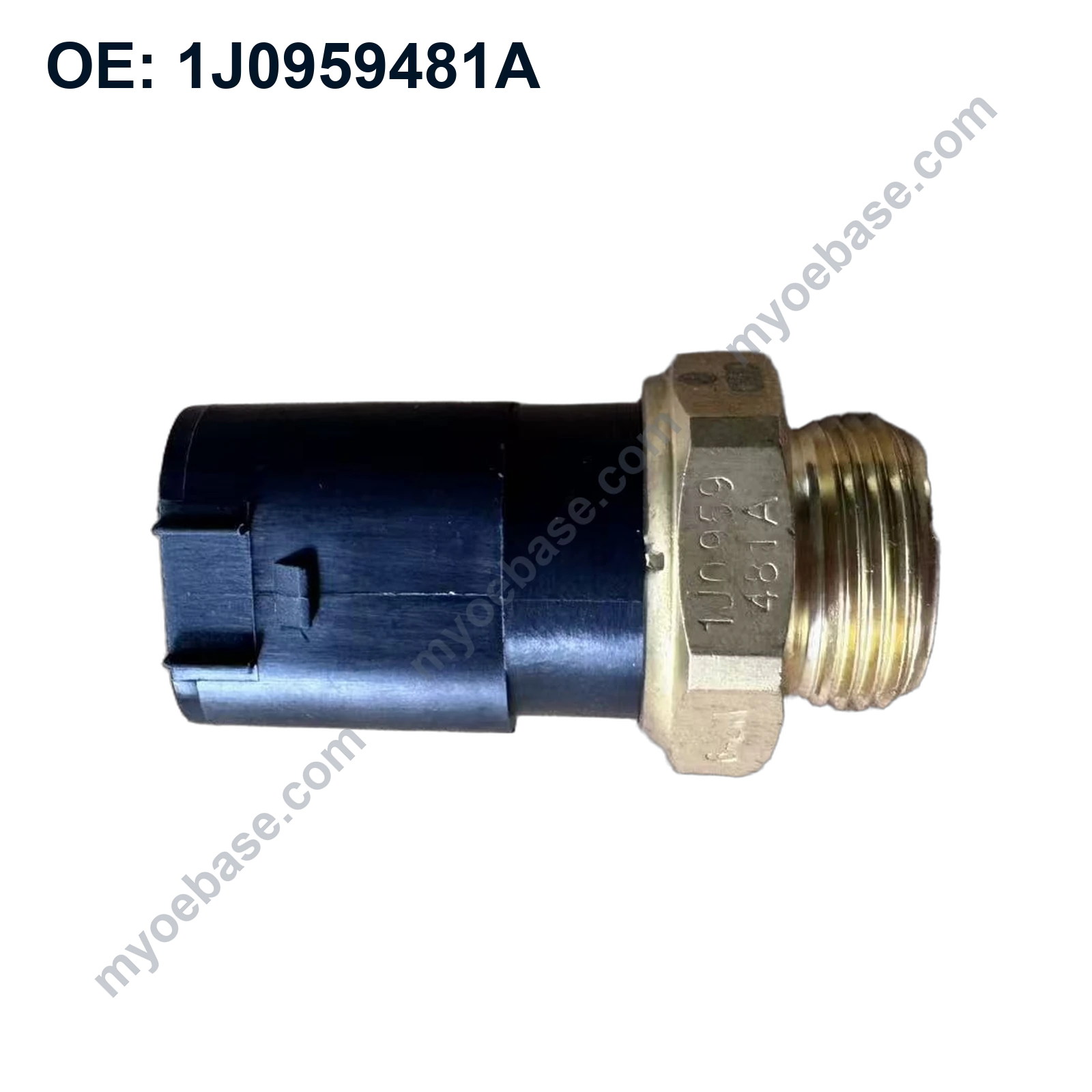
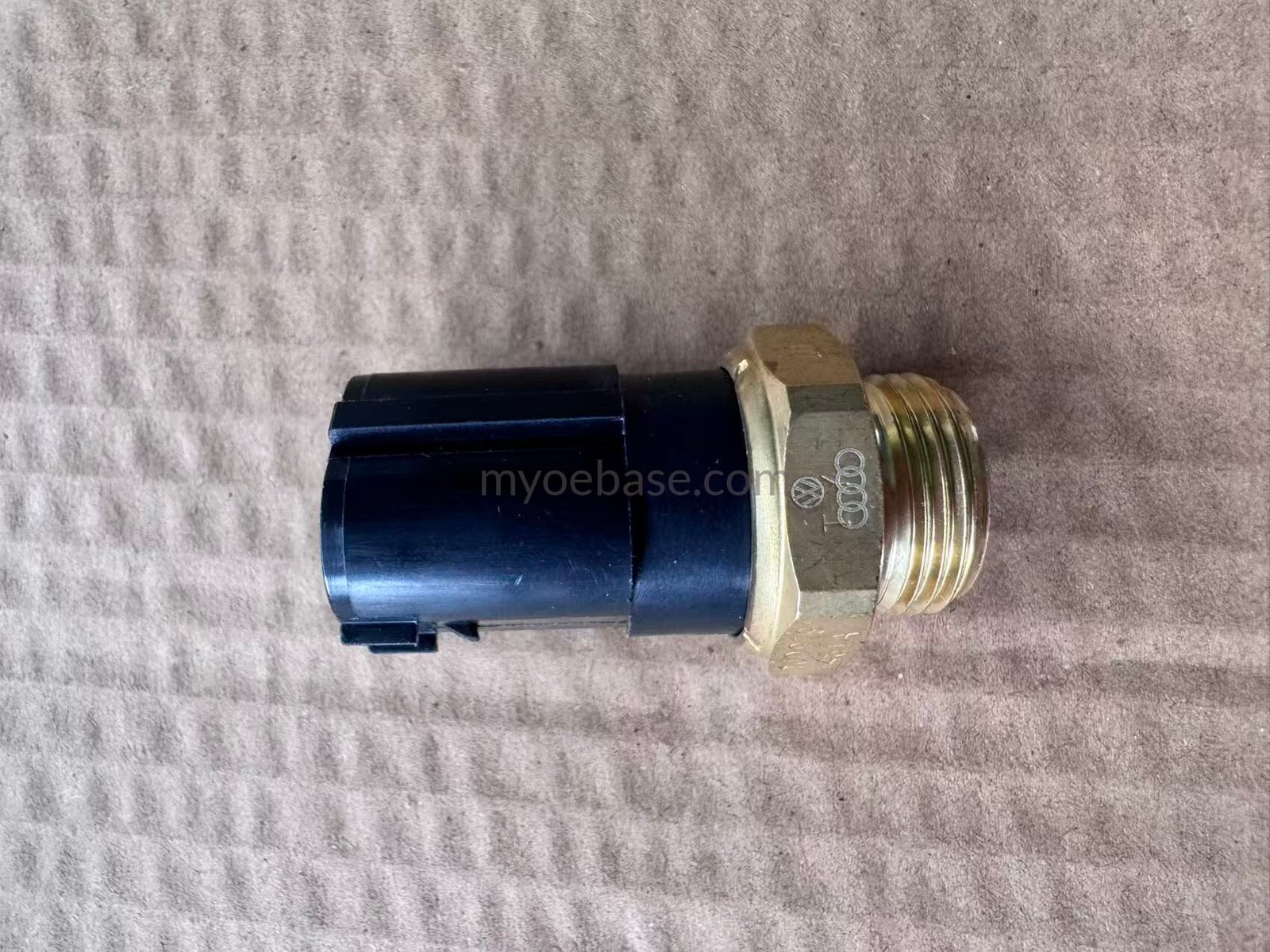
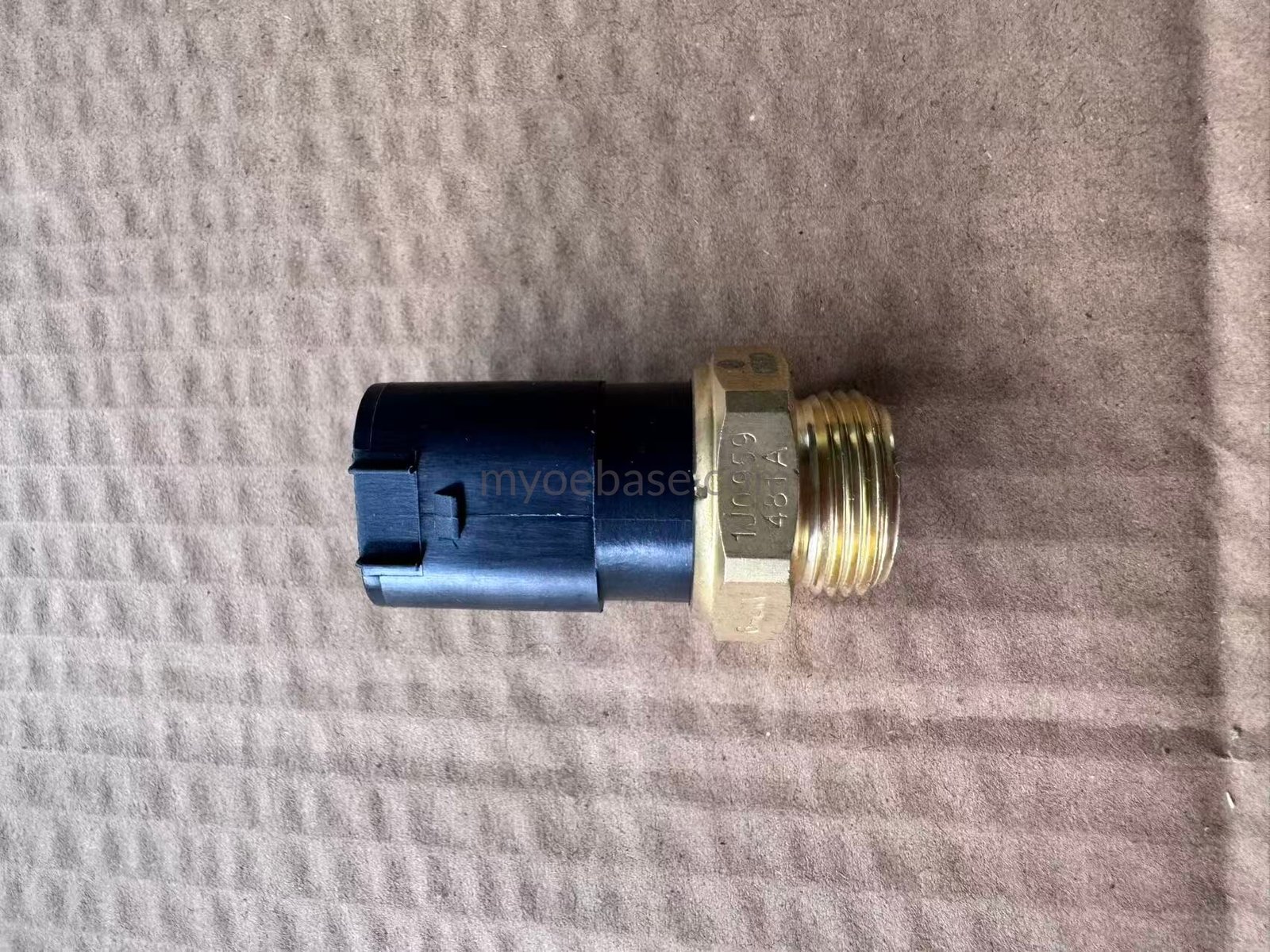
The 1J0959481A Fan Switch is a brand new genuine VAG dual stage radiator cooling fan thermo switch, the small screw-in part that tells the electric radiator fans when to run on the Golf Mk4, Bora, Jetta, Passat B5, New Beetle, Audi A3 8L and TT 8N generation of Volkswagen Group cars. It is not a temperature sender for the dashboard gauge and it is not an electronic sensor that reports a variable value to the engine control unit: it is a simple, rugged, self contained thermomechanical switch with two independent bimetal contact sets that close at two preset coolant temperatures. Our photographs show the real part. A brass hexagonal body with an M22 x 1.5 male thread screws into the radiator side tank or the coolant housing so that its tip sits in the coolant stream. One flat of the hexagon carries the laser etched number 1J0 959 on the first line and 481 A on the second, which is the spaced out form of the OE number 1J0959481A. Above it is a black moulded plastic housing that carries the four ring Audi emblem on the opposite face, and a triangular, D shaped 3 pin socket on the connector face. The brass thread is real machined metal with its original tool marks, and nothing in the picture has been redrawn, retouched or simplified. This is a genuine brand new unused original equipment part, not a reconditioned switch, not a universal three wire sensor, not a cut and spliced harness repair and not a used part pulled from a scrap radiator. Please note that we sell ONE switch per unit and that the main image shows that single part on its own; there is no seal ring, no retaining screw, no fan motor and no relay in the parcel.
Radiator fan thermo switch — one brand new genuine 1J0959481A dual stage switch with its brass M22 x 1.5 threaded body, 29 mm hexagon, laser marked number, black housing and 3 pin triangular connector, supplied on its own without the seal ring N90544501, the screw 8D0121100, the radiator, the fan motor, the fan relay or control module, coolant, diagnostic time or fitting labour.
OE/OEM Part Number:
1J0959481A, 1J0 959 481 A, 1J0959481, 1J0 959 481, 1009590016, 109772755, 19941, 100 899 0005, 7.5678, ST090, SRF015, ELC0049P, 6ZL 800-021, 37880, 001567
Manufacturer and catalogue cross references include FEBI 19941, MEYLE 100 899 0005, FACET 7.5678, BERU ST090, SMPE SRF015, Rein ELC0049P and HELLA 6ZL 800-021. Related but DIFFERENT numbers: 1J0 959 481 without the A suffix is the earlier catalogue switch entry, N90544501 is the separate 27 x 3 seal ring and 8D0121100 is the separate retaining screw; none of those is this switch. 1K0 series fan switches, the 2 pin single stage switches with different temperature markings, the coolant temperature sender G62 and the MQB platform cars whose fans are driven only by the engine control unit are not interchangeable with 1J0959481A. If the old part in your hand has two pins, four pins, a round plug, a different thread or a different stamped number, stop and check the catalogue before ordering.
Reading the part in our photographs
Look first at the hexagon. It is brass, not plated steel, because it has to conduct heat from the coolant to the bimetal elements quickly and resist corrosion in the cooling system for years. The thread is M22 x 1.5 and the across flats dimension is 29 mm, so a 29 mm deep socket is the correct tool; an adjustable spanner will round the corners and leave you with a leaking radiator. The laser etching reads 1J0 959 / 481 A in two lines, the factory spaced form of the OE part number, and it is etched into the metal rather than printed on a sticker. The upper body is black glass filled plastic with moulding ribs and a stepped shoulder; on the reverse face it carries the four ring emblem, which is why many parts catalogues file this number under Audi as well as Volkswagen. The connector is a triangular, D shaped 3 pin socket with a locking ramp, and the three pins are what make this a DUAL stage switch: one common feed and two switched outputs, one for the low speed fan circuit and one for the high speed circuit. A two pin switch can only ever switch one stage.
Compare those four things with the part you remove: the stamped number, the M22 x 1.5 thread and 29 mm hexagon, the triangular 3 pin plug and the two stage calibration. Catalogues quote the switch on and switch off temperatures a little differently. The OE supplier and Facet data give roughly 97 degrees C on / 87 degrees C off for the first stage and 102 degrees C on / 97 degrees C off for the second; some aftermarket listings give 95 / 84 and 102 / 91, and the Rein listing describes it simply as a 95 degrees C and 102 degrees C switch. The hysteresis between switch on and switch off is deliberate: it stops the fans chattering on and off every few seconds as the coolant hovers at the threshold. What matters for identification is that this is the dual stage, 3 pin, M22 x 1.5, 1J0959481A calibration. Switches marked for a single lower temperature, or for a single higher temperature, belong to different cooling system specifications even when they physically screw into the same radiator.
How a dual stage thermo switch works
Inside the brass body sit two bimetal discs, each made from two bonded metals with different thermal expansion rates. As the coolant heats them they snap over at their own calibrated temperature and push a contact closed against a fixed terminal; as the coolant cools they snap back and the contact opens again. There is no software, no calibration procedure and no adaptation value to reset after fitting. The first contact closes at roughly 97 degrees C and feeds the low speed fan circuit, normally through a series resistor or a low speed relay so that the fan runs quietly at part speed in traffic. If the coolant keeps climbing, the second contact closes at roughly 102 degrees C and brings in the high speed circuit, the after run circuit or the second fan depending on the exact wiring of the car. When the coolant falls back to roughly 87 and 97 degrees C the contacts open in turn. On many of these cars the same switch also provides the signal that keeps the fan running for a short after run period once the ignition is off, which is why a switch with a stuck contact can flatten a battery overnight.
This is a genuinely elegant piece of engineering: the switch measures the coolant at the radiator outlet, exactly where the decision about airflow matters, and it keeps working even if the battery is flat or a control module is unplugged. It is also the reason a fan problem on these cars must be diagnosed in order. The switch is only one link in a chain that includes the fuse, the ignition or battery feed, the low speed resistor, one or two relays or a fan control module, the fan motor itself, the wiring and the connectors. A new switch cannot close a burned out motor or a corroded relay. Equally, a perfectly good switch cannot help if the coolant level is low, the radiator is blocked, the thermostat never opens or there is an air lock, because then the switch is sitting in hot air or stagnant coolant instead of a representative flow.
Symptoms that point to this switch
Fans that never come on. The classic complaint is a car that is perfectly fine on the open road but creeps up towards the red in stop start traffic, at a long traffic light or while queuing, with the radiator fans staying still. The temperature gauge climbs, the cabin heater may go cool or the coolant warning light may flash, and then the needle drops as soon as the car moves again and ram air does the fan’s job. On a hot day the engine may boil over, push coolant out of the expansion tank cap or cut into a reduced power protection mode.
Fans that never stop. A contact welded shut or a bimetal disc that has lost its calibration leaves a fan running with a stone cold engine, often continuing after the ignition is switched off. Owners notice a flat battery the next morning, a fan that spins as soon as the key is turned, or a constant drone at idle. The opposite failure, a contact that never closes at all, is just as common and is the usual cause of the traffic jam overheat described above. A switch that closes one stage but not the other produces the confusing case where low speed works in mild weather but the car still overheats under load, in hot climates or with the air conditioning on, because the high speed stage is missing.
What it is not. A coolant temperature sender G62 fault, an air lock after a coolant change, a seized thermostat, a slipping water pump impeller, a blocked radiator, a blown head gasket, a failed fan motor, a corroded fan relay, a melted low speed resistor pack, a blown fuse or a chafed harness can all look like a bad thermo switch. Fault codes on these older systems are sparse; many cars with a failed switch store no code at all, and a P0480 style cooling fan control circuit code points at the circuit rather than proving the switch has failed. Do not buy this part simply because the fan is quiet.
Check the circuit before buying a switch
Start with the simple things while the engine is cold: coolant level, the condition of the expansion tank cap, visible leaks around the radiator and the switch itself, and the fuses for the radiator fans. Then warm the car up at idle with the air conditioning off and watch the gauge. On most of these cars the low speed stage should cut in a little below the normal fan threshold and cycle, and the high speed stage should appear if the engine is held at a fast idle or the air conditioning is switched on. Note which stage is missing; a switch that has lost only its second contact will still pass a quick low speed test.
The cleanest switch test is with the connector unplugged. With the ignition on, bridge the relevant terminals in the harness plug one at a time with a fused jumper: each bridge should make the corresponding fan stage run. If bridging produces a fan, the wiring, fuse, relay, resistor and motor are good and the switch is the prime suspect. If bridging produces nothing, chase the feed, the relay, the resistor pack, the plug and the motor before ordering a switch. Alternatively remove the switch and test it in a pan of water with a thermometer and an ohmmeter: the two contact pairs should go from open to closed near their marked temperatures and open again as the water cools. Never test it with a naked flame or by heating it dry, and never bridge pins without a fuse in line.
Inspect the plug for green corrosion, coolant wicking up the wires, pushed out or spread terminals, a cracked latch and melted plastic around the high current pins. A switch that has been weeping from its seal often corrodes the connector from the inside, and fitting a new switch onto a green plug simply reproduces the fault within weeks; replace the pigtail at the same time. Check that the radiator itself gets hot evenly across its core as the thermostat opens, because a cold patch means a blockage or an air lock and no switch can compensate for that. Finally, remember that the switch reads the coolant at the radiator, not the cylinder head: if the thermostat is stuck shut, the radiator and the switch stay cold while the engine boils.
Compatible vehicles
Use this table as a starting point only. The rows follow the VAG parts catalogue and the published application lists for 1J0959481A. Fitment depends on the VIN, the build date, the engine code, the cooling system specification, the air conditioning option, the market and the number of radiator fans fitted. Two otherwise identical cars can leave the factory with different fan switches and different temperature calibrations. Every row below assumes the dual stage 3 pin triangular plug switch with the M22 x 1.5 thread and the 1J0959481A marking. The busiest applications are the VW Golf Mk4 and Bora, the SEAT Leon 1M and the Skoda Octavia 1U, all of which share the 1J0 platform cooling system. Rows marked Not covered are listed on purpose so that owners of two pin, single stage, later 1K0 / MQB and coolant sender jobs do not order the wrong part. Confirm by VIN, engine code and the number stamped on the old hexagon before ordering.
| Make | Model / variant | Years / build date | Engine / notes |
|---|---|---|---|
| Audi | A1 (8X) 1.2 TSI / 1.4 TFSI / 1.6 TDI | 2010 – 2015 | Catalogued for the 9AA / TH4 cooling specification; VIN check |
| Audi | A3 (8L1) 1.6 / 1.8 T / 1.9 TDI | 1996 – 2003 | AEH AKL AGN AGU ARX AUM AHF ALH ASV; the classic 1J0 platform application |
| Audi | A3 (8P1) and Sportback (8PA) | 2003 – 2013 | Where the VIN and old part confirm the 3 pin dual stage switch |
| Audi | TT Coupe (8N3) 1.8 T and TT Roadster (8N9) 1.8 T | 1998 – 2006 | AJQ APP ARY AMU APX BAM BFV BEA; confirm the triangular 3 pin plug |
| Audi | TT RS and TT quattro where catalogued | 1998 – 2006 | Only where the old hexagon reads 1J0 959 481 A |
| VW | Golf Mk4 (1J1) 1.4 / 1.6 / 1.8 T / 2.0 / 1.9 TDI | 1997 – 2006 | AHW AXP AEH AKL AGN AGU AUM AEG APK AQY ALH AGR AHF ASV; VIN check |
| VW | Golf Mk4 Variant (1J5) and 4Motion | 1999 – 2006 | Same 1J0 cooling system and dual stage switch as the hatchback |
| VW | Bora / Jetta Mk4 (1J2) 1.6 / 1.8 T / 2.0 / 1.9 TDI / 2.3 VR5 / 2.8 VR6 | 1998 – 2005 | AEH AKL AGU AUM AEG APK AQY ALH AHF AGZ AQN AUE BDF; manual and automatic |
| VW | Bora / Jetta Variant (1J6) | 1999 – 2005 | Confirm the old part number and the 3 pin triangular connector |
| VW | Jetta (1K2 / 5K) and Jetta City 2.0 | 2005 – 2010 | Later applications where the catalogue still lists 1J0959481A |
| VW | Jetta USA and Jetta Wagon 2.0 / 1.8 T / 1.9 TDI | 1998 – 2005 | North American cooling specification; confirm by VIN |
| VW | Passat B5 (3B2) and B5.5 (3B3) 1.6 / 1.8 T / 2.0 / 1.9 TDI / 2.8 V6 | 1996 – 2005 | ADP AHL AEB APU AEG APK AQY AFN AJM ATJ ACK APR AMX BBG; VIN check |
| VW | Passat B5 Variant (3B5 / 3B6) and 4Motion | 1997 – 2005 | Same dual stage fan switch family as the saloon |
| VW | New Beetle (9C1 / 1C1) 1.4 / 1.6 / 1.8 T / 2.0 / 1.9 TDI | 1998 – 2010 | AHW AYD BFS AGU APH AWC AEG APK AQY ALH; check the old hexagon |
| VW | New Beetle Cabriolet (1Y7) | 2002 – 2010 | Only where the VIN and old part number agree |
| VW | Polo (6N2 / 9N / 6R) 1.0 / 1.2 / 1.4 / 1.6 / 1.4 TDI / 1.9 TDI | 1999 – 2022 | Wide catalogue coverage including Polo 1.6 2020 – 2022; VIN check |
| VW | Polo Limousine / Polo Sedan (Brazil and China markets) | 2002 – 2022 | Market specific cooling systems; confirm the stamped number |
| VW | Sharan (7M) 1.8 T / 2.0 / 1.9 TDI / 2.8 VR6 | 1995 – 2010 | Only where the old part is the 3 pin dual stage switch |
| VW | Touran (1T) 1.4 TSI / 1.6 / 2.0 / 1.9 TDI / 2.0 TDI | 2003 – 2010 | Check the fan control module specification on later cars |
| VW | Caddy (2K) 1.4 / 1.6 / 1.9 TDI / 2.0 TDI | 2004 – 2015 | Where the radiator mounted 3 pin switch is fitted |
| VW | Touareg (7L) 3.2 V6 and where catalogued | 2003 – 2005 | Confirm by VIN; some cooling systems use a module instead |
| VW | Phaeton (3D) where catalogued | 2003 – 2006 | Only where the old hexagon reads 1J0 959 481 A |
| VW | Fox (5Z) and Golf Brasil / Golf BR USA | 1999 – 2009 | South American market applications; VIN and old part check |
| VW | up! (121), SEAT Mii and Skoda Citigo 1.0 | 2011 – 2019 | Catalogue lists 1J0959481A with PR code 9AA on some builds |
| SEAT | Leon (1M1) 1.4 / 1.6 / 1.8 T / 1.9 TDI / 2.8 V6 Cupra R | 1999 – 2006 | AHW AXP AEH AKL AGU ARX AUM APP AMK BAM ALH AHF ASV AUE BDE |
| SEAT | Toledo II (1M2) and Toledo (5P) Reference | 1998 – 2019 | Confirm the old part number, the plug shape and the pin count |
| SEAT | Ibiza (6L / 6J) 1.2 / 1.4 / 1.6 / 1.4 TDI / 1.9 TDI | 2002 – 2015 | Where the dual stage 3 pin switch is fitted; VIN check |
| SEAT | Cordoba (6L / 6K) 1.4 / 1.6 / 1.9 TDI | 2002 – 2009 | Confirm by engine code and the stamped hexagon number |
| SEAT | Altea / Altea XL (5P) 1.4 / 1.6 / 2.0 / 1.9 TDI / 2.0 TDI | 2004 – 2013 | Check whether a fan control module is fitted instead |
| Skoda | Octavia (1U2) and Octavia Combi (1U5) 1.4 / 1.6 / 1.8 T / 1.9 TDI / 2.0 | 1996 – 2010 | AMD AEH AKL AVU BFQ AGU ARX AUM AGN AEG APK AQY ALH AHF ASV |
| Skoda | Octavia (1Z3 / 1Z5) 1.4 / 1.6 / 1.9 TDI / 2.0 TDI | 2004 – 2013 | Only where the VIN and old part confirm 1J0959481A |
| Skoda | Fabia (6Y / 5J) and Fabia Combi 1.0 / 1.2 / 1.4 / 1.6 / 1.4 TDI / 1.9 TDI | 1999 – 2022 | Wide catalogue coverage including recent 9AA builds; VIN check |
| Skoda | Roomster (5J) 1.2 / 1.4 / 1.6 / 1.4 TDI / 1.9 TDI | 2006 – 2015 | Confirm the connector shape and the temperature marking |
| Skoda | Rapid (NH) and Rapid Spaceback 1.2 / 1.4 / 1.6 TDI | 2012 – 2022 | Where the radiator mounted dual stage switch is retained |
| Not covered | Single stage 2 pin fan switches and switches with other temperature markings | – | Same thread but only one contact and one fan speed; not interchangeable |
| Not covered | The earlier 1J0 959 481 catalogue switch without the A suffix | – | Check the exact suffix on the old hexagon before ordering |
| Not covered | 1K0 series switches, Golf Mk6 and MQB platform cars with ECU controlled fans | – | Cooling fans driven by a control module, no independent radiator switch |
| Not covered | Coolant temperature sender G62 and dashboard gauge senders | – | Variable resistance sensors, different function and different location |
| Not covered | Radiator fan motors, relays, fuse boxes, low speed resistor packs and fan control modules | – | Diagnose the circuit before blaming the switch; this listing is one switch only |
| Not covered | Seal ring N90544501 (27 x 3) and retaining screw 8D0121100 | – | Separate VAG part numbers, NOT included in the parcel |
| Not covered | Thermostat, water pump, radiator, expansion tank cap, coolant and hoses | – | Other cooling system parts; a new switch will not fix a stuck thermostat or an air lock |
| Not covered | Used, tested, repaired, opened or previously fitted switches | – | Genuine brand new part only; a fitted switch cannot be returned as unused |
Fitting – read this before you buy
Identify the old part first. Read the engine code from the VIN, the service book or the sticker in the spare wheel well, and compare the old switch with our photographs: a brass M22 x 1.5 threaded body, a 29 mm hexagon, the etched 1J0 959 / 481 A number, a black upper housing and a triangular 3 pin plug. If the plug is round, has two pins or four pins, if the thread is a different size, or if the number stamped on the hexagon differs, stop and check the catalogue. Order the correct switch and a fresh seal ring before the car is stripped. The 27 x 3 seal ring is VAG part N90544501 and is a separate item; a flattened, swollen or perished old ring is the most common cause of a slow weep after a switch has been replaced. The retaining screw is 8D0121100 on the applications that use a clamp rather than a screw-in radiator boss.
The physical job. Let the engine cool completely, switch off the ignition and, where the workshop procedure requires it, disconnect the battery. The switch is usually low down on the radiator side tank or in the coolant housing near the upper hose, often reached from underneath after removing the undertray. Unplug the connector first and inspect it. Have a drain tray ready and either drain enough coolant to bring the level below the switch or be prepared to swap the parts quickly with the new switch and seal already in hand. Unscrew the old part with a 29 mm deep socket, clean the threads and the sealing face without scoring the aluminium or plastic radiator tank, and check the bore for cracks. Lightly lubricate the new seal with clean coolant, fit the switch by hand to start the thread so it cannot cross thread, then tighten to the workshop torque for your radiator, typically in the 15 to 25 Nm region but always verify in the manual: over tightening splits a plastic side tank, and under tightening leaves a leak. Do not use thread sealant or PTFE tape on a switch that seals on a face gasket; the taper and the seal do the sealing, and tape can insulate the switch from the coolant it is trying to measure. Reconnect the plug until the latch clicks, and route the harness away from the fan blades and the exhaust.
After fitting. Refill with the correct coolant specification, bleed the system according to the workshop procedure and leave the expansion tank cap off while the thermostat opens if that is what the manual calls for. An air lock around the switch is a classic cause of a fan that still will not come on. Warm the engine at idle and confirm that the low speed stage cuts in and cycles, then load the system or switch on the air conditioning to exercise the high speed stage. Check for weeping around the hexagon once the system is hot and under pressure, recheck the coolant level after a full cool down, and take the car for a road test in traffic. On a hot day it is worth deliberately sitting at idle with the air conditioning on for a few minutes, because that is the condition that exposes a missing high speed stage. Keep the old switch until the car has passed that test.
What is and is not in the parcel
ONE brand new genuine 1J0959481A dual stage radiator fan thermo switch as photographed, complete with its brass threaded body, 29 mm hexagon, laser etched number, black housing and triangular 3 pin connector. Nothing else. The main image shows that single part on a plain white background; it is not a pair of switches, not a switch and seal kit and not a cooling system repair set. No seal ring N90544501, no retaining screw 8D0121100 or clamp, no connector pigtail or repair harness, no radiator, no fan motor or fan blade, no fan relay, low speed resistor pack or fan control module, no fuse, no thermostat, no water pump, no coolant, no hoses, no expansion tank cap, no coolant temperature sender G62, no diagnostic tool, no software, no coding or adaptation service, no workshop manual and no fitting labour. This is a single switch listing for a workshop that already has the rest of the cooling system in hand. If you need the gasket, order it separately by its own number rather than assuming it is in the box.
Condition and warranty
Brand new, unused and unopened, with twelve months warranty against manufacturing defects, covering the one switch as supplied. The warranty excludes any part that has been fitted, dropped, over tightened, cross threaded, cut, soldered, opened, drilled, painted, cleaned with solvent, pressure washed, overheated or modified, and any claim arising from a corroded or wet connector, a damaged harness, a missing or re-used seal ring, a cracked radiator side tank, low coolant, an air lock, a stuck thermostat, a blocked radiator, a failed fan motor, relay or control module, or a vehicle whose VIN, engine code or cooling specification requires a single stage 2 pin switch or a later 1K0 part. It does not cover other cooling system faults, diagnostic time, coding, recovery, car hire or fitting labour. A switch that has been fitted and had coolant through it cannot be returned as unused. If a part looks wrong on arrival, compare the hexagon, the M22 x 1.5 thread, the 3 pin triangular plug and the etched number with our photographs and send us a clear picture before it is installed; keep the old switch and the job card until the car has passed a hot idle fan test.
Shipping and packing
Orders leave within one to two working days of cleared payment. Each switch is individually wrapped so the machined brass thread and the etched hexagon flat cannot be scored, the connector face is protected from impact and the locking ramp is not crushed, then the part is boxed with rigid padding. On arrival, open the parcel before booking workshop time and confirm the quantity, the 1J0 959 / 481 A etching, the M22 x 1.5 thread, the 29 mm hexagon and the triangular 3 pin socket. Please photograph the outer carton before signing for a parcel showing impact or water damage. Import duties and local taxes, where they apply, are the buyer responsibility. Tracking is emailed when the parcel is handed to the carrier.
Not sure this is the right switch?
Send us the VIN, the model, the build date, the engine code, whether the car has air conditioning, a clear photograph of the number etched on the hexagon of the old switch, a photograph of the connector face showing the pins and its shape, and a note of which fan stage is missing. The three most useful facts are the pin count and plug shape, the thread and hexagon size, and the stamped number: a triangular 3 pin plug with M22 x 1.5 and 1J0 959 481 A points to this switch, while a 2 pin plug, a different temperature marking or a 1K0 number points elsewhere. Tell us whether the fans never come on, never stop, or only fail on the high speed stage, whether the car overheats only in traffic, whether the air conditioning makes any difference, whether bridging the harness plug makes the fan run, and whether the connector shows coolant or green corrosion. We will check the engine code and cooling specification with you and confirm whether you need this switch, a seal ring, a connector pigtail, a fan motor, a relay or a wiring repair. That takes minutes and is far cheaper than fitting the wrong part to a car that is already overheating.
Wholesale
Tiered pricing for 1 pc, 5 pcs and 20 pcs is shown below, with every tier priced for ONE switch, not for a pair, a switch and gasket kit or a cooling system repair set. Independent VAG specialists, radiator shops, fleet workshops, recovery operators, used car preparers and parts distributors buy these in bulk because the radiator mounted thermo switch is a known wear item on the Golf Mk4 and 1J0 platform generation: coolant contamination, heat cycling and connector corrosion eventually weld a contact shut or leave it open, and the resulting traffic jam overheat is one of the most common summer callouts on these cars. A workshop that keeps two or three on the shelf can often diagnose and repair a fan fault the same day instead of ordering a single part and losing the job. Ask for a combined quote if you also need N90544501 seal rings, connector pigtails, thermostats, coolant temperature senders, fan relays or our other VAG engine and cooling parts; we price mixed orders together and can hold stock for repeat workshop orders. Send the engine code and cooling specification mix with volume enquiries so we can confirm the correct switch number before dispatch.
Do not confuse this listing with our other parts
We also list the 078906433B Crankshaft Sensor (product 5039), the 06J906461D MAF Sensor (product 4813), the 036906051 MAP Sensor (product 4601), the 5730084100 DSG Pressure Sensor (product 4654) and the WHT003856 ABS Sensor (product 5023), all of which are electronic sensors measuring engine speed, air flow, intake pressure, mechatronic clutch position and wheel speed. The 04E103175AC PCV Valve (product 5009) is a crankcase breather, the WHT004739 Injector Bolt (product 5032) is a single diesel fastener and the 03L130277B Injector (product 4797) is a complete common rail injector. None of those listings is a cooling fan thermo switch and none includes this part. Our switch is a self contained thermomechanical two stage contact set, not a variable resistance sender, not the dashboard G62 sensor and not a fan control module. A car whose fans stay silent does not automatically need a switch: check the fuse, the relay, the motor, the coolant level and the thermostat first. Send us a photograph of the old hexagon and the connector face and we will tell you exactly which parts the job needs.