About this part
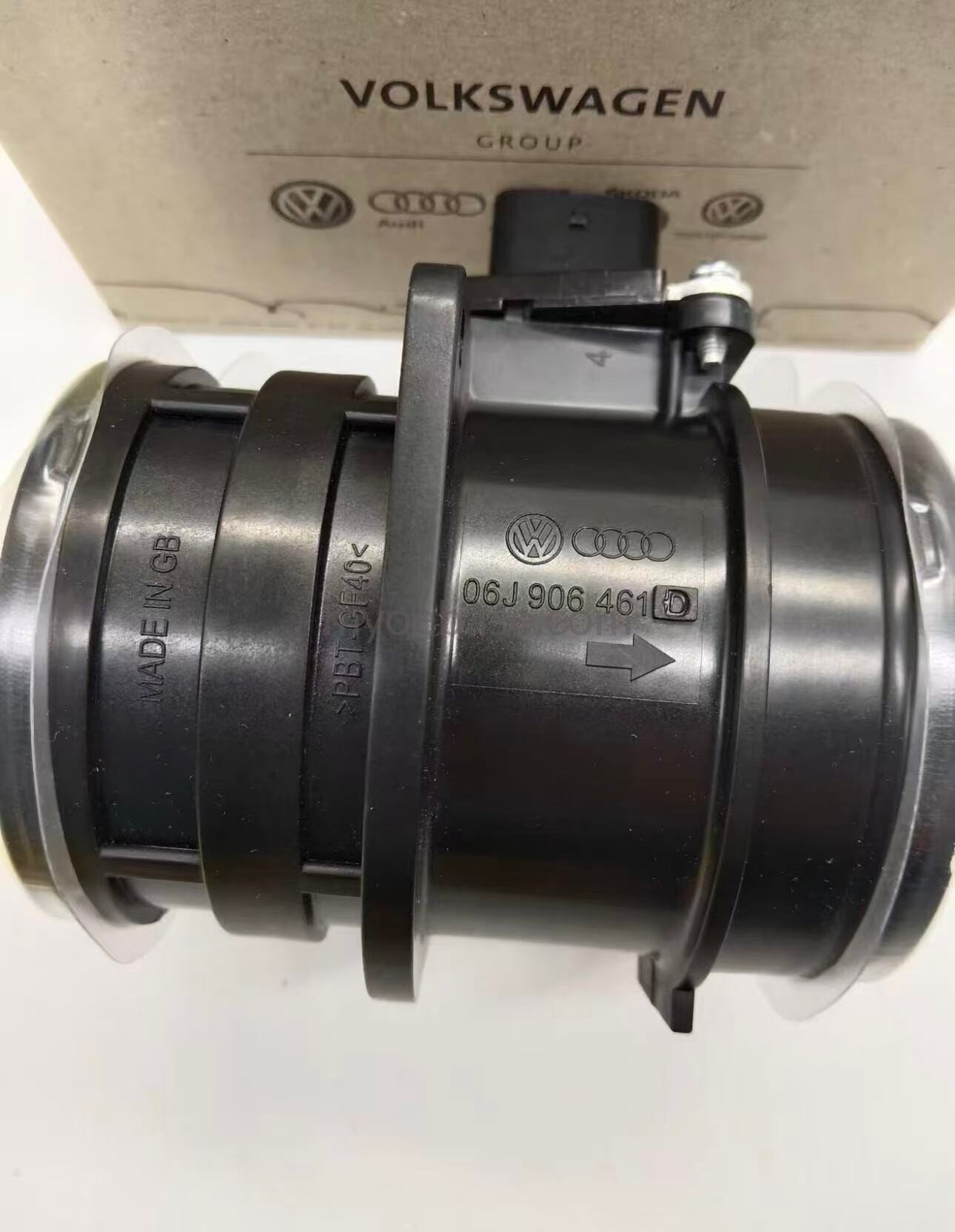
The 06J906461D MAF sensor is a brand new genuine OEM hot film air mass meter for the turbocharged 1.8 and 2.0 litre TSI and TFSI petrol engines fitted across the Volkswagen Group range. It sits in the intake duct between the air filter box and the throttle body, where a heated film element and an integrated intake air temperature sensor measure the mass of air entering the engine and pass that value to the ECU over a five pin connector. The ECU uses the signal to set injection quantity, ignition timing, boost target and the lambda control loop, so even a small error in the reading shows up immediately as a driveability fault. This is the complete meter with its moulded housing, not a bare insert: the cylindrical body carries the laser marked part number 06J 906 461 D and the production markings, a rectangular electrical connector on the top face, a flanged mounting face with its sealing O ring, and the flow straightening ring at the inlet end. It is a Hitachi hot film unit, also catalogued under the Porsche number 95860612510 and the Hitachi reference AFH6037. Applications run from the Golf VI GTI, Passat B6 and B7, Tiguan 5N, Scirocco, Eos, Beetle, Jetta and Amarok 2.0 TSI through the Audi A3 8P, A4 B8, A5 8T, A6 C7, Q3, Q5 8R and TT 8J, and on to the Skoda Octavia, Superb and Yeti and the SEAT Leon and Altea with 1.8 and 2.0 TSI engines. When the hot film becomes contaminated the driver normally sees a rough or hunting idle, hesitation and flat spots under boost, higher fuel consumption, hard starting, an illuminated check engine light and, on some calibrations, a limp home mode that caps boost.
Mass air flow sensor — genuine 06J906461D Hitachi hot film air mass meter with housing, five pin plug and integrated intake air temperature sensor, brand new and factory tested, supplied as one single sensor for 1.8 and 2.0 TSI / TFSI petrol engines.
OE/OEM Part Number:
06J906461D, 06J 906 461 D, 06J-906-461-D, 95860612510, AFH6037, AFH60-37, 2505079, MAF0116, 135079, 7.22184.75.0, 722184750, V10-72-0872, 558256, 86361, 38.956, 38956, 7516361, 0890336, 13560, B12847, MA328, MAS0402, AF10480, FDM5023, 19855, MAFS526-OE
Hitachi: AFH6037 / HC1AFH60-37, 2505079, MAF0116, 135079; Pierburg: 7.22184.75.0; Porsche: 95860612510
What you receive
This listing is for one single air mass meter, exactly one 06J906461D sensor as shown in the photographs and as packed in the original 1 Stück / 1 PC box. The tiered pricing below applies to 1 sensor, 5 sensors and 20 sensors respectively, which suits independent VAG workshops, tuners and parts distributors who keep intake sensors on the shelf. The unit is supplied complete with its housing and sealing O ring; the intake hose, hose clamps, air filter element, wiring harness repair plug, fixing screws and the ECU are not included. If your vehicle uses two banks or a twin intake layout, note that the standard 1.8 and 2.0 TSI / TFSI four cylinder applications take one meter per car, so a single order covers one vehicle. Check the laser marked number on the original unit before ordering, or send us the VIN and engine code and we will confirm the match.
Because this is an electronic measuring component, each sensor is shipped in anti static protective packaging with a cap over the connector and a plug in the inlet end so that the hot film element cannot be touched or contaminated in transit. Do not remove the protective plug until the sensor is being fitted, and never wipe, brush or spray the film with carburettor cleaner, brake cleaner or any solvent. A single fingerprint or a film of oil on the sensing element is enough to shift the calibration permanently.
How a hot film air mass meter works and why it fails
The measuring principle. A platinum hot film resistor is held at a fixed temperature above the incoming air temperature by a control circuit. As airflow increases, more heat is carried away and the circuit has to supply more current to hold the temperature difference constant. That heating current is converted into a voltage or a frequency signal proportional to the air mass flow, and a second temperature element compensates for the density change between a cold winter morning and a hot engine bay. Unlike older flap type meters there are no moving parts, and unlike a speed density system the ECU gets a direct mass reading, which is why a biased signal cannot be corrected by the lambda sensor — the ECU simply fuels for air that is not there.
Why the signal drifts. Oil vapour from a worn turbocharger seal or a crankcase breather, fine dust that gets past a cheap or overdue air filter, and silicone or oil based filter treatments all bake onto the hot film. The deposit insulates the element, so the meter under reads at low flow and reports a slow, lazy response during a snap throttle. Unmetered air is the other half of the story: a split intake hose downstream of the meter, a loose hose clamp, a leaking breather pipe or a cracked PCV hose lets air in that the sensor never measured, which produces the same lean mixture and the same fault codes as a failed meter. Water ingress at the five pin connector, corroded pins, a chafed harness and a falling supply voltage are the electrical causes. Typical diagnostic trouble codes are P0100 through P0104 for the mass air flow circuit and its plausibility, P0171 or P0172 for a lean or rich mixture, P0299 for low boost and, on some cars, misfire codes on several cylinders at once.
Diagnose before replacing. Read the fault memory, then compare the measured air mass at idle with live data — a healthy 1.8 or 2.0 TSI usually sits around 2 to 5 g/s at a warm idle depending on engine and load — and watch how quickly the value climbs on a snap throttle. Check the whole intake tract for leaks, inspect the air filter, look for oil pooling in the charge pipe and verify the five pin supply and ground before condemning the sensor. If the reading is plausible and the mixture codes remain, a smoke test of the intake system and a check of the crankcase breather will usually find the real cause. Fitting a new meter without fixing a leaking hose or a failing PCV valve will simply contaminate the new part within a few thousand kilometres.
Part number confusion: not the earlier MAF and not for diesel
Check the index letter. 06J906461D belongs to the EA888 generation 1.8 and 2.0 TSI / TFSI chain driven four cylinder engines. Earlier cars with the belt driven 2.0 TFSI or the old 1.8T 20V use different meters, commonly listed as 06F906461A or 06A906461L with Bosch references, and those have a different housing diameter, a different connector and a different calibration curve. They cannot be swapped with this part even though the numbers look similar. Some early 2009 model year cars sit exactly on the changeover point, so the number on the original sensor and the engine code are the deciding factors, not the registration year alone.
Petrol only. This meter is calibrated for the 1.8 and 2.0 turbocharged petrol engines listed in the table below. TDI diesel engines, the 3.0 TFSI and the naturally aspirated FSI variants use other air mass meters and different intake plumbing. A number of marketplace listings print every VAG MAF number in one compatibility block, which is the most common reason buyers order the wrong sensor. Cross references 95860612510 (Porsche), AFH6037, 2505079, MAF0116 and 135079 (Hitachi), 7.22184.75.0 (Pierburg) and V10-72-0872 (Vemo) all describe this same 06J906461D unit; if the number on your old sensor is one of those, this is the correct replacement.
Plug, position and coding. The sensor has a five pin blade connector, a round housing with a flow straightening ring at the air filter side and a flange that seals with an O ring against the intake hose. Airflow direction is marked on the housing and must point toward the throttle body; a meter fitted backwards will read nonsense. On these engines the air mass meter is a plug and play replacement — there is no coding or adaptation routine to run with ODIS or VCDS — but the fault memory should be cleared and, where the ECU has learned a long term fuel trim around a contaminated sensor, the adaptation values can be reset and then relearned over a short drive. A smoke test and a visual check of the intake hose are worth doing at the same time.
Installation notes
Fitting. Switch the ignition off, disconnect the battery negative terminal if you prefer to work with the ECU fully powered down, unplug the five pin connector and release the hose clamps on both sides of the meter. Note the airflow arrow and the orientation of the connector before lifting the old unit out. Clean the mating faces of the intake hose, check that the new O ring is seated and undamaged, then push the meter fully home in the original orientation and tighten the clamps evenly — an unevenly clamped or distorted hose will admit unmetered air and reproduce the original fault. Reconnect the plug until the latch clicks, refit any harness clips and make sure the wiring is not stretched or resting on a hot charge pipe. Do not touch the hot film with fingers or tools and do not apply any cleaner to the sensing element.
After fitting. Clear the engine fault memory with ODIS, VCDS or an equivalent VAG capable scan tool, then start the engine and let it reach operating temperature. Watch the measured air mass, short term fuel trim and misfire counters on live data, take a road test through a full throttle pull in a safe gear and confirm that the value rises cleanly with no flat spots, then re read the fault memory after the drive. If a lean code returns, smoke test the intake tract and the crankcase breather system before suspecting the new part. Diagnostic labour, coding work and any consequential engine damage are the responsibility of the fitting workshop and are not covered by the parts warranty.
Physical specification. Hot film air mass meter with moulded housing, integrated intake air temperature sensor, five pin blade connector, O ring sealed flange and flow straightening inlet ring. Approximately 110 mm overall length and 79 mm housing diameter, 12 V supply, net weight around 0.22 kg, roughly 0.3 kg packed. Brand new, factory tested for output signal, temperature compensation and insulation, supplied one unit per box. Confirm the part number, the connector pin count and the engine code on the original sensor before ordering.
Fitment
Fitment is by the number laser marked on the original meter, the five pin connector and the engine code, not by the model name alone. Use this table as a guide and check your VIN or the old part before ordering. Diesel TDI engines and the earlier 06F906461A / 06A906461L applications are not covered:
| Make | Model | Years | Engine / System |
|---|---|---|---|
| VW | Golf VI GTI 5K1 2.0 TSI | 2009 – 2013 | CCZB, 155 kW, EA888 |
| VW | Golf VI 5K1 1.8 TSI | 2009 – 2013 | CDAA, 118 kW |
| VW | Passat B6 / B7 3C 2.0 TSI | 2008 – 2014 | CCZB / CAWB, EA888 |
| VW | Passat CC 357 2.0 TSI | 2008 – 2012 | CCTA / CBFA, 147 kW |
| VW | Tiguan 5N 2.0 TSI | 2008 – 2015 | CCZB / CAWA / CCTA |
| VW | Scirocco 137 / 138 2.0 TSI | 2008 – 2017 | CCZB, EA888 |
| VW | Eos 1F 2.0 TSI | 2009 – 2013 | CCZB, 155 kW |
| VW | Beetle 5C / Jetta IV 162 2.0 TSI | 2010 – 2016 | CCTA / CBFA |
| VW | Amarok 2H 2.0 TSI | 2010 – 2016 | CFPA, 118 kW |
| Audi | A3 8P 1.8 TFSI / 2.0 TFSI | 2008 – 2013 | CDAA / CCZA / CCTA |
| Audi | A4 B8 8K 1.8 TFSI / 2.0 TFSI | 2008 – 2015 | CDHB / CDNC / CAEB |
| Audi | A5 8T 2.0 TFSI | 2008 – 2016 | CDNC / CAEB |
| Audi | A6 C7 4G 2.0 TFSI | 2011 – 2018 | CAEB / CDNB |
| Audi | Q3 8U / Q5 8R 2.0 TFSI | 2009 – 2018 | CDNC / CAEB / CCTA |
| Audi | TT 8J 2.0 TFSI | 2007 – 2014 | 2.0 TFSI quattro |
| Skoda | Octavia 1Z / Superb 3T 1.8 2.0 TSI | 2008 – 2015 | CDAA / CCZA |
| Skoda | Yeti 5L 1.8 TSI | 2009 – 2017 | CDAA, 4×4 |
| SEAT | Leon 1P 1.8 TSI / 2.0 TSI | 2007 – 2012 | CDAA / CCZB |
| SEAT | Altea XL 5P 1.8 TFSI | 2007 – 2015 | CDAA, 118 kW |
Shipping and packing
Orders leave within one to two working days of cleared payment. Each meter is capped at the connector and at the inlet end, cushioned in anti static packaging and boxed individually so the hot film element and the O ring cannot be scuffed in transit. Tracking is emailed when the parcel is handed to the carrier. Customs charges, where they apply, are the buyer’s responsibility.
Condition & warranty
Brand new genuine quality 06J906461D mass air flow sensor, twelve months warranty against manufacturing defects covering the unit as supplied. The warranty does not cover contamination of the hot film by oil, filter treatments or cleaning solvents, an unmetered air leak in the intake hose, a damaged connector or harness, incorrect orientation on fitting, or diagnostic labour. If a part arrives faulty, send us photographs and the engine fault scan before returning anything.
Wholesale
Tiered pricing for 1 sensor, 5 sensors and 20 sensors is shown below. Independent VAG workshops and tuners usually keep two or three of these on the shelf because a contaminated air mass meter is one of the most common causes of a P0101 plausibility fault on the 1.8 and 2.0 TSI engines. Ask for a combined quote if you also need intake hoses, hose clamps, air filters, PCV valves or ignition coils for the same job; we price mixed orders together and can hold stock for repeat workshop orders.