

About this part
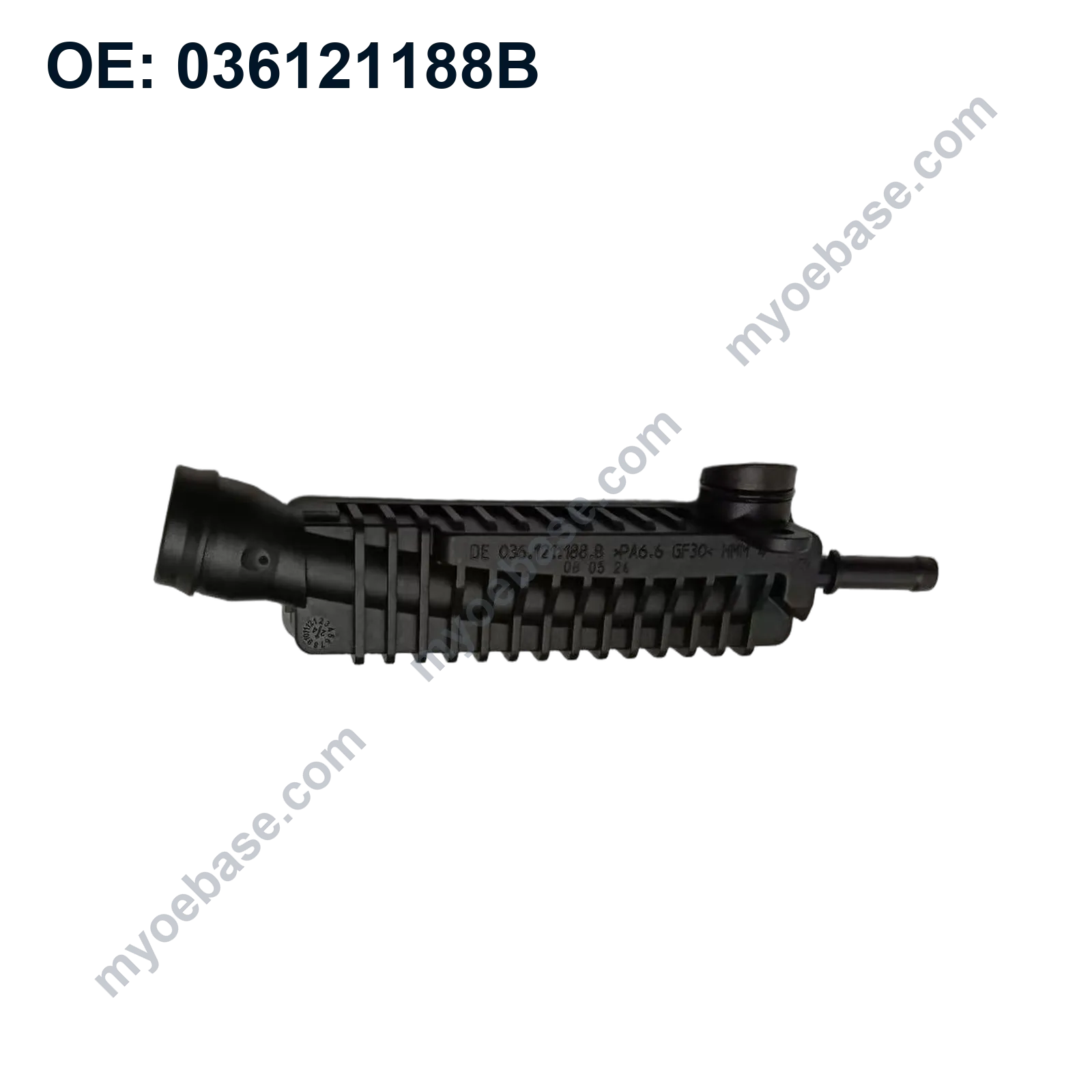
The 036121188B heater pipe is the coolant-heated pipe bolted to the intake manifold of the Volkswagen Group EA111 1.4 and 1.6 petrol engines, the unit fitted to the Golf, Jetta, Polo, Caddy, Skoda Fabia, Octavia, Roomster, Rapid and the SEAT Ibiza, Leon, Altea and Toledo. It is a genuine OEM-quality part, brand new, moulded in glass-filled nylon with the same internal restrictor and the same three-port layout as the original, for owners chasing a slow coolant loss, a sweet smell under the bonnet or a rough cold idle that clears once the engine warms up.
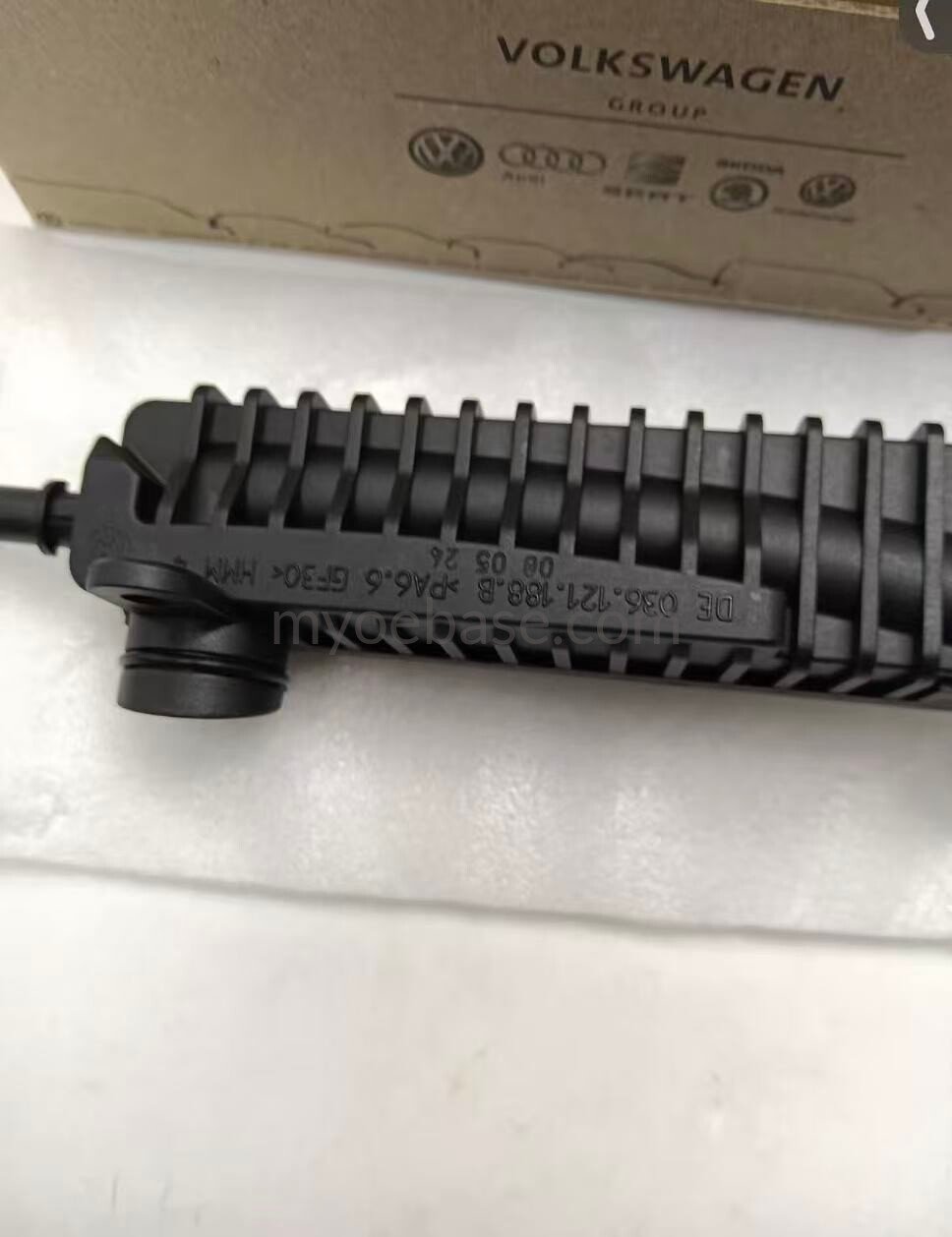
heater pipe — coolant-heated intake manifold pipe for EA111 1.4 / 1.6 petrol engines, complete with the mounting bracket, the small breather spigot and the O-ring groove at the cylinder-head end; replaces 036121188B and 03C121188.
OE/OEM Part Number:
036121188, 036121188B, 36121188B, 03C121188
What it does, and why the original cracks
It stops the throttle body icing up. On a small petrol engine the throttle plate sits in a fast-moving stream of air, and in cold, damp weather the pressure drop across a partly closed plate is enough to drop the air temperature below freezing. Moisture in the air then freezes on the plate and on the bore, the plate sticks or the idle bypass blocks, and the engine idles badly or stalls. The heater pipe is the fix: engine coolant is routed from the cylinder head, through this pipe and back into the cooling system, so the casting around the throttle body is kept warm and the ice never forms. The same coolant flow also warms the crankcase breather connection on the underside of the manifold, which is where emulsion sludge otherwise builds up in winter.
Failure mode: heat ageing and vibration. The pipe is moulded in PA6.6 with 30 percent glass fibre, which is strong but becomes brittle after years of thermal cycling between cold soak and 90 degree coolant. The failure almost always starts at one of three places: the seam where the small breather spigot is welded on, the flange at the cylinder-head end where the O-ring sits, or the mounting lug that carries the bracket. A hairline crack there weeps coolant onto the top of the gearbox bellhousing, where it dries to a pink or white crust and is easy to mistake for a leaking thermostat housing. Because the leak is small and the coolant evaporates on the hot manifold, many cars run for months with nothing more than a slowly dropping expansion tank and a faint sweet smell after a hard drive.
Why it matters more than it looks. A pipe that weeps onto a hot exhaust-side component is also a pipe that can suddenly let go. When the crack opens the coolant hits the manifold and turns to steam, the expansion tank empties within minutes, the temperature gauge climbs and the head gasket becomes the next item on the bill. On these engines the heater pipe also feeds the throttle body coolant gallery, so a fracture at the flange can pull air into the cooling system and leave an airlock that makes the heater blow cold at idle. Replacing a twenty-dollar plastic pipe before it splits is the cheapest maintenance on the car.
Symptoms, checks and installation
• Typical symptoms — a slow drop in the expansion tank with no visible puddle; pink or white crystalline crust around the pipe flange or under the breather spigot; a sweet coolant smell from the engine bay after a drive; a rough or hunting cold idle that smooths out at operating temperature; white steam from under the bonnet in the worst case, followed by a temperature warning.
• Confirm the source before ordering — pressure-test the cooling system cold at about 1.5 bar and watch the pipe joints with a torch; a weep will show as a bead of coolant at the flange or a dark damp patch on the bellhousing. Clean the area first with brake cleaner and talc, then re-test after a fifty kilometre drive — the talc leaves a clear track from the crack. Check the breather hose and its clips as well: splits there mimic a pipe failure and are cheaper to fix. On turbocharged engines confirm you are not looking at the charge-air pipe, which sits in the same area but carries no coolant.
• Installation notes — work on a cold engine and release the expansion tank cap slowly to drop the residual pressure. Clamp or drain the coolant below the manifold level; there is no need to drain the whole system. Unclip the breather hose and the small coolant hose, undo the bracket bolt, and pull the pipe straight out of the head — if it is stuck, twist rather than lever, the flange is brittle. Clean the bore in the head, fit a new O-ring lightly greased with silicone, and seat the new pipe fully before tightening the bracket. Refit the hoses, fill with the specified G12++ or G13 coolant mixed 50/50, and bleed the system with the heater set to hot until the radiator fan cycles twice. Re-check the level after the first cool-down and again after a week; a small drop is normal as the air works out.
• Fitment caution — 036121188B was superseded by 03C121188 at the end of 2011 and the two are interchangeable, but the pipe is engine-specific: it does not fit the 1.2, the 1.8 or any diesel. Confirm the engine code on the data sticker or by VIN decode, or send us a photo of the pipe you are removing with the casting marks visible.
Fitment
The 036121188B heater pipe is fitted to the EA111 family of 1.4 and 1.6 litre petrol engines built between roughly 2004 and 2017, in the Golf, Jetta, Polo, Caddy, Touran, Fabia, Roomster, Rapid, Octavia, Ibiza, Leon, Altea and Toledo. It is not used on the 1.2 three-cylinder, on the 1.8 or 2.0, or on any diesel, and it does not fit the later EA211 engine. Confirm your engine code on the vehicle data sticker or by VIN decode before ordering; the table below lists the usual applications.
| Make | Model | Years | Engine |
|---|---|---|---|
| VW | Golf VI / Golf Plus, Golf Variant | 2008 – 2014 | 1.4 / 1.6 petrol — CGGA, CGGB, CLRA, CMXA |
| VW | Jetta VI, Bora, Sagitar | 2011 – 2018 | 1.4 / 1.6 petrol — CLRA, CFNA, CGPA |
| VW | Polo V 6R / 6C, Derby, Vento | 2009 – 2017 | 1.4 / 1.6 MPI — CGGB, CLPA, CFNA |
| VW | Caddy III, Touran I, Beetle | 2004 – 2015 | 1.4 / 1.6 petrol — BUD, BTS, CGGA, CFNA |
| Skoda | Fabia II, Roomster, Rapid | 2007 – 2017 | 1.4 / 1.6 MPI — CGGB, BXW, CFNA |
| Skoda | Octavia II, Yeti | 2004 – 2013 | 1.4 / 1.6 petrol — BUD, BTS, CAXA, CFNA |
| SEAT | Ibiza IV 6J, Cordoba, Leon II, Altea, Toledo | 2006 – 2015 | 1.4 / 1.6 petrol — BXW, CGGB, CFNA |
Shipping and packing
Orders leave within one to two working days of cleared payment, each pipe bagged and boxed with foam so the spigots and the flange arrive unbroken. Tracking is emailed when the parcel is handed to the carrier. Customs charges, where they apply, are the buyer’s responsibility.
Condition & warranty
Brand new, twelve months warranty against manufacturing defects. The warranty does not cover damage from overtightened clamps, from fitting with petroleum grease on the O-ring, from running the engine with the cooling system dry, or from using the pipe on an engine outside the applications listed above. If a part arrives faulty, send us photos before returning anything.
Wholesale
Tiered pricing for 1 pc, 5 pcs and 20 pcs is shown below. Workshops and resellers should ask for a combined quote — we price mixed orders of heater pipes, coolant hoses, thermostats and water pumps together.